







































Description
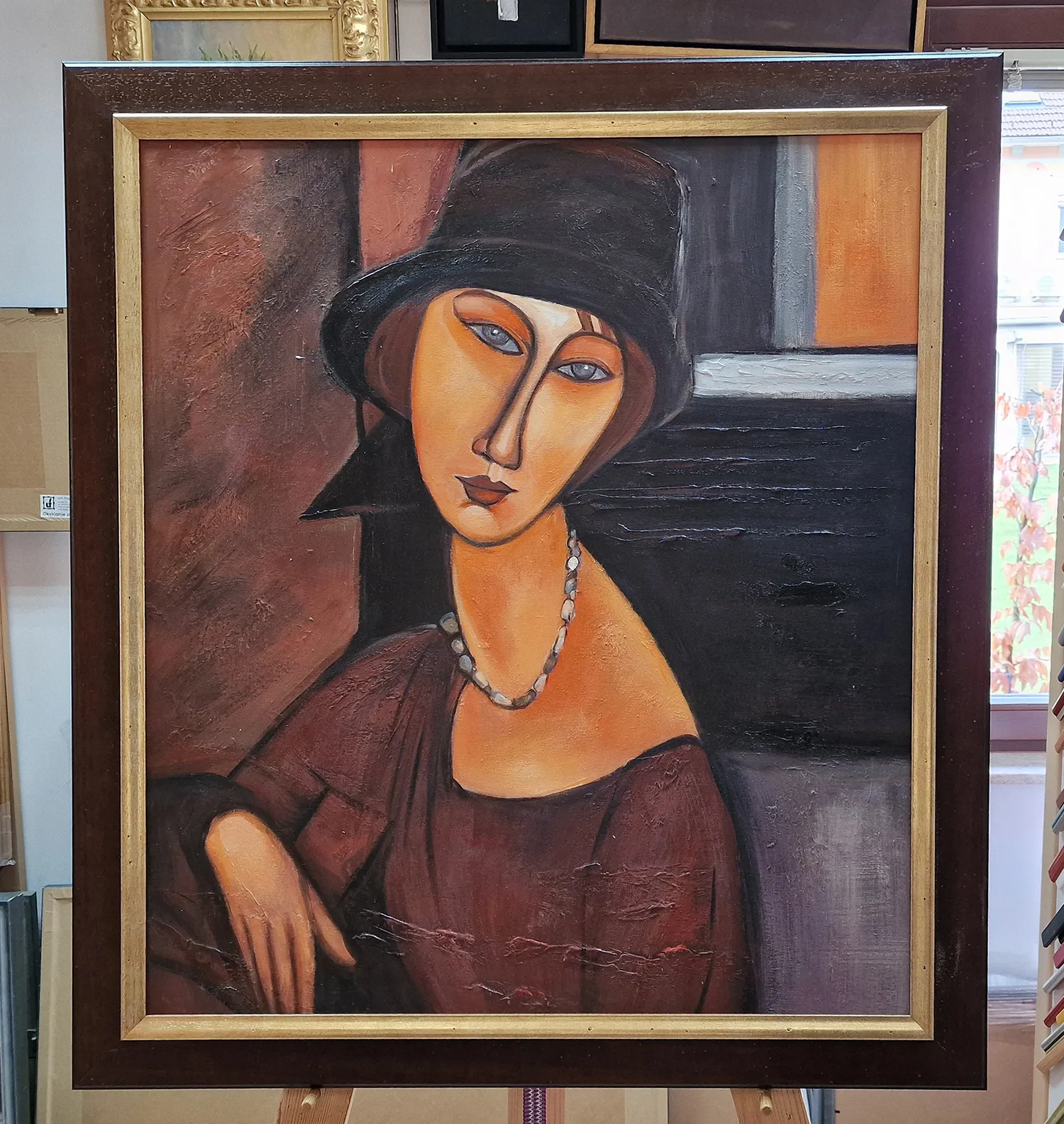
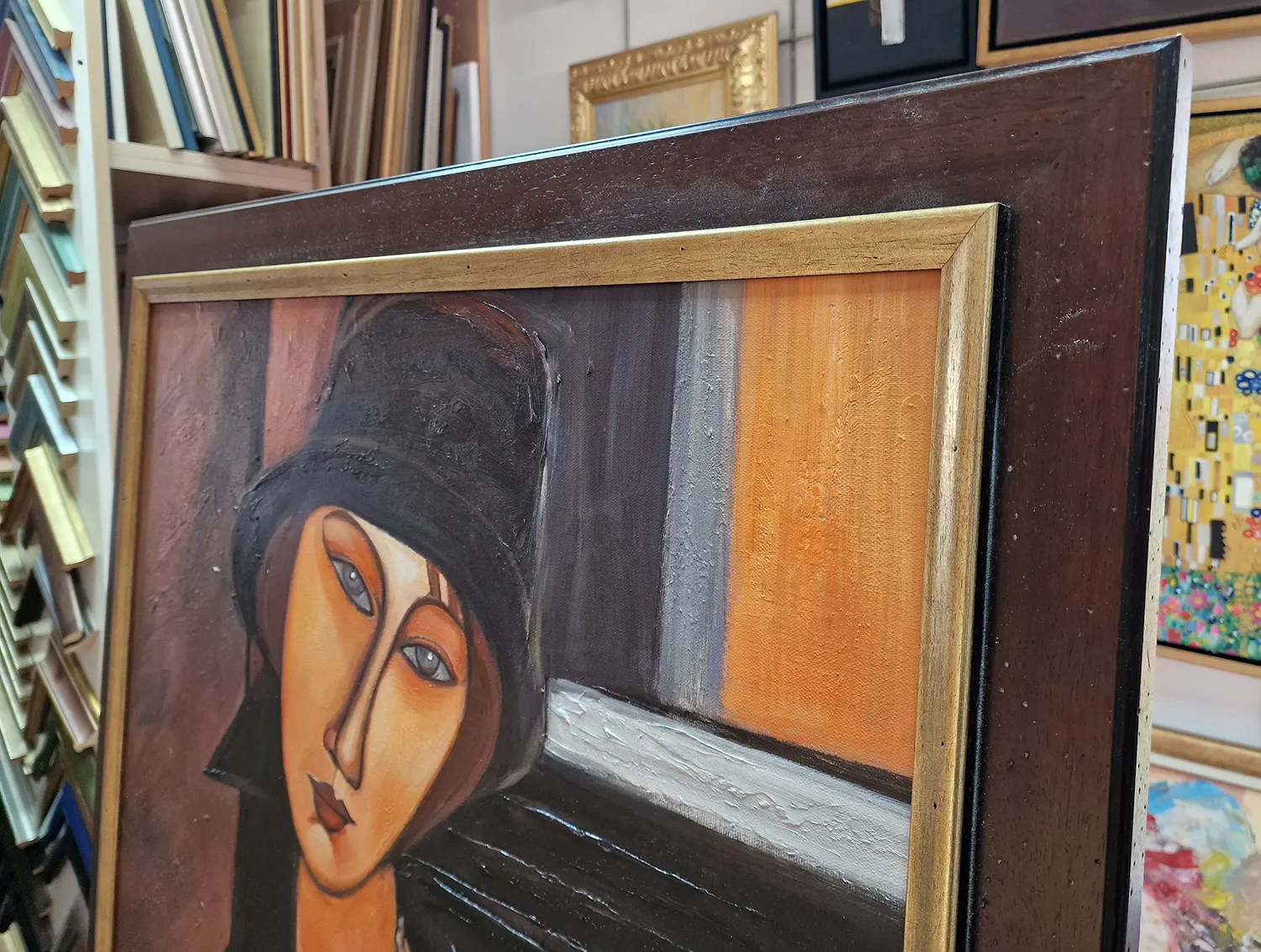
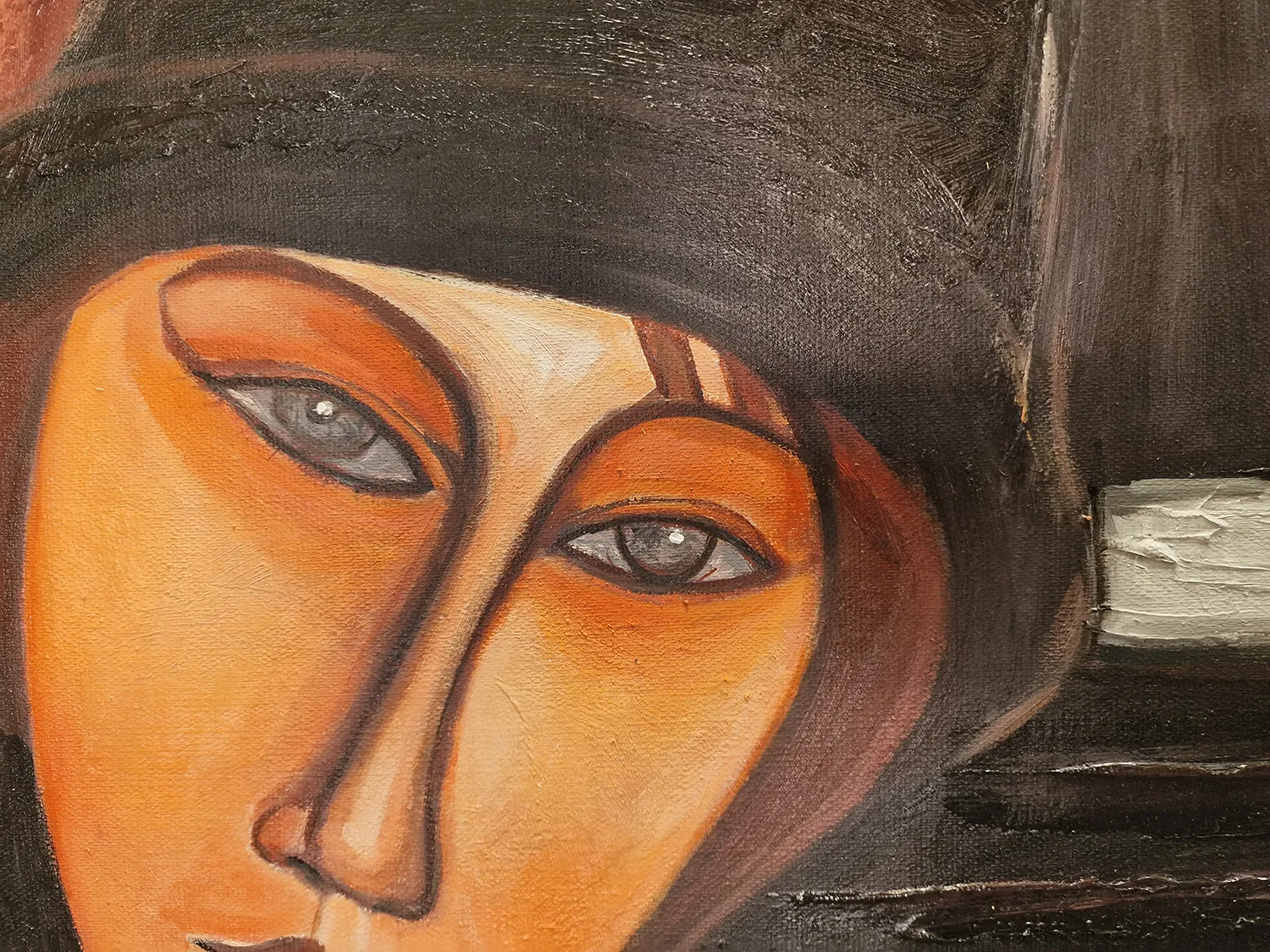
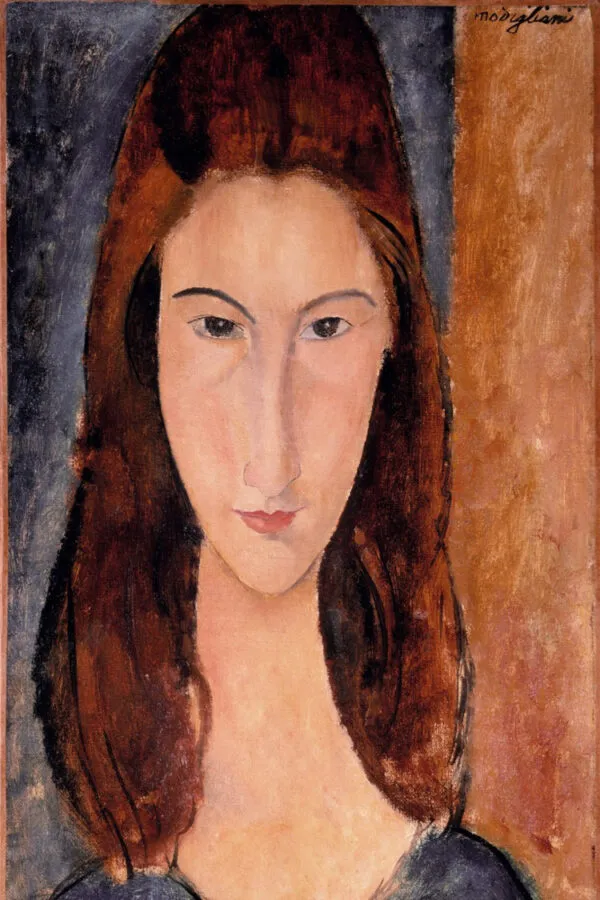
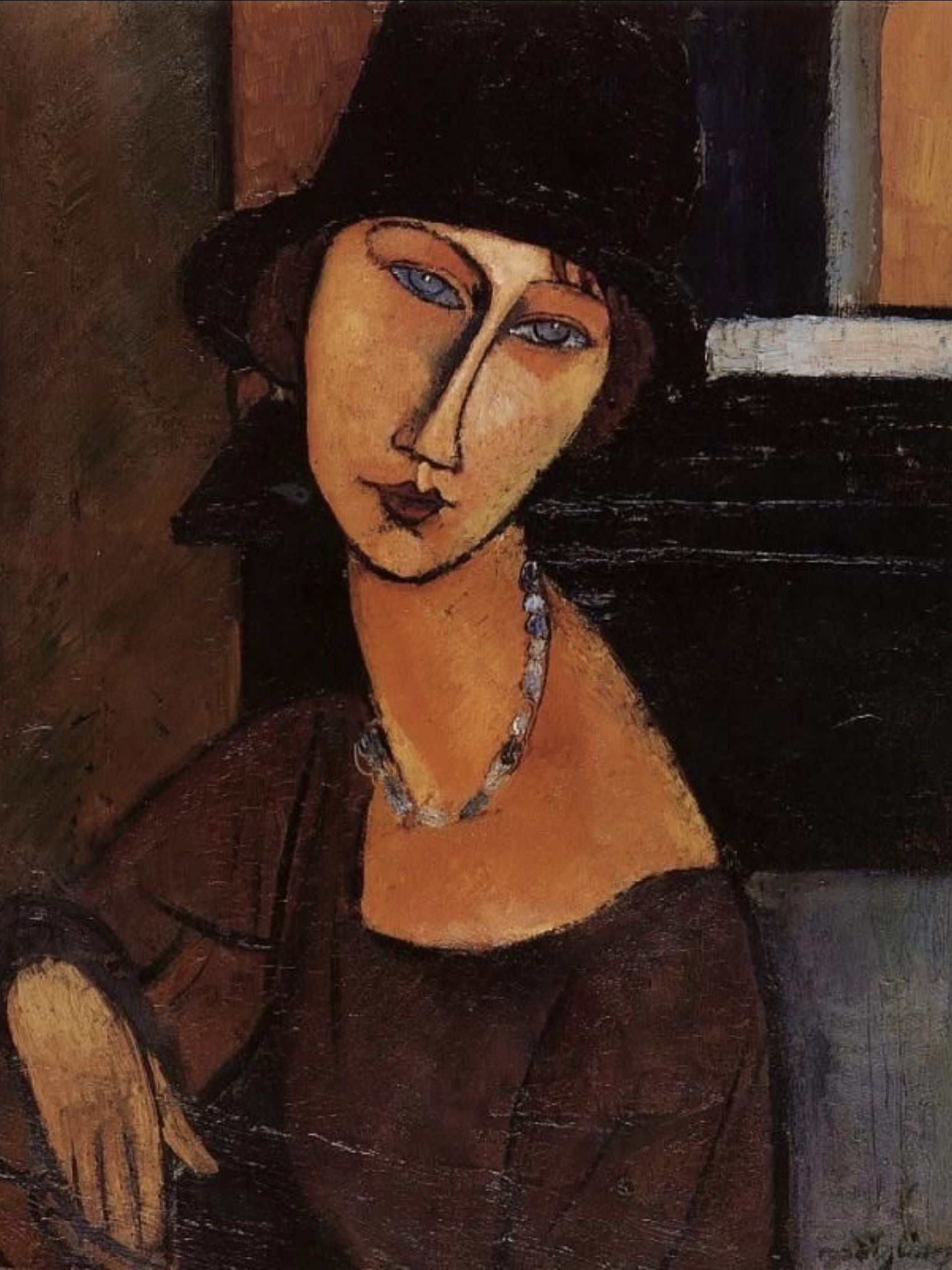
Portrait of Jeanne Hébuterne IV is an oil painted by Amedeo Modigliani in 1917 and recorded in the catalogues as Jeanne Hébuterne (au chapeau); the original measures 67 × 51.5 cm, is signed lower right and is in private hands. Our canvas painting is a hand-painted copy of that work: an academy-trained painter makes it in oil on cotton canvas, in eight sizes from 60 × 70 cm to 150 × 180 cm or in the size you specify, and before dispatch we photograph it and send you the photograph for approval.
| Title: | Portrait of Jeanne Hébuterne IV |
| Other titles: | Jeanne Hébuterne (au chapeau) · Madame Hébuterne à la cloche · Jeanne Hébuterne with Hat and Necklace |
| Painter: | Amedeo Modigliani (1884–1920) |
| Year: | 1917 |
| Original size (height × width): | 67 × 51.5 cm |
| Original technique: | Oil on a rigid support, signed lower right |
| Painting style: | Modern art, École de Paris |
| Where it is: | Private collection – catalogue entry; last at Sotheby’s New York, 2010 |
| Our reproduction: | hand-painted oil on canvas, eight sizes from 60 × 70 cm to 150 × 180 cm, custom size on request |
Portrait of Jeanne Hébuterne IV – Amedeo Modigliani
Who is the woman on the canvas?
Jeanne Hébuterne, a nineteen-year-old art student whom Modigliani met in the spring of 1917 at the Académie Colarossi. Over the next three years he painted her more than twenty times; no other sitter appears so often in his work. This portrait is from the first year of their acquaintance, when the hat was still part of a young Parisienne’s appearance and not the sign of intimacy of the later portraits. The versions read like a diary: the same features, less and less clothing, more and more silence.
What is on the canvas?
Jeanne is painted to the waist, in a black cloche hat that sits low on her forehead and hides most of her hair; only a brown strand shows at the sides. The neck is elongated, as in all his portraits, and a necklace of small pale blue beads runs down it — the only light accent in the upper half. The eyes are pale blue and barely worked. The dress is a dark reddish violet, and one hand rests at the lower left. The background is not a room but a sequence of planes: a warm field at the left, black at the right, a pale band across it and a warm panel above. Nothing narrates: no objects, no event — only face, hat and colour.
What do the photographs on this page show?
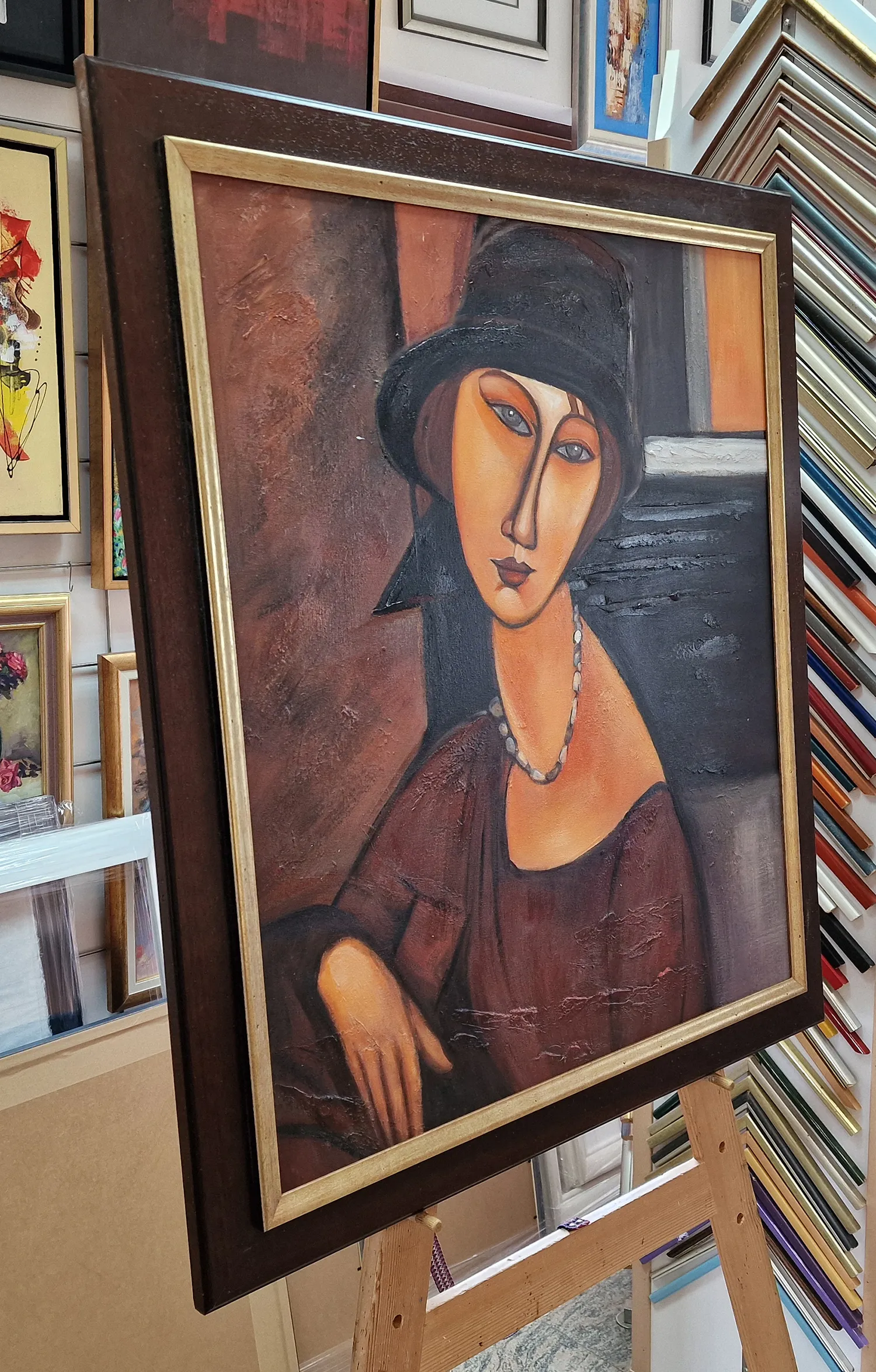
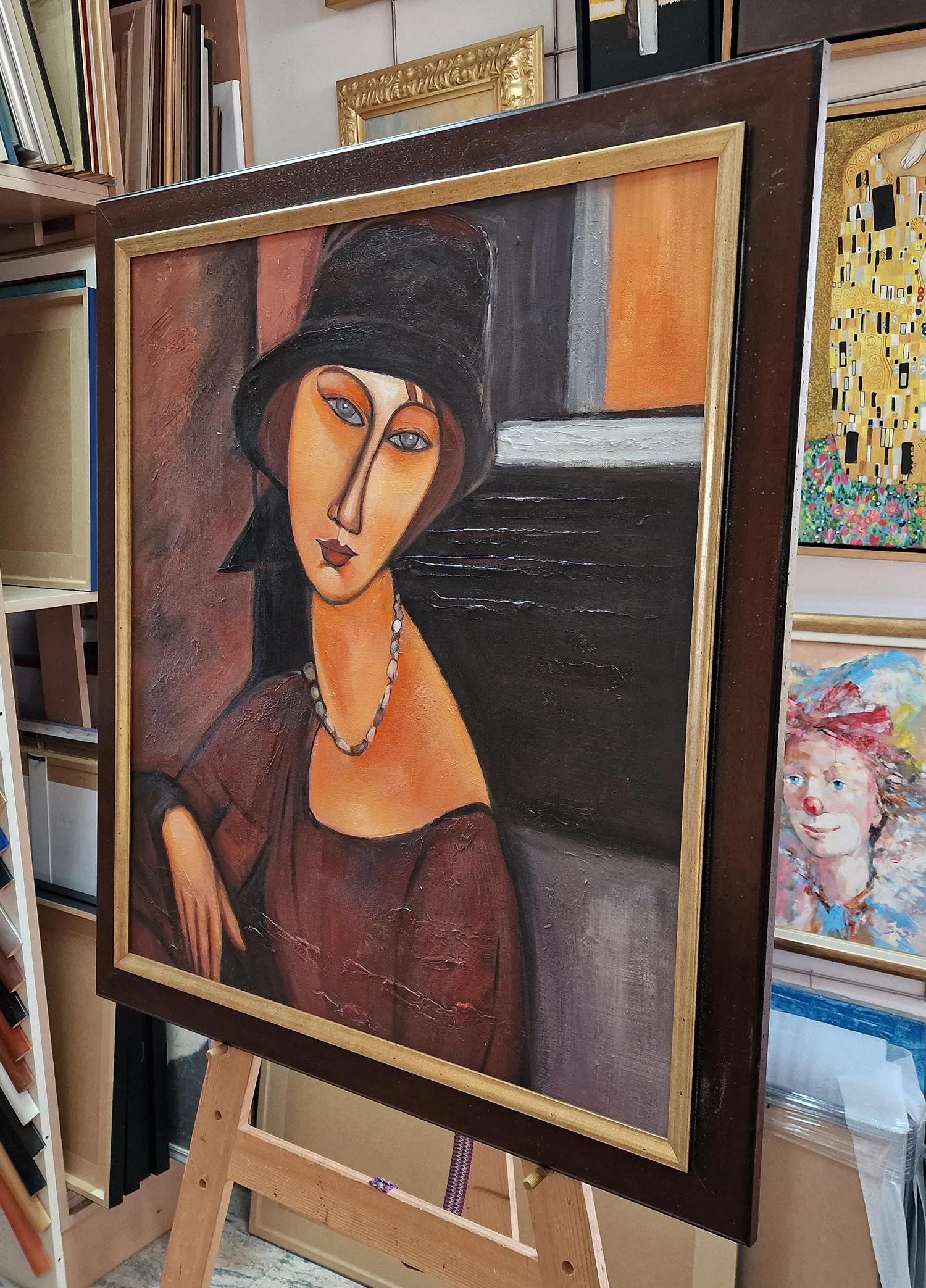
All five photographs show our own hand-painted canvas, not the original. The first photograph shows the work square-on and whole, in a dark brown frame with a narrow gold inner edge. The second photograph shows the same canvas from the side, in our framing workshop, with the rack of moulding samples behind it. The third was taken at an angle among other framed works. The fourth photograph is a close view of the upper left corner: the frame profile, the edge of the hat, and the warm panel with the pale band beside it. The fifth photograph shows the face — both eyes, the arch of the brow and the rim of the hat. The frame shown is one of many; you choose it yourself.
Why does this portrait matter?
Because it is the first large portrait of Jeanne, from the year their relationship was only beginning. Everything Modigliani developed after 1916 gathers in it — the elongated neck, the tilted head, the stylised nose, the small mouth and a flat ground without depth. It is a post-impressionist painting in the sense in which post-impressionism meant building the face out of planes rather than describing light. In Paris Modigliani belonged to that circle of immigrant painters we now call the École de Paris. The catalogue records a detail visible only under infrared: the necklace was not painted at the same time as the neck but added afterwards, in a second stage. The one thing in the picture that shines was therefore a later decision.
Where is the original and which measurement is right?
In a private collection, so there is no accession number. In 2010 the work was offered at Sotheby’s in New York with an estimate of nine to twelve million dollars; the page does not publish the result, so neither do we. Its first owner was Leopold Zborowski, the painter’s dealer, then Jonas Netter and Etienne Bignou in Paris, Frank Crowninshield in New York and Edward A. Bragaline. It was shown in New York in 1929, 1938 and 1971. On the measurement the sources differ: the auction record and the catalogue entry independently give 67 × 51.5 cm, while 164 × 137 cm also circulates online — a figure from a single entry that cites only itself and gives more than double. We hold to 67 × 51.5 cm because two independent records give that size.
How is our hand-painted version made?
The work is made by an academy-trained painter in oil on cotton canvas, stretched over a wooden frame. It is not a print: every stroke is laid by hand, and your canvas always differs a little from the one in the photographs in brushwork and thickness of paint. The painter begins with the planes of the ground, because those decide how light the face will look; hat and dress are both dark and have to be separated by warmth rather than by brightness. The necklace goes on last, as in the original. When the paint is dry we photograph the work and send the photograph for approval.
Which size for which wall?
The original is small, 67 × 51.5 cm, so every size we offer enlarges it; our canvases are also a little wider in proportion, so the painter fits the composition to the format. The smallest, 60 × 70 and 70 × 85 cm, come close to the original and suit a hallway or a narrow wall. The medium ones, 90 × 110 and 100 × 120 cm, work above a sideboard or sofa. The large ones, 110 × 130, 120 × 140, 137 × 164 and 150 × 180 cm, want a free wall and three metres of distance; there the head is larger than life and the work takes the room. The format is upright, so it works where the wall is taller than wide. The work is mostly dark with one light accent, so it is at its best on a light wall; on a dark one the necklace is lost.
Custom size, stretcher and frame
If your wall asks for a size that is not on the list, we will make it. Give us the height and width in centimetres; we check whether the proportion carries the crop and tell you what changes at the edges — here it shows first at the lower left, where the hand is, which cannot be cut without taking the figure’s support with it. It arrives stretched on a wooden frame, ready to hang, or rolled in a tube, which is cheaper to ship. You pick the frame in our 3D application, and on request we set the work into a photograph of your wall. If you are looking for a work we do not carry, see our made-to-order paintings.
Delivery and guarantee
We deliver to your address, the canvas clear of the outer wall of the packaging. Lead time depends on size and the workshop’s load: we estimate it when you order and tell you if it changes. We guarantee workmanship and materials: if the work arrives damaged or does not match the photograph you approved, we repaint it at our own cost. Because you see it in a photograph before it ships, most questions are settled before it leaves.
Frequently asked questions
Where is the original kept?
In a private collection. As it is privately owned, there is no accession number.
Why does 164 × 137 cm appear elsewhere?
It comes from a single entry that cites only itself. The auction record and the catalogue give 67 × 51.5 cm; an older dealer record gives 64.5 × 52 cm. The right measurement is therefore about 67 × 51.5 cm.
Is the original painted on canvas?
Not certainly. The auction record says a wooden panel, the catalogue cardboard, Restellini canvas. Our reproduction is oil on canvas in any case.
Does any of your sizes match the original?
No. The original is smaller than our smallest size and the proportion differs slightly too; the closest is 60 × 70 cm.
Do the photographs on this page show the original?
No. All five show our own hand-painted canvas, photographed here.
What is it about, in one sentence?
A woman the hat hides so far that only the gaze and one bright necklace are left.
How high should it hang?
With its centre about 145 cm above the floor — a little lower than feels right, with an upright format.
Which other Modigliani portraits do you have?
See Portrait of Jeanne Hébuterne I, Portrait of Jeanne Hébuterne III and Portrait of Jeanne Hébuterne VI, and among the other sitters Portrait of Beatrice Hastings and the Self-Portrait. The full choice is in the Amedeo Modigliani gallery, and we have written a longer article about the painter.
How closely does it follow the original’s proportions?
The original measures 51.5 × 67 cm. The closest of our sizes is 90 x 110 cm, which departs from the original’s proportions by 6.44%.
- Subject: Jeanne Hébuterne to the waist, in a black cloche hat low on her forehead, with a necklace of pale blue beads
- Original: 67 × 51.5 cm, oil, signed lower right, 1917, private collection
- Our version: hand-painted oil on canvas, eight sizes from 60 × 70 to 150 × 180 cm; none matches the original, which is smaller
- Worth knowing: the infrared image shows the necklace was added afterwards, in a second stage of the work
The eyes on this canvas do have pupils. Of the 76 Modigliani works on this shelf 17 are like that, and 53 have no pupils – work by work.