


Description
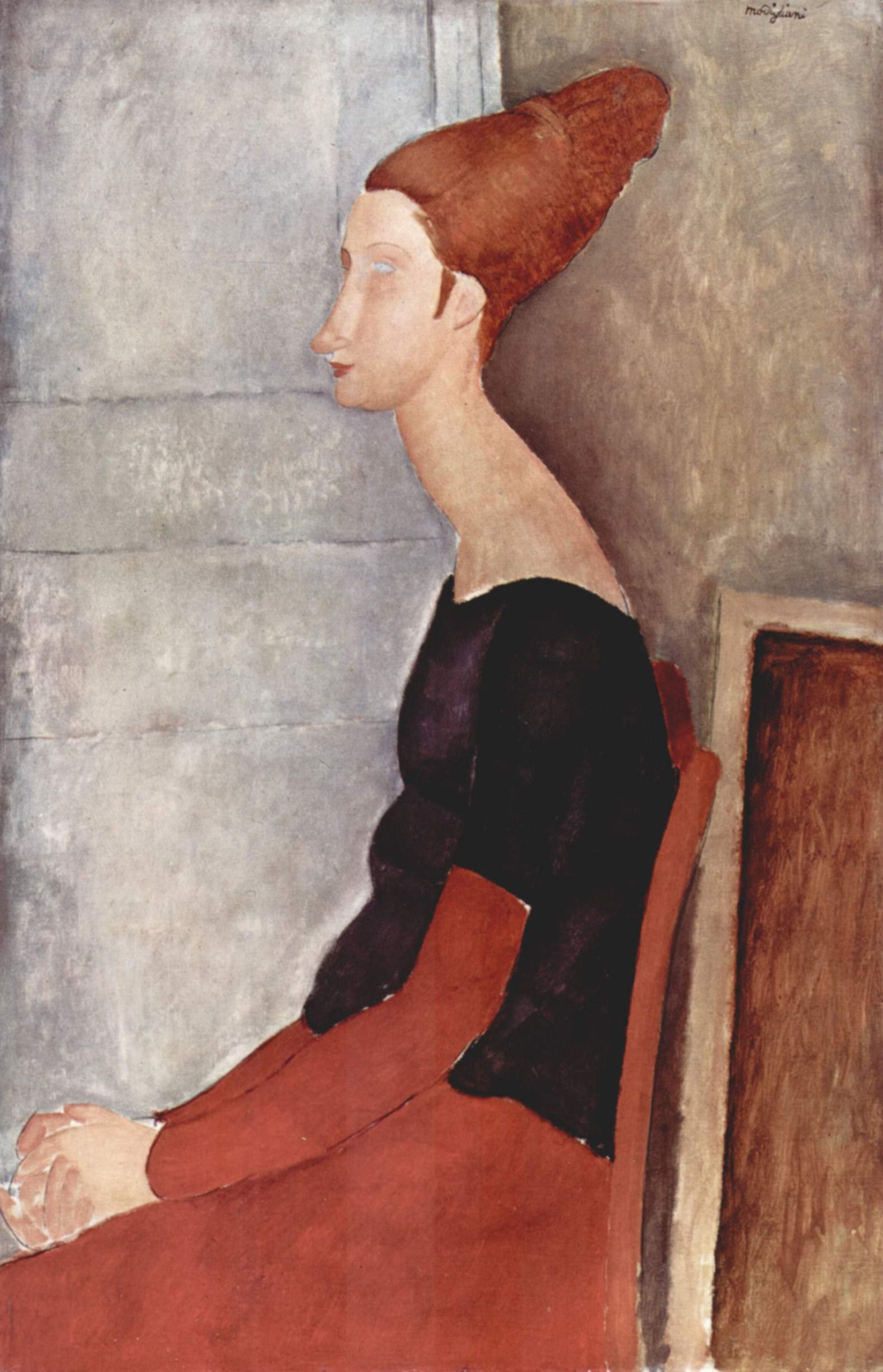
Portrait of Jeanne Hébuterne in Black and Red Dress is an oil on canvas by Amedeo Modigliani; the catalogue records it with the year 1918 and the measurements 100 × 65 cm, signed upper right. The original is in private hands. Our canvas painting is a hand-painted copy of that work: an academy-trained painter makes it in oil on cotton canvas, in eight sizes from 40 × 60 cm to 120 × 180 cm or in the size you specify, and before dispatch we photograph it and send you the photograph for approval.
| Title: | Portrait of Jeanne Hébuterne in Black and Red Dress |
| Other titles: | Jeanne Hébuterne au henné · La femme au hénin · Jeanne Hébuterne seated in profile |
| Painter: | Amedeo Modigliani (1884–1920) |
| Year: | 1918 (the catalogue marks it with a question mark) |
| Original size (height × width): | 100 × 65 cm |
| Original technique: | Oil on canvas, signed upper right |
| Painting style: | Modern art, École de Paris |
| Where it is: | Private collection – catalogue entry; from the Zborowski collection, later Netter, Paris |
| Our reproduction: | hand-painted oil on canvas, eight sizes from 40 × 60 cm to 120 × 180 cm, custom size on request |
Portrait of Jeanne Hébuterne in Black and Red Dress – Amedeo Modigliani
What is on the canvas?
A woman sits on a reddish chair, turned in pure profile to the left. The hair is pinned up in a dense chestnut knot that extends the shape of the head upwards. Above she wears a black bodice with a narrow white edge at the neck, below a long red skirt that falls to the floor and takes up almost the whole lower half of the canvas. The hands rest folded in her lap. Behind her a grey wall, and at the right a brown door jamb that closes the scene. Because the figure is in profile, the body reads as a single long line from the crown of the head to the knees, where the red skirt spreads. The signature is at the upper right. It is a post-impressionist painting in the sense in which post-impressionism meant building the body out of planes rather than describing light. In Paris Modigliani belonged to that circle of immigrant painters we now call the École de Paris.
Why does the profile take away the gaze?
Modigliani painted faces almost always frontally or slightly turned, so that the eyes — empty of pupils though they are — face the viewer. Here he makes an exception and puts the sitter in pure profile. With that he removes the one thing that makes contact in his portraits: the look. What is left is the contour — forehead, nose, lips, chin, neck — and it is that contour which carries the whole work. This portrait is therefore closer to a relief or a medal than to a conversation with the viewer. For the painter reproducing it that means one single, unforgiving demand: the profile must be right to the millimetre, because nothing else can save it.
Where is the original today?
In private hands, so there is no accession number and we quote none. The recorded route is short: from the hands of Léopold Zborowski, the painter’s dealer, the work passed to the Netter collection in Paris. The catalogue also names the present owner, but with a question mark, and that is exactly why we do not write the name down: the source itself does not claim the entry is verified, and we will not claim more than the source. The year 1918 carries a question mark in the catalogue too; we give it as it stands there, and no more.
Why is this work often confused with the Barnes Foundation’s?
Because there are two almost identical seated profiles from the same year and of almost the same size. This one is in a black and red dress and is privately owned; the other is in a white dress, measures 99.7 × 64.8 cm and belongs to the Barnes Foundation in Philadelphia under accession number BF422. The confusion is not our supposition: the catalogue entry expressly notes that Pfannstiel’s 1956 catalogue, under number 148, mixes this work up with the Barnes painting and gives it the wrong size and the wrong provenance. So if you find this picture anywhere with a museum accession number, it is most likely the other canvas. Ours is the one with the red skirt.
Where does the title “au henné” come from?
The work also appears in the catalogues as Jeanne Hébuterne au henné, Jeanne with henna, and as La femme au hénin, the woman with the hennin. The first title refers to the colour of the hair, which on the canvas is markedly chestnut red; the second to the high pinned knot, whose shape recalls the hennin, the medieval conical headdress of French noblewomen. Both titles therefore describe the same thing — the head — and not the person, which is common in Modigliani: his works travelled through history under whatever was most visible in them.
How is our hand-painted version made?
The work is made by an academy-trained painter in oil on cotton canvas, stretched over a wooden frame. It is not a print: every stroke is laid by hand, and your canvas always differs a little from our reference. With this subject everything depends on the contour. The painter lays in the grey wall and the brown door jamb at the right first, because those two settle where the profile will stand; only then does he draw the contour of the head, and that comes in one movement or not at all. The red skirt is the largest surface in the scene and has to stay quiet, without exaggerated folds, or it overpowers the head. When the paint is dry we photograph the work and send the photograph for approval.
Which size for which wall?
For most homes the right choice is 65 × 100 cm — that size is the original’s, so you receive one-to-one proportions. The smallest, 40 × 60 cm, belongs in a hallway or on a narrow wall between two doors. The medium ones, 50 × 80, 70 × 110 and 80 × 120 cm, work above a sideboard or a sofa. The large ones, 90 × 140, 100 × 150 and 120 × 180 cm, want a free wall and at least three metres of distance; at those sizes the figure is larger than life. The format is upright and works where the wall is taller than wide. Because of the profile and the quiet, almost ceremonial pose, this work can also hang beside a door or in a corridor, where it is seen from one side only.
Custom size, stretcher and frame
If your wall asks for a size that is not on the list, we will make it. Give us the height and width in centimetres; we check whether the proportion carries the original’s crop and tell you what changes at the edges — here it shows first at the right, where the brown door jamb stands, and at the bottom, where the red skirt spreads; both hold the figure in its space and cannot be cut away without cost. You can choose whether it arrives stretched on a wooden frame, ready to hang, or rolled in a tube, which is cheaper to ship. You pick the frame in our 3D application, which shows it realistically on the work, and on request we set the work into a photograph of your wall. If you are looking for a work we do not carry, see our made-to-order paintings.
Delivery and guarantee
We deliver to your address, the canvas held clear of the outer wall of the packaging. Lead time depends on size and the workshop’s load: we estimate it when you order and tell you if it changes. We guarantee workmanship and materials: if the work arrives damaged or does not match the photograph you approved, we repaint it at our own cost. Because you see it in a photograph before it ships, most questions are settled before it leaves.
Frequently asked questions
Where is the original?
In a private collection. We do not name the collection, because the catalogue itself puts a question mark against it.
Is this the same work as the one at the Barnes Foundation?
No. The Barnes painting is in a white dress and measures 99.7 × 64.8 cm; this one is in a black and red dress and is privately owned.
Why is the sitter painted in profile?
Because Modigliani made an exception here. Almost all his portraits look towards the viewer; this one does not.
What does “au henné” mean?
With henna. The title refers to the markedly chestnut-red colour of the hair.
Which size should I choose?
If you cannot decide, take 65 × 100 cm, the size of the original. For a narrow hallway wall 40 × 60 cm, for a large wall 120 × 180 cm.
Is the original for sale?
We do not know and we do not guess. It is in private hands and we put no value on it.
How high should it hang?
With its centre about 145 cm above the floor. With an upright format it pays to hang it a little lower than feels right.
Which other portraits of Jeanne Hébuterne do you have?
See Portrait of Jeanne Hébuterne I, Portrait of Jeanne Hébuterne III, Portrait of Jeanne Hébuterne IV and Portrait of Jeanne Hébuterne VI, and among the other sitters Portrait of Lunia Czechowska. The full choice is in the Amedeo Modigliani gallery, and we have written a longer article about the painter.
How closely does it follow the original’s proportions?
The original measures 65 × 100 cm, and that is exactly the size we list: 65 x 100 cm. The proportions are the original’s, with no deviation.
- Subject: Jeanne Hébuterne seated in pure profile, chestnut hair pinned high, in a black bodice and a long red skirt
- Original: 100 × 65 cm, oil on canvas, 1918, private collection
- Our version: hand-painted oil on canvas, eight sizes from 40 × 60 to 120 × 180 cm; the 65 × 100 cm size is one-to-one with the original
- Worth knowing: Pfannstiel’s 1956 catalogue confuses this work with the white-dress portrait at the Barnes Foundation
The eyes on this canvas are painted without pupils. We counted all 76 Modigliani works on this shelf: 53 are like that, 17 are not – work by work.