
Description
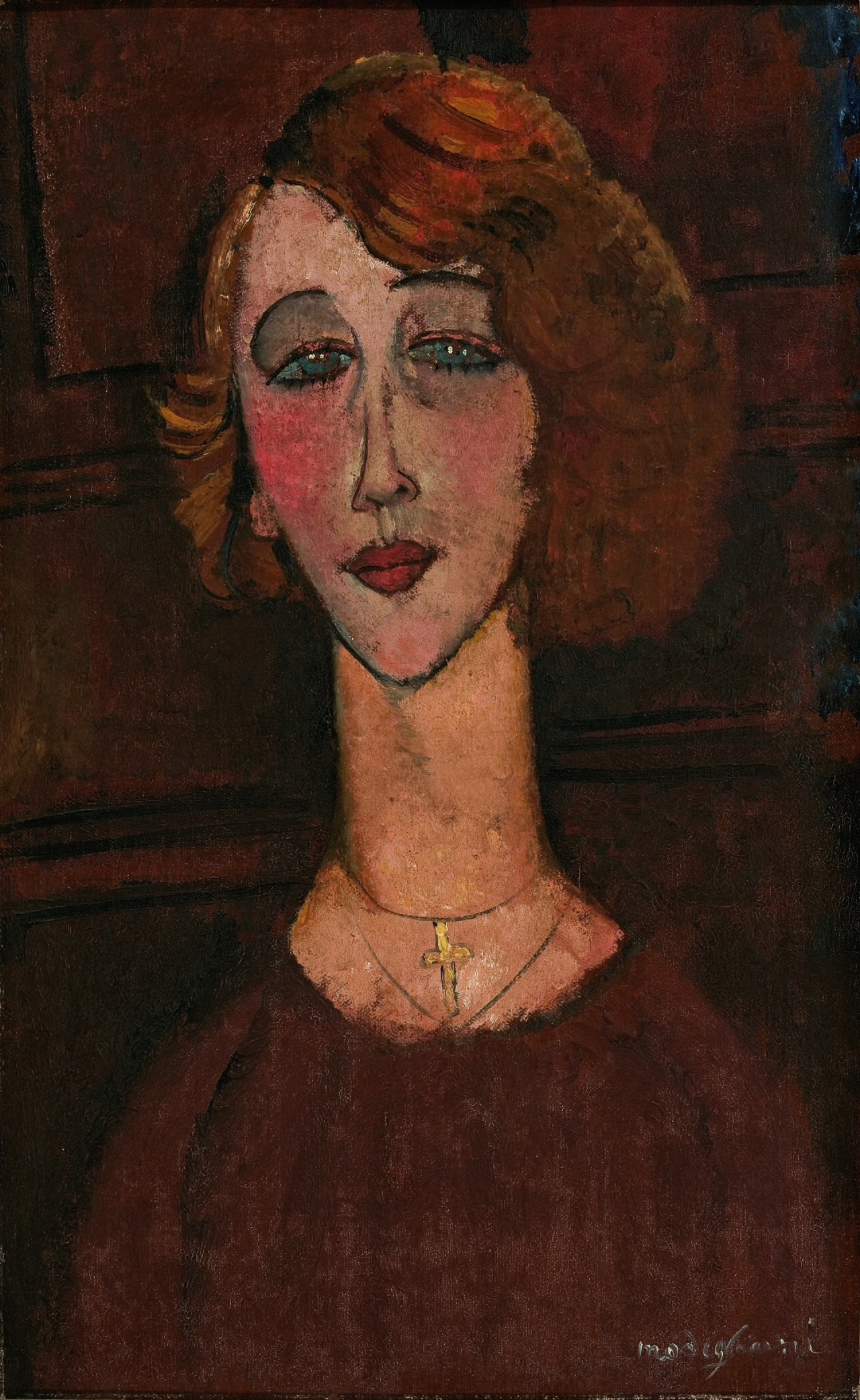
Renée is a portrait of 1917 held by the São Paulo Museum of Art under inventory number MASP.00149. Modigliani painted the sitter to just below the shoulders, with thick reddish-chestnut hair framing the face on both sides and a thin gold chain at the throat. With us it is made as a hand-painted copy, oil on canvas, to order, in eight sizes or in a size you give us; before dispatch we send you a photograph of the finished canvas.
| Title: | Renée |
| Other titles: | Renée (the only title MASP’s record gives) |
| Painter: | Amedeo Modigliani (1884–1920) |
| Year of creation: | 1917 |
| Original size (width × height): | 38 × 61 cm |
| Original technique: | oil on canvas |
| Painting style: | expressionism, École de Paris |
| Located: | São Paulo Museum of Art (MASP) (inv. MASP.00149) |
| Our reproduction: | hand-painted copy, oil on canvas, eight sizes or a custom size |
Renée – Amedeo Modigliani
What is on the canvas?
The woman is shown to just below the shoulders. The hair is full, reddish chestnut, loose, and frames the face on both sides. The forehead is high and rounded, the brows arched, the eyes almond-shaped and grey-green. A rosy flush sits high on both cheeks; the mouth is small and red. The neck is long and slender, lengthened in Modigliani’s way. The dress is a deep dark red with a rounded neckline; a thin gold chain with a small pendant hangs at the throat. The ground is a dark brown-burgundy crossed behind the shoulders by a lighter horizontal band. The signature is at the lower right.
Who was Renée?
The museum’s record does not answer that. MASP gives only the first name, with no surname and no account of who she was, and so we write no more than is known. A sitter of that name appears on a few other canvases of the same year. The portrait was made in 1917, in Modigliani’s densest period, when he was working under the protection of the dealer Léopold Zborowski — his portrait is on this shelf too, Portrait of Léopold Zborowski, and beside it Madame Hanka Zborowska, a canvas the São Paulo museum today lists as a portrait of Lunia Czechowska and not of Zborowski’s wife. Zborowski paid for the studio and sent the sitters, and the circle around them was the one we now call the École de Paris; in a single year the run of portraits Modigliani is known for came into being.
The record of the original, and how it reached São Paulo
The original is oil on canvas; MASP measures it as 61 × 38 × 3 cm, that is 38 cm wide and 61 cm high, the third figure being the depth of the stretcher — the museum records the thickness of the canvas as well, which is unusual. The year 1917 is recorded to year precision. How the work reached Brazil is in the record too: in 1951 it was given to the museum by Cotonifício Guilherme Giorgi S.A., a São Paulo cotton mill. That is the whole documented route, and we go no further than it. The work also has its own Wikidata entry.
The motif among the painter’s works
For a city outside Europe São Paulo is unusually rich in Modiglianis, and beside Renée our shelf carries three more canvases from the same collection: Madame G. van Muyden and the portraits named above, of Léopold Zborowski and of the sitter São Paulo now calls Lunia Czechowska. Their inventory numbers are neighbours — MASP.00148, 00149, 00150 and 00152 — so they were registered together or nearly so, and that too is part of the story of how the circle around Zborowski was one day scattered across the world. Renée is the warmest of them in colour; the portrait Lolotte, which hangs in Paris and not in São Paulo, from the same years, shows the same hair with a quite different expression, and it shows well how few strokes Modigliani needed to tell two faces apart. The whole selection is in the Amedeo Modigliani gallery, and we have written a longer article about the painter.
How is our hand-painted version made?
A painter paints it, with a brush, in oil on canvas, to your order. Every canvas painting takes some weeks, and each copy comes out slightly its own; that is not a fault but the consequence of a person working rather than a machine. On this motif the hardest thing is the flush on the cheeks: it sits high and soft, and if it settles too low the face loses its youth. Before dispatch you receive a photograph of the finished canvas and approve it. It is never a print.
Which size for which wall?
For this motif we suggest 50 × 80 cm. The original is upright and fairly small, but the portrait is built on a long neck and high hair and takes 60 × 90 cm without strain. For a narrow wall or a hallway, 40 × 60 cm is enough. If you want a post-impressionist painting in a size that is not on the list, we make it to order.
Frequently asked questions
Where is the original?
In the São Paulo Museum of Art (MASP), inventory number MASP.00149, given by the Cotonifício Guilherme Giorgi company in 1951.
Which size should I choose?
For a bedroom or hallway 40 × 60 cm; for a living-room wall 50 × 80 cm or 60 × 90 cm.
How closely does it follow the original’s proportions?
The original measures 38 × 61 cm. The closest of our sizes is 50 x 80 cm, which departs from the original’s proportions by 0.33%.
- Subject: a woman to below the shoulders, loose reddish-chestnut hair, deep red dress, thin gold chain with a pendant
- Original: 38 × 61 cm, oil on canvas, 1917, São Paulo Museum of Art, inv. MASP.00149
- Ours: hand-painted oil on canvas, eight sizes or a custom size, with a photograph to approve before dispatch
- Worth knowing: who Renée was, the museum’s record does not say — it gives only the name, and we go no further
The eyes on this canvas are painted without pupils. We counted all 76 Modigliani works on this shelf: 53 are like that, 17 are not – work by work.