




Description
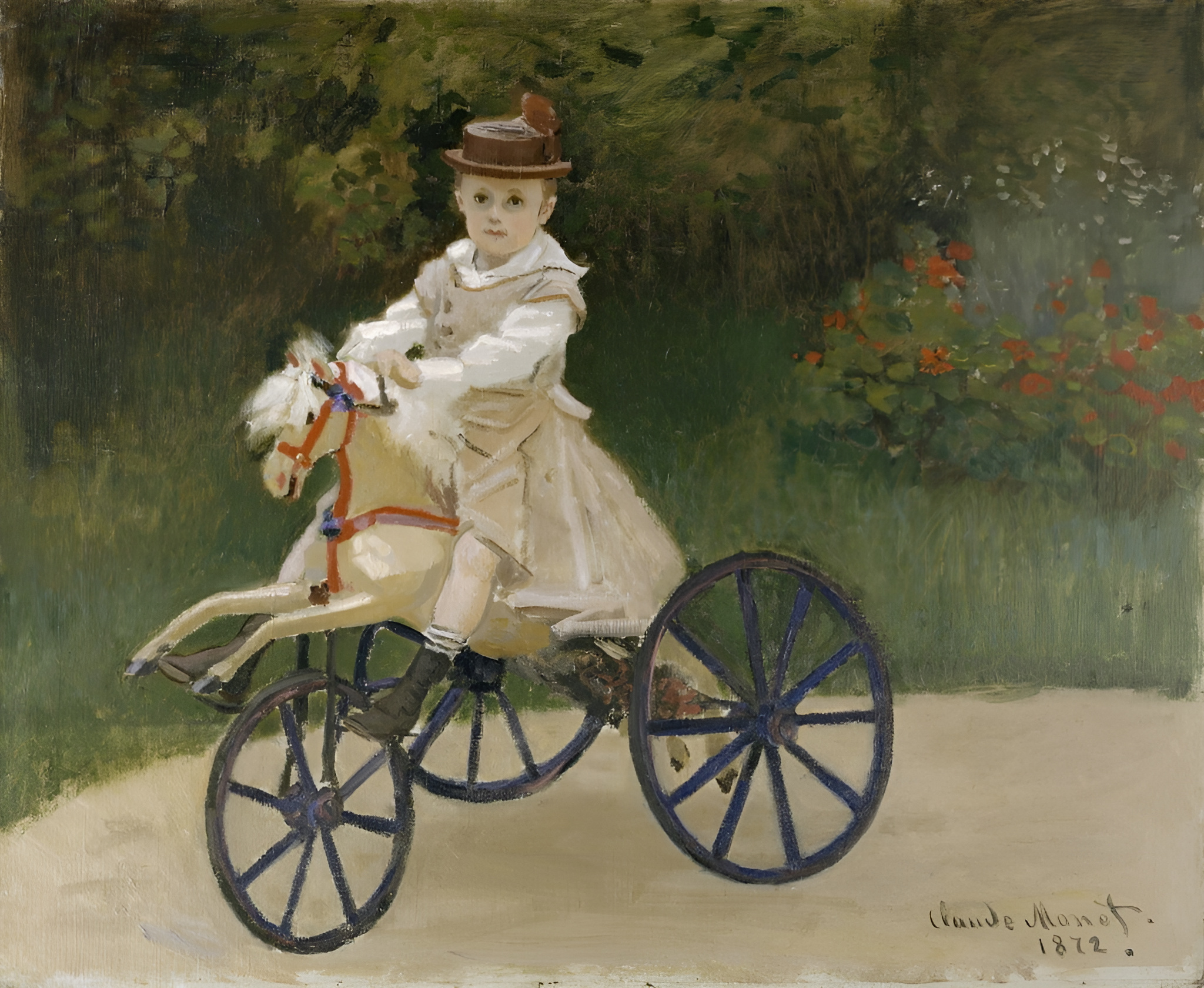
Jean Monet on His Hobby Horse is a hand-painted oil painting after Monet’s family portrait of 1872: the painter’s elder son, then about five, sits on a toy horse mounted on three wheels in the middle of a pale garden path, before a dark hedge, and looks straight out. The original measures 74.3 x 60.6 cm and is held at the Metropolitan Museum of Art in New York, accession 2000.195. We paint it in eight sizes or to your own measurement, with a photograph of the finished work sent for approval before dispatch.
| Title: | Jean Monet on His Hobby Horse |
| Other titles: | Jean Monet (1867–1914) on His Horse Tricycle |
| Painter: | Claude Monet (1840–1926) |
| Year painted: | 1872; signed and dated at the lower right |
| Original size: | 74.3 cm x 60.6 cm |
| Original technique: | Oil on canvas |
| Painting style: | Impressionism |
| Located at: | The Metropolitan Museum of Art, New York (inv. 2000.195) |
| Our reproduction: | Hand-painted oil on canvas, eight sizes or made to measure |
Jean Monet on His Hobby Horse – Claude Monet
Who is the child in the painting?
The child is Jean Monet, the elder son of the painter Claude Monet, born in 1867 and so about five when the work was made. The museum names him in the title itself, with his dates, and lists him as the main person shown rather than an anonymous child model. That changes the reading: not a genre scene with some child and a toy, but the portrait of a particular child, painted by his father.
What is on the canvas?
The canvas lies wide. The middle is taken by the child, in a long cream-white coat with a short cape and small buttons down the front; on his head a brown hat with a hard flat crown, a brown feather upright at the back. The face is turned squarely forward, the mouth closed, the expression serious and a little uncertain. He sits on a toy horse: the body pale cream, the mane white and unkempt, bridle and breast strap a bright red with blue rosettes at the joins, the dark-hooved forelegs stretched far to the left. The toy stands on a frame with three spoked wheels in dark blue verging on black, the largest at the right. The upper two thirds are a dense wall of foliage, so dark it passes into black in places; to the right a bush of red geraniums, and above it a few white flowers in thick impasto standing above the surface. The lower third is a pale sandy path, almost without detail. At the lower right stand the signature and the date, on a canvas less than eighty centimetres across.
Hobby horse or tricycle?
The toy is the most precisely painted thing here and the only one the records disagree about. The title we sell under speaks of a hobby horse; the Metropolitan Museum of Art, in its present entry, calls it „Jean Monet (1867–1914) on His Horse Tricycle“. Wikidata still carries the older museum form, „Jean Monet (1867–1913) on His Hobby Horse“, and lists among the objects depicted a stick horse, absent here entirely; the two records do not even agree on the boy’s dates. One canvas, three names. Where sources disagree we follow the institution that holds the work: the museum form stands as the other title above, the text uses the name we sell under. Anyone who looks can see whose description is more exact — the horse stands on wheels, not on rockers and not on a stick.
That same toy explains why the work looks unusual. The child is painted softly, the edge of his coat dissolving into the background, while the horse, bridle and wheels are drawn sharply, every spoke counted. The toy is more solid than the child riding it — in a portrait, the opposite of what one expects. The hedge behind has no depth, surface not space, so both stand as though cut out. This is an impressionist painting by style; by construction it is closer to a considered arrangement than a scene caught in passing.
Details from the museum record
The canvas is recorded at the Metropolitan Museum of Art in New York under accession number 2000.195: oil on canvas, 60.6 x 74.3 cm, the year 1872. The museum writes the height first, our column the width. The year carries no qualification and matches the date the painter wrote on the canvas. It came to the museum in 2000 as a gift of the Sara Lee Corporation, which is all the record says of its earlier owners; the Wildenstein catalogue numbers it 238. The parallel record is kept by Wikidata, which agrees with the museum on accession, collection, both measurements and the object identifier; the museum record is linked in the row „Held at“ above. The work predates the first impressionist exhibition of 1874.
Monet’s family on other canvases we sell
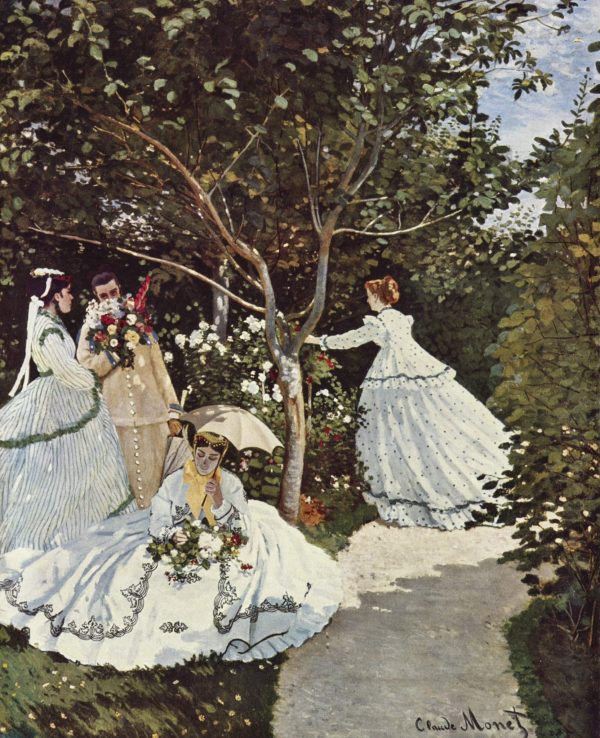
The same child, older and half hidden behind the table after a meal, appears in The Luncheon. A figure in the open air is Woman with a Parasol; the garden version with several figures is Women in the Garden; the interior portrait from the same household is Madame Monet in a Kimono. All four we paint by hand, in the same range of sizes.
How is our hand-painted version made?
This subject stands or falls on two opposite ways of laying paint. The hedge is built from the back forward: a cool dark ground, then hundreds of short touches in three or four greens, or it collapses into an even black. The coat is made the other way round, in broad soft areas with a stroke that is hardly visible. The hard parts come last: the wheel rims, every spoke one by one, the red bridle and the blue rosettes. Draw the wheels too early and the edges smear into the green, losing the sharpness the scene rests on. The oil painting reproduction you receive follows that order, and takes longer in the larger sizes.
Which size for which wall?
The short answer: 74 x 61 cm is the size closest to the original — 3 mm narrower and 4 mm taller; 90 x 70 cm above a chest of drawers, 110 x 90 cm above a sofa, 150 x 120 cm for a large open wall. A canvas painting with this subject works best at eye level: the child looks straight out, and the gaze is most direct when the painted face and the viewer’s are level. The smallest, 60 x 50 cm, suits a hallway or a narrow wall beside a door; at 130 x 110 cm the spokes separate from a few steps away; 80 x 65 cm and 100 x 80 cm sit between. Because the upper two thirds are dark, impressionist wall art of this kind wants a light wall and daylight; in a dark corner the hedge closes up. It is a painting for a child’s room by subject, not colour.
How high to hang the painting: centre about 150 cm above the floor. Because the child looks straight out, the scene is lost if it hangs too high — the viewer looks up and the child looks past him.
Custom sizes, stretcher bar and frame
If none of the eight sizes fits your room, we paint the work to a measurement you set — send width and height and we will quote price and lead time. Made to measure, this subject keeps its side ratio: otherwise the wheels stretch into ellipses and the toy loses what makes it convincing. It is stretched over a wooden stretcher bar with the edges painted, so it does not look unfinished unframed. A narrow dark moulding or a warm walnut suits it; a wide gilt frame pulls the coat’s creamy white towards yellow.
Delivery and guarantee
The work travels to sixteen countries of the European Union — among them Ireland, Germany, Austria, Italy, Slovenia and Croatia — wrapped in protective film in a rigid box. You receive the photograph of the finished canvas before dispatch: if something is not right, we correct it while the work is still in the studio. Other subjects by Monet are in the Claude Monet gallery, and we write about the work on our blog.
If the painting is a gift and you are unsure of the size, there is a gift voucher: the recipient chooses the size and the subject.
Frequently asked questions
Where is the original?
At the Metropolitan Museum of Art in New York, accession 2000.195, department of European paintings. The record names no gallery, so we do not claim it is on view.
Is anyone else in the painting besides the child?
No. One person, Jean Monet, and one toy. The rest is garden: hedge, red geraniums, sandy path.
What is the painting about, in one sentence?
That a father painted his five-year-old son on a toy horse — and painted the toy more sharply than the child.
What year is it from?
1872. Jean, Monet’s elder son, was about five at the time; the family was living at Argenteuil.
- Subject. Jean Monet, about five, in cream-white coat and brown hat on a toy horse with three blue wheels, before a dark hedge.
- Original. Oil on canvas, 74.3 x 60.6 cm, 1872, Metropolitan Museum of Art, inv. 2000.195, Wildenstein 238.
- Ours. Eight sizes or made to measure, 60 x 50 to 150 x 120 cm; 74 x 61 cm matches the original.
- Worth knowing. The museum now calls it a horse tricycle, not a hobby horse — and the canvas agrees, because the toy has wheels.