




Description
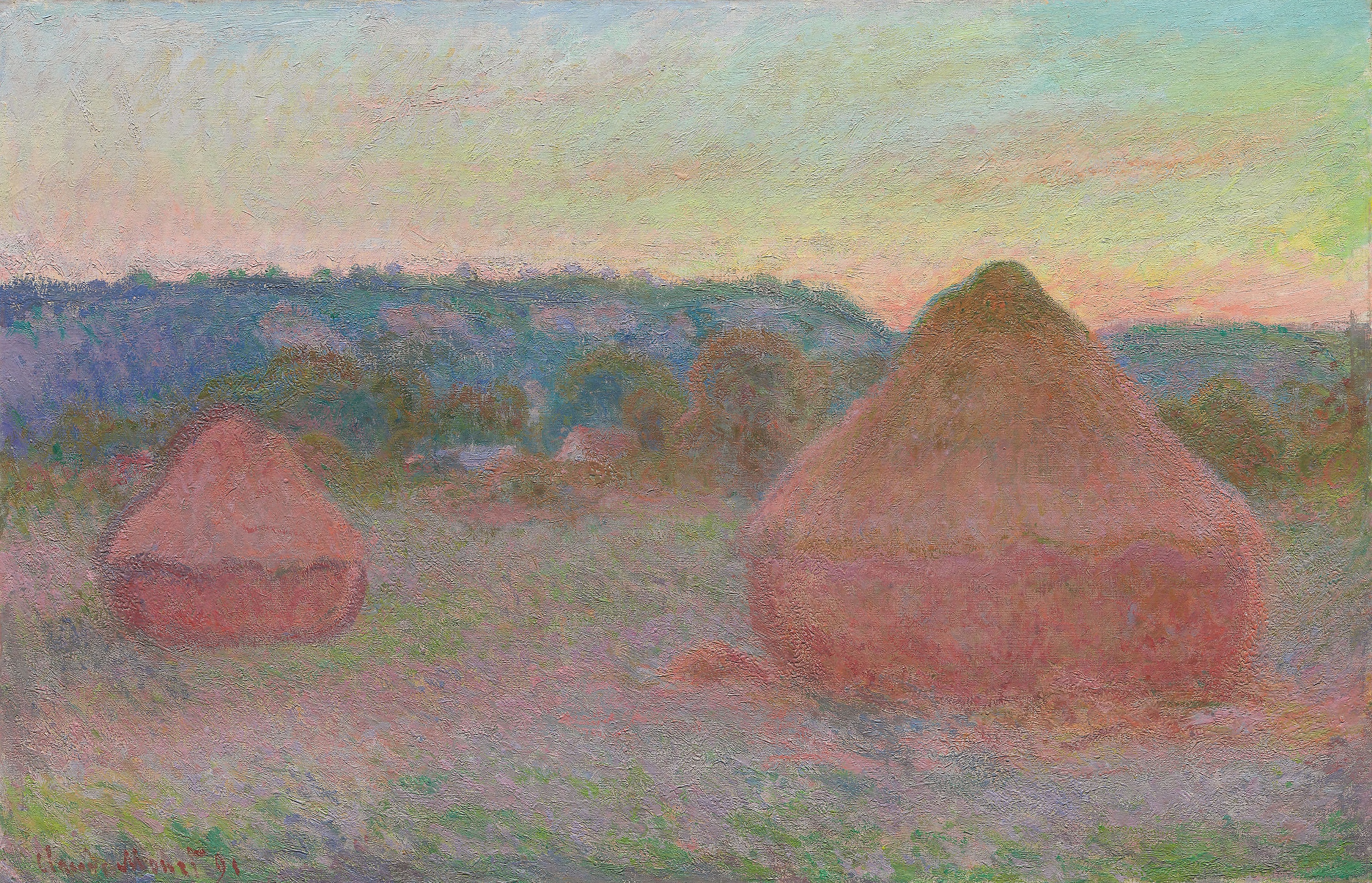
Stacks of Wheat (End of Day, Autumn) is a hand-painted reproduction of Monet’s canvas in the Art Institute of Chicago: two stacks of wheat stand in an autumn field at the end of the day, a smaller, rounded one to the left and a large conical one right of centre, whose tip rises above the line of the hills into a pink band of sky. The original measures 101 x 65.8 cm, is oil on canvas and carries accession number 1933.444. The museum dates it to the span 1890–91, and the signature at the lower left reads »Claude Monet 91«. We paint it in eight sizes or to your own, with a photograph of the finished work sent for approval before dispatch.
| Title: | Stacks of Wheat (End of Day, Autumn) |
| Other titles: | Deux meules, déclin du jour, automne (the French title in Wikidata); in the Wildenstein catalogue the work is number 1270 |
| Painter: | Claude Monet (1840–1926) |
| Year painted: | 1890–91 per the museum record, which gives a span and not a single year; the signature at the lower left reads »Claude Monet 91« |
| Original size: | 101 cm x 65.8 cm |
| Original technique: | Oil on canvas |
| Painting style: | Impressionism |
| Located at: | Art Institute of Chicago (inv. 1933.444) |
| Our reproduction: | Hand-painted oil on canvas, eight sizes or made to measure |
Stacks of Wheat (End of Day, Autumn) – Claude Monet
What is on the canvas?
A field at the end of an autumn day, seen from almost ground level. Right of centre stands a large stack with a conical top; the tip is darker, nearly olive green, the flanks orange-brown and the lower part pink, as if the last light had caught it. Right against its left foot lies a low orange heap. To the left, nearer the edge, stands a smaller stack, more rounded than pointed, with a darker horizontal band around its lower part.
When was it painted: 1890 or 1891?
The museum does not pick a year. Its record gives the span 1890–91, starting in 1890 and ending in 1891, and the museum explains it itself: through those two years the painter worked on the series in the field, at several easels at once, and in the studio, where he refined the harmonies of colour. The canvas was made over time, not in one afternoon.
Better no figure than one nobody asserts.
The same museum dates another canvas we sell to the same span: Poppy Field (Giverny).
What does the museum record say about the work?
The work is held by the Art Institute of Chicago, accession 1933.444, which gives the size height first, 65.8 x 101 cm, and 125.5 x 90.9 cm (width first) with the frame. The credit line reads Mr. and Mrs. Lewis Larned Coburn Memorial Collection, the canvas hangs in Gallery 243, and in Daniel Wildenstein’s catalogue raisonné of 1979 it is number 1270.
The same museum records exactly that size, to the millimetre, for a different canvas of the series that we also sell: Stacks of Wheat (Sunset, Snow Effect), accession 1922.431. We do not guess where the match comes from; the institution’s own figure stands.
Whose hands has the canvas passed through?
The museum publishes the full chain of owners with prices and sources, so we give it as it gives it. The painter sold the canvas to Durand-Ruel in Paris on 2 July 1891 for 3,200 francs. According to the Durand-Ruel archives, the firm’s New York house sold it the same day to Potter Palmer of Chicago for 1,200 dollars, or 6,000 francs; the same archives note that their books hold a discrepancy about this sale that they cannot explain.
The canvas was back in Durand-Ruel’s New York stock by 7 March 1892, when Potter Palmer bought it for 1,500 dollars; the firm had it back by 19 April that year and sold it that day to William Van Horne of Montreal for 1,250 dollars. By 22 November 1892 it was with Durand-Ruel in New York again, and that day Potter Palmer bought it for 1,200 dollars.
By 1932 it belonged to Howard Young of New York, and by the same year to Annie Swan Coburn of Chicago, who died in 1932 and bequeathed it to the museum; it has been there since 1933. How the canvas kept returning to stock the record does not say, and we do not fill it in.
End of summer or autumn?
Durand-Ruel’s stock books do not use the museum’s title: Paris entered the canvas in 1891 as number 1063, Meules, fin de l’été, stacks at the end of summer, and New York kept that name in 1892. Two other canvases carry it today: Stacks of Wheat (End of Summer), 1985.1103, at the Art Institute of Chicago, 100.5 x 60 cm, and Meules, fin de l’été, RF 1975 3, dated 1891, at the Musée d’Orsay, 100.8 x 60.5 cm. Both are lower than ours; go by accession number 1933.444, not by title.
Why does this work matter?
Because of the tip of the large stack. The museum notes that in this view and in nearly all the autumn views the conical tops break the horizon, while in most winter views, the core of the series, the stacks seem wrapped in bands of hill and field. The winter side is shown by Stack of Wheat (Snow Effect) and by the Stacks of Wheat (Sunset, Snow Effect) named above.
After the stacks, the museum record says, came series of poplars, of the facade of Rouen Cathedral and later of his own garden at Giverny. From the first two we sell Poplars and Rouen Cathedral, the Portal and Saint-Romain Tower. An impressionist painting of this kind is not a view of a place but one of several decisions about the same object, at another hour and in other weather.
How is our hand-painted version made?
Every order is painted individually by an artist, in oil on cotton or linen. That is how every canvas painting leaves us, with no print and no machine step. This oil painting reproduction is demanding in its transitions: the sky passes from greenish through yellow into orange-pink, and if those bands melt into one even gradient the canvas loses the hour of the day it is named after.
The second test is the stacks. Their shaded side must stay built of pink and lilac strokes, not brown or grey, or the stack turns heavy and comes loose from the field. A Monet reproduction of this kind depends on the stacks staying part of the field. Work of this kind will not take a high gloss, so ours is matt. A hand-painted copy is not a facsimile; two canvases of the same size always differ in the brushwork.
Which size for which wall?
There are eight sizes, from 70 x 45 to 200 x 130 cm. Closest by size is 100 x 65 cm, a centimetre narrower and 0.8 cm lower; closest by proportion is 92 x 60 cm, at 1.5333 against the original’s 1.5350, with 100 x 65 and 200 x 130 just behind at 1.5385.
If you want nearly the size of the original, take 100 x 65; for a large wall, 200 x 130 is just as elongated. The warm tones of sky and field hold up well in the evening under artificial light, which makes this a good painting for the dining room. All sizes are listed with the product in our Claude Monet gallery.
Custom size, stretcher bar and frame
For a size not on the list, made to measure is the only route; send us the width and height and we keep the proportion of the original. The canvas is stretched on a wooden bar. A frame is not included; the museum’s own measures 125.5 x 90.9 cm.
Delivery and guarantee
Making it takes two to three weeks, a few days more at the largest sizes. It arrives stretched on its bar in a rigid box, or rolled in a tube, with tracking. If it arrives damaged or differs noticeably from the approved photograph, we replace it or refund. Small differences in the brushwork are expected in handwork; damage is not.
If the painting is a gift and you are unsure of the size, there is a voucher: the recipient chooses the size and the subject.
Frequently asked questions
Where is the original?
In Chicago, at the Art Institute of Chicago, accession number 1933.444, on view in Gallery 243.
How many haystack paintings did Monet make?
About thirty. Between 1890 and 1891 he painted the stacks in a field near his house at Giverny again and again, and fifteen of them were shown together at the Galerie Durand-Ruel in Paris in 1891.
Where did the stacks stand?
In a field just outside Monet’s house at Giverny, fifteen to twenty feet high. He painted them from the summer of 1890 into the winter of 1891, at several easels at once, and in May 1891 hung fifteen of them together at the Galerie Durand-Ruel in Paris.
Why did Monet paint haystacks?
The stacks stood in a field next to his house at Giverny. He wanted to show how the same simple motif changes with the light, the season and the weather, so he worked on several canvases at once.
- Subject. Two stacks of wheat in a field at the end of an autumn day; the tip of the large stack reaches above the line of the hills into a pink sky.
- Original. Oil on canvas, 101 x 65.8 cm, 1890–91; signed at the lower left »Claude Monet 91«; Art Institute of Chicago, inv. 1933.444.
- Ours. Eight sizes; 100 x 65 cm is closest by size, 92 x 60 cm by proportion.
- Worth knowing. In 1891 Durand-Ruel entered the canvas as Meules, fin de l’été, a name two other canvases carry today.