Description
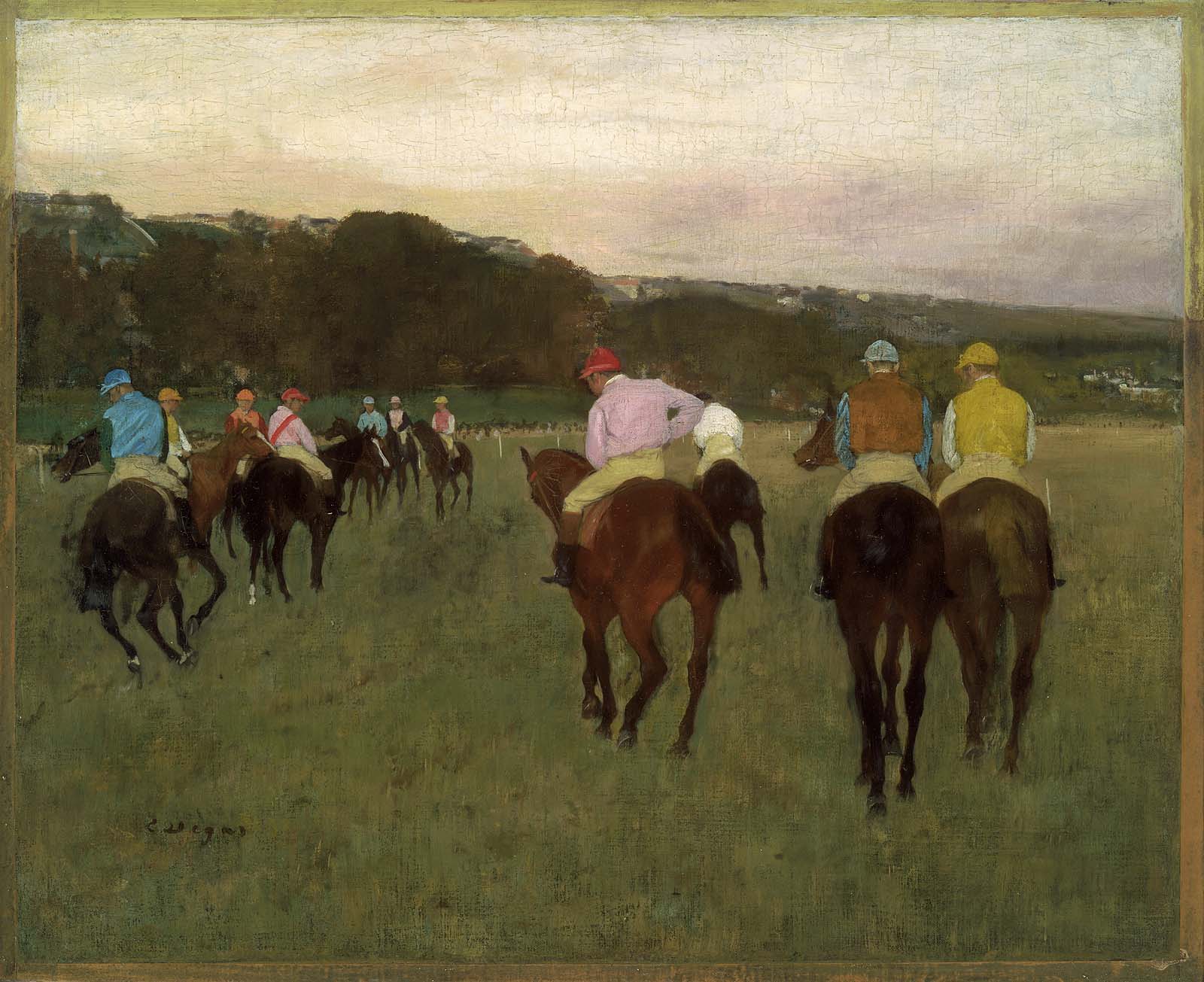
Racehorses at Longchamp shows riders spread across the grass beside the racecourse, nearly all of them with their backs to us. Four move off at the right: one in a rose jacket with a red cap, one in white, one in brick red with a pale blue cap, and one in yellow. A smaller group stands at the left, a rider in blue in front, and behind him further red, yellow and rose caps are set down in tiny strokes. The horses are standing quietly. A dark wooded ridge rises behind, and beyond it a rolling landscape opens with a few white houses; the sky is pale and sunless. The museum reads the scene as the moment at the end of a race. The original is small, 41.9 x 34 cm, held by the Museum of Fine Arts in Boston under number 03.1034, and signed at the lower left. Ours is painted by hand in six sizes from 50 x 40 to 100 x 80 cm or to your own measurement, and you receive a photograph of the finished work for approval before it ships.
| Title: | Racehorses at Longchamp |
| Other titles: | Courses de chevaux à Longchamp |
| Painter: | Edgar Degas (1834–1917) |
| Year: | 1871, possibly reworked in 1874 (signed lower left: E Degas) |
| Size of the original: | 41.9 cm x 34 cm |
| Technique of the original: | oil on canvas |
| Style: | Impressionism |
| Where it hangs: | Museum of Fine Arts, Boston (inv. 03.1034; Schulman catalogue MS 87) |
| Our version: | hand-painted oil on linen canvas, 6 sizes from 50 x 40 cm to 100 x 80 cm, custom size on request |
Racehorses at Longchamp – Edgar Degas
Who is in the scene?
Riders and horses, none of them named. The museum record names nobody, so neither do we. Four move off at the right: first one in a rose jacket with a red cap, behind him a rider in white, then one in brick red with a pale blue cap, and last one in yellow. All four are turned away from us, so we see backs and the napes of necks. At the left stands a smaller, more tightly packed group; in front is a rider in a blue jacket, the only one turned more towards the middle of the scene, and behind him the caps are set down in tiny red, yellow and rose strokes that are never worked up into faces. The horses stand quietly, heads low or turned aside; not one is running. The Boston museum describes the scene as jockeys and their mounts milling beside the track at the end of a race.
What is on the canvas?
A wide, low field of grass and a great deal of sky above it. The grass is painted in green and brownish bands that run horizontally across the canvas and carry the groups of riders like ruled lines on paper. A dark wooded ridge rises behind, and beyond it a rolling landscape opens in which a few small white houses are strung along an invisible road. The sky takes the upper third and is pale, greyish and sunless; there is no sharp shadow anywhere. That is exactly why the jackets read so strongly: red, yellow, rose and blue are the only saturated colours in the scene and the eye jumps from one to the next. The canvas is small, 41.9 x 34 cm, and the strokes are short to match; a single cap is often one touch of the brush.
Why does this scene matter?
Because it does not show the race. It shows the waiting around it. Almost any other painter of the period would have chosen the gallop, the finish or the crowd; Degas chooses the moment when nothing is happening and everyone is facing away. The second reason is the arrangement: the riders are not gathered in the centre but scattered across the width of the canvas in two groups with empty grass between them. The third is historical. The Longchamp racecourse was built in 1857 on the western edge of Paris, and horse racing was then a new sport in France, imported from England and followed by a fashionable public. Degas painted it not as a stage for luxury but as a flat, windy field where people wait.
What does the scene mean?
That most of any event is waiting. Impressionism in Degas means close observation of modern life rather than effects of light, and here the thing observed is the dead time between actions. As a canvas painting it is unusually calm: horizontal, quiet, with no dramatic centre, so it works where you want a scene that does not shout. Because the colours are mostly green, brown and grey with a few strong points, it makes generous wall art for a living room, a dining room or an office. Anyone hoping for a galloping large painting will find something rarer instead: the pause.
How did the canvas reach Boston?
By a route the museum publishes in full, and it is worth reading. In 1900 it was with the dealer Bernheim-Jeune in Paris; on 10 February that year he sold it to Durand-Ruel in Paris. It was then deposited with Cassirer in Berlin and returned to Paris on 10 June 1900. On 19 December 1900 it went on deposit to M. Whitaker in Montreal. In February 1901 Durand-Ruel Paris sold it to Durand-Ruel New York, who on 27 March 1901 sold it to Mrs William H. Moore of New York; on 1 April 1901, a week later, they bought it back. In 1903 Durand-Ruel New York sold it to the Boston museum for $9,000, and it was accessioned on 28 April 1903. The museum record adds that this was the first Degas painting bought by an American museum. On one date the sources disagree: the Paris-to-New-York sale is recorded as either 18 or 20 February 1901, and we do not smooth that over.
The motif among the painter’s works
The racecourse stayed with Degas all his life, exactly as the ballet did. The closest to this canvas among the works we offer are Race Horses before the Stands, where the riders are likewise before the race rather than in it, At the Races in the Countryside, which shows the same world from the spectator’s side, and Gentlemen’s Race. Before the Start, another moment of expectation. This canvas is entered in the Schulman catalogue of Degas’s work as MS 87, and it is held by the Museum of Fine Arts in Boston under inventory number 03.1034.
How is our hand-painted version made?
With a brush and oil paint, in the same technique as the original, so ours is oil on canvas too. The hardest part is scale. The original is very small and the jackets on it are often a single touch of the brush; when the scene is enlarged to 70 x 60 or 100 x 80 cm that touch cannot simply be stretched, or it becomes a blot. So the tiny figures in the left-hand group are built from several short strokes and kept deliberately unfinished, as they are in the original; anyone who paints faces onto them destroys the scene. The second hard part is the grass: it has to run in horizontal bands and still not look like a track, so we lay several greens and browns over one another. The sky we keep thinnest, because it is pale and must stay airy. Every reproduction is made afresh and no two are quite alike; every hand-painted copy is its own. We have no photographs of our own finished canvases for this subject yet, because we have not painted it before, so none is shown here and none is described. You receive a photograph of your own canvas before it ships.
Which size for which wall?
If you are unsure: 70 x 60 cm. There is a peculiarity here worth saying plainly: the original is smaller than anything we make. It measures 41.9 x 34 cm, and our smallest size is 50 x 40 cm, so every version we paint is larger than the original. In proportion the match is almost exact: 80 x 65 cm gives 1.231 against the original’s 1.232. 50 x 40 and 60 x 50 cm suit a narrow wall, a hallway or a shelf and stay close to the feel of the original. 70 x 60 and 80 x 65 cm are the right choice above a chest of drawers, a desk or in a dining room. 90 x 70 and 100 x 80 cm need a wider wall and some distance; at those sizes the tiny caps in the left-hand group read as individual figures. We do not paint this subject larger than 100 x 80 cm, because the brushwork would be stretched past its own measure. Measure your chosen size on the wall first with a paper cut-out. None is held in stock: each piece is painted to order.
Custom size, stretcher bar and frame
If none of the six sizes suits, or if you want exactly the proportion of the original, we paint to your measurement and keep the width of the field, so that both groups of riders stay in the frame and the ridge behind does not lose the sky above it; that is our work made to order. Every piece is sent stretched on a wooden stretcher bar, ready to hang. For the frame use our 3D application: on this subject it shows every moulding we carry — gold, silver, black, white and natural wood — and it is for choosing a frame and nothing else. How the work sits on your own wall is shown by our separate service, placement in the room.
Delivery and guarantee
Each piece is painted to order in our workshop in Slovenia; allow 15-45 days depending on the size, at the largest sizes usually at the upper end. It travels stretched and protected for transport, framed if you chose a frame, to sixteen countries in the European Union, without customs. Before dispatch you receive a photograph of the finished work for approval, and our returns arrangement applies to every order. The full range is in the Edgar Degas gallery, and his life is described in our article about Edgar Degas.
Frequently asked questions
Which painting is this?
Degas’s oil Racehorses at Longchamp, a small canvas of 41.9 x 34 cm. It is held by the Museum of Fine Arts in Boston under inventory number 03.1034.
When was it painted?
The museum states: 1871, possibly reworked in 1874. We keep that hedge rather than removing it. The Schulman catalogue gives 1873 for the same canvas; where the sources differ we follow the museum that holds it.
How big is the original?
Very small: 41.9 cm wide and 34 cm high, shorter than a sheet of A3 on its long side. The Schulman catalogue gives 30 x 40 cm; here too we follow the museum’s measurement. Every size we offer is larger than the original.
Is the canvas signed?
Yes. The museum record gives the inscription at the lower left: E Degas.
What did the museum pay for it?
$9,000 in 1903, bought from Durand-Ruel in New York. The museum record also states that this was the first Degas painting purchased by an American museum.
Where can it be seen?
At the Museum of Fine Arts in Boston. At the time of reading, the museum record lists it as on view in the Sidney and Esther Rabb Gallery (Gallery 255); whether it still hangs there can change.
Which moment of the race is this?
By the museum’s description, the moment at the end of a race, when riders and horses are milling beside the track. Nothing sudden is happening on the canvas; not one horse is running.
Who are the riders?
The museum record does not name them, so neither do we. The jacket colours are distinct on the original, but no rider’s name appears in the record.
Can I have a size that is not listed?
Yes. The six sizes are our usual choice, but we also paint to your measurement, including exactly the proportion of the original. Tell us where the work will hang so we can fit the framing to it.
Is this a print?
No. The work is made by hand in oil on linen; the brush strokes are visible and can be felt, particularly on the jackets and in the grass.
Is it suitable as a gift?
Yes, particularly for someone who likes horses or quiet landscapes. Because each piece is painted to order, allow for the making time; if you would rather leave the choice to them, there is our gift voucher.
- Subject: riders and horses gathered beside the track at Longchamp, nearly all turned away from us
- Original: Edgar Degas, oil painting on canvas, 41.9 x 34 cm, Museum of Fine Arts, Boston (03.1034)
- Ours: painted by hand in oil, six sizes from 50 x 40 to 100 x 80 cm
- Worth knowing: the museum bought it in 1903 for $9,000 — the first Degas painting owned by an American museum