














Description
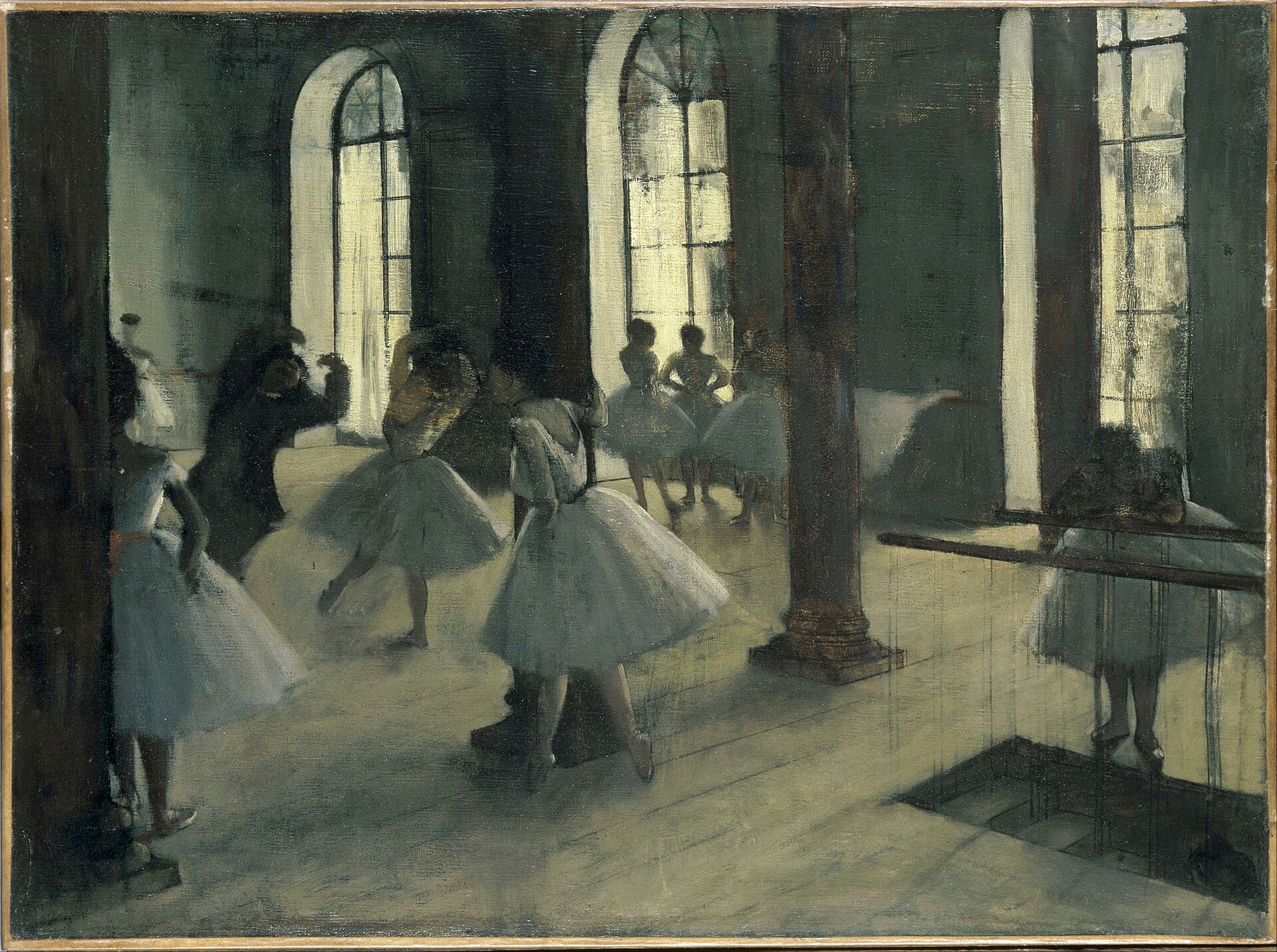
Dance Rehearsal in the Foyer shows a tall, greenish-grey practice room at the Paris Opéra during a rehearsal. Three tall arched windows at the back let in a pale daylight, a heavy brown column stands right of centre, a wooden barre runs along the right-hand wall, and at the lower right a dark rectangular hole opens in the floor. On the left a dancer stands on a low block, in the middle two lean towards one another, and at the barre on the right one lies across it with her head on her arms. Nearly half the canvas is empty floor. The original is an oil work on canvas and is held by The Phillips Collection in Washington under inventory number 2001.014.0001. Ours is made by hand in eight sizes from 27 x 20 to 150 x 110 cm, or to your own measurement, and you receive a photograph of the finished work for approval before it ships.
| Title: | Dance Rehearsal in the Foyer |
| Other titles: | Danseuses à l’exercice, Dance Rehearsal |
| Painter: | Edgar Degas (1834–1917) |
| Year: | 1873–1875 |
| Size of the original: | 40.6 cm x 54.6 cm |
| Technique of the original: | oil, canvas |
| Style: | impressionism |
| Where it hangs: | The Phillips Collection, Washington (inv. 2001.014.0001) |
| Our version: | hand-painted in oil on linen, 8 sizes from 27 x 20 cm to 150 x 110 cm, custom size on request |
Dance Rehearsal in the Foyer – Edgar Degas
Who is in the scene?
Nine or ten dancers and one dark figure; none of them is named. At the far left a dancer stands on a low dark block, one hand on her hip, a red ribbon at her waist. Left of centre stands a figure in black with a raised arm; whether that is the ballet master or a musician, the scene does not say, and the record names nobody. In the middle two dancers stand close together, one bending forward. By the windows at the back stand three or four more, one with her hands on her hips. On the right at the barre one lies across it with her head on her arms, and beyond her another stands.
What is on the canvas?
A tall room, painted thin, so that the weave of the canvas shows through the colour. Three tall arched windows at the back carry a pale light, and at the right edge stands a further, taller rectangular window. Right of centre a heavy brown column with a moulded base runs the full height of the scene. Along the right-hand wall runs the wooden barre, and beside it vertical runs of paint trail down the floor. At the lower right a dark rectangular hole opens in the floor. The colours are held back: greenish-grey wall, dirty-white skirts, pale yellow windows, brown column. Nearly half the surface is empty floor.
Why does this scene matter?
Because the room is mostly empty, and still the eye cannot leave the dancer lying across the barre with her head on her arms. Rehearsal here is work, not performance: a big cold room, light arriving from behind and only outlining the figures, and bodies that rest as much as they move. Degas puts nobody at the centre and singles nobody out; instead he lets the bare floor take half the scene. It is precisely that emptiness that makes the tiredness at the barre visible.
What does the scene mean?
The labour the audience never sees. Impressionism in Degas meant a cut taken from the instant as the eye sees it from one particular place, and that place here is a corner of the practice room, not a box. An impressionist painting of this kind shows the trade, not the performance. As wall art it reads quiet and collected; the held-back colours make it one of the calmest subjects people choose for a bedroom or a study. Anyone wanting a large painting that lowers the temperature of a wall rather than raising it will find one here. The scene wants a little distance, so the figures separate from the wall.
The subject among Degas’s works
Practice rooms and stages form a whole family of works in Degas. The Ballet Class shows the same work from closer in and with more figures, Ballet Rehearsal on Stage moves the rehearsal onto the stage, and Orchestra Musicians shows the same day from a seat in the pit. The work is recorded in the Degas catalogue raisonné as MS 209, and a practice-room scene of the same years is at the Art Institute of Chicago.
How is our hand-painted version made?
With a brush and oil paint, not a printer. The original is oil on canvas, so the same technique as ours, except that in Degas the paint lies extraordinarily thin and the weave comes through it. That is exactly what we try to keep: we build the walls and the floor out of sparse, translucent layers so the scene stays cold and airy, and we paint the skirts with lean, light colour so they stay weightless. Two passages are the hardest: the windows, which must be bright without being white, and the column, which has to carry weight without turning black. The dancer lying across the barre we leave until last, because she is the one the eye stops on. Every reproduction is painted afresh, and no two are quite alike, because a hand does not repeat the same stroke twice; each hand-painted copy is therefore its own. For this work we have no photographs of our finished canvases, so none are shown here and none are described. You receive the photograph of your own canvas before it ships.
Which size for which wall?
If you do not know which: 60 x 45 cm. The original is 40.6 x 54.6 cm; our 50 x 40 cm is closest to it in size, while in proportion the closest is 27 x 20 cm — which is unusual on this work: the size-nearest rung is at the same time among the furthest in proportion, so we name the two separately. The 27 x 20 cm is small and belongs on a shelf or in a narrow strip between two windows. The 50 x 40 and 60 x 45 cm are the usual choice above a sideboard; at 60 x 45 cm the figure at the barre already reads clearly. The 70 x 50 and 80 x 60 cm want a broader wall. The 100 x 75 cm is the real room for this subject, because the empty floor gets its weight. The 120 x 90 and 150 x 110 cm are already at the scale where a canvas painting changes a room and the figures come close to life size. Measure the size you choose on the wall first with a paper cut-out. No size is kept in stock as a finished piece: every copy is painted to order and stays a single piece.
Custom size, stretcher and frame
If none of the eight sizes fits, or if you want the exact proportion of the original, we paint to your measurement and keep the proportions of the scene as we do, so that the column stays where it is and the empty floor at the lower right does not lose its share; this is our work painted to order. Every piece ships stretched on a wooden stretcher, ready to hang. For the frame, use our 3D app: it shows every moulding we carry on this subject, so you can compare gold, silver, black, white and natural wood — it is for choosing a frame and nothing else. If you want to see how the work looks on your own wall, we have a separate service for that, placement in the room.
Delivery and guarantee
Every piece is painted to order in our workshop in Slovenia, so allow 15-45 days depending on the size chosen; at the largest sizes the time is usually at the upper end. It travels stretched and protected for transport, framed if you chose a frame, to sixteen countries in the European Union, with no customs. Before it ships you receive a photograph of the finished work for approval, and our returns policy applies to every order. The painter’s full offer is in the Edgar Degas gallery, and his life is described in our article about Edgar Degas.
Frequently asked questions
What is happening in the scene?
A rehearsal in the practice room. Some dancers are working, others stand or rest; there is no performance.
Who is the figure in black?
The record names nobody. Left of centre stands a dark figure with a raised arm; whether ballet master or musician, the scene does not say.
Why is one dancer lying across the barre?
She is resting. Her head is down on her arms, and it is this figure the eye stops on.
What is the dark hole in the floor?
A rectangular opening at the lower right leading below the room. Degas painted it as a dark hole, with no explanation.
Where is the original?
In The Phillips Collection in Washington, under inventory number 2001.014.0001.
How big is the original?
40.6 x 54.6 cm. Our 50 x 40 cm is the closest to it in size.
Why is the year given as a range?
Because that is how it is recorded: 1873–1875. Where a record gives a range, we keep it and do not squeeze it into a single year.
Do your sizes follow the proportion of the original?
Mostly very well; our most common size, 50 x 40 cm, is the exception and is squarer. In proportion the closest is 27 x 20 cm.
Is this a print?
No. The work is made by hand in oil; the brushstrokes are visible and can be felt.
Can I have a size that is not on the list?
Yes, we paint to measurement and keep the proportions of the scene as we do.
Is it suitable as a gift?
Yes, especially for someone who dances or goes to the ballet. Because every piece is painted to order, allow for the making time; if you would rather leave the choice to the recipient, there is our voucher.
- Subject: a practice room at the Paris Opéra during rehearsal, dancers at the windows and one lying across the barre
- Original: Edgar Degas, oil work on canvas, 40.6 x 54.6 cm, The Phillips Collection, Washington (2001.014.0001)
- Ours: painted by hand in oil, eight sizes from 27 x 20 to 150 x 110 cm, stretched and framed on request
- Note: nearly half the canvas is empty floor, and at the lower right a dark hole opens in it