





Description
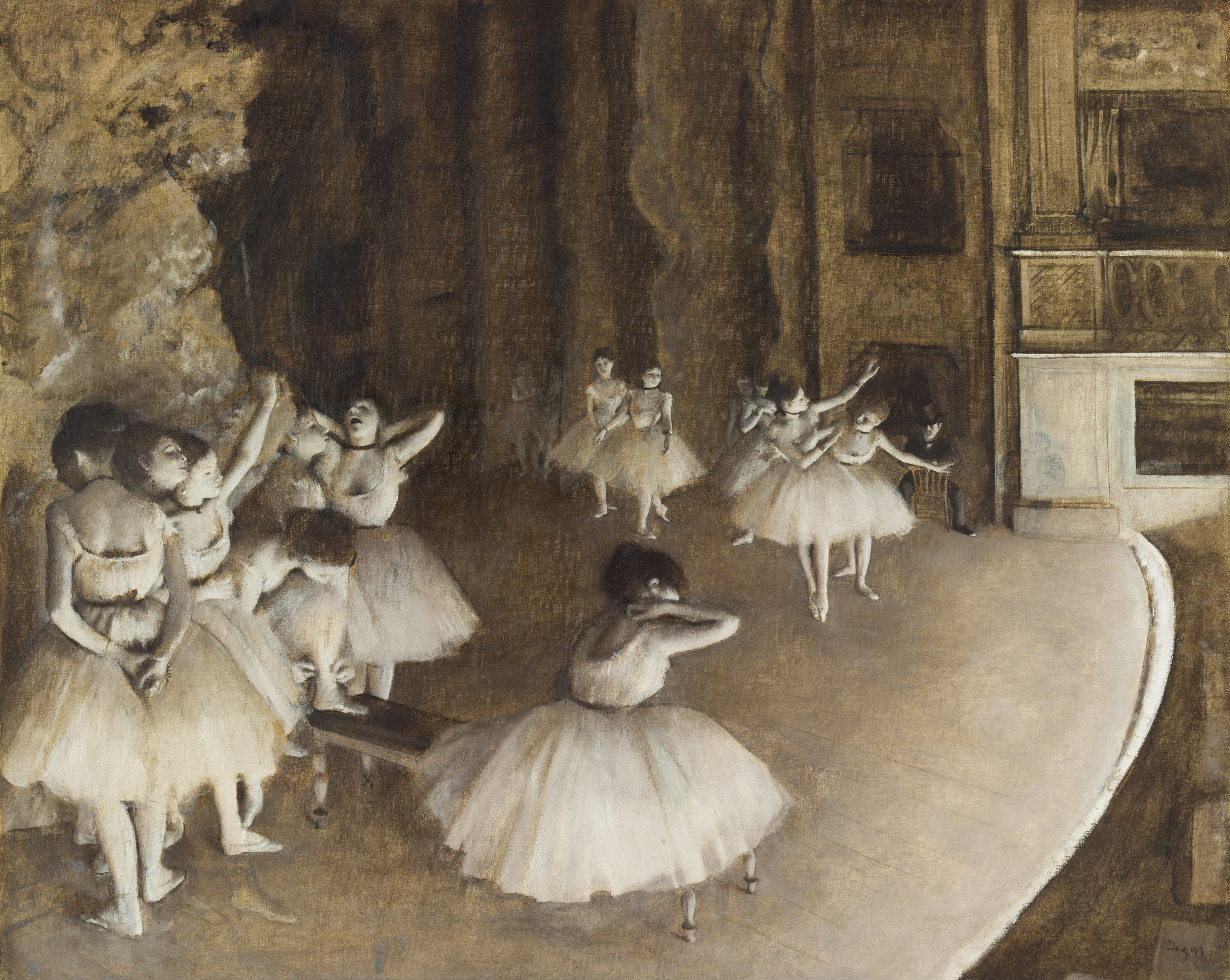
Ballet Rehearsal on Stage shows dancers during a rehearsal on an almost empty stage: at the left a cluster of girls in pale skirts crowds together, one tying her shoe, another stretching, in the centre a single dancer stands turned away from us, and at the right a line of others is practising. As a canvas painting this is a landscape-format scene painted almost without colour – in browns, ochres and creams. The original is oil on canvas and is held in the Musée d’Orsay in Paris under the inventory number RF 1978. We make it as a hand-painted work on linen, in sizes from 50 x 40 to 180 x 150 cm or to your own measurements, and you receive a photograph of the finished work for approval before dispatch.
| Title: | Ballet Rehearsal on Stage |
| Other titles: | Répétition d’un ballet sur la scène |
| Painter: | Edgar Degas (1834–1917) |
| Year of execution: | 1874 |
| Original size: | 65 cm x 81,5 cm |
| Original technique: | Oil on canvas |
| Painting style: | Impressionism |
| Located at: | Musée d’Orsay, Paris (inv. no. RF 1978) |
| Our reproduction: | hand-painted oil on linen canvas, 7 sizes from 50 x 40 cm to 180 x 150 cm, custom sizes on request |
Ballet Rehearsal on Stage – Edgar Degas
Who is shown?
About fifteen dancers, none of them named. This is not a performance but a rehearsal, and that is exactly why the attitudes are so unordered: at the left one sits tying her shoe, a second stretches with her arms raised, a third scratches her back, the rest wait. In the centre stands a single ballerina, turned away from us, her hands at her hair. At the right a line of dancers practises with raised arms, and at the edge of the stage sits a dark male figure – the only spectator in the scene. Nobody looks out at us.
What is on the canvas?
The first thing you notice is the absence of colour. The whole canvas is carried in browns, ochres, greys and creams, almost like a drawing – the only really coloured thing is the warm ground of the stage. At the lower right the empty stage opens in a wide arc, and that curve carries the entire composition. Above hang dark flats and a painted rocky set, and at the right the architecture of the proscenium is visible: a pale decorated box front and a rectangular opening. At the left, among the cluster of girls, stands a low bench. At the lower right is the signature.
Why does this particular scene matter?
Because it shows the ballet from the wrong side. The audience sees the performance; Degas painted what comes before it – the waiting, the shoe being fixed, the scratching, the boredom. The empty stage in the lower half takes up nearly a third of the canvas and is filled with nothing at all: that is a nerve almost nobody had in those years. The absence of colour is not unfinishedness but a decision – without costumes and stage light, only the movement of bodies is left, and that is exactly what interested Degas.
What does the scene mean?
Work, not performance. Every figure is doing something of her own and none of them poses. Impressionism for Degas always meant a cutting caught as the eye sees it and not as composition arranges it; an impressionist painting of this kind therefore reads as a look from the wings rather than a scene from the stalls. As wall art it carries a room through movement and light rather than through colour.
The motif among Degas’s works
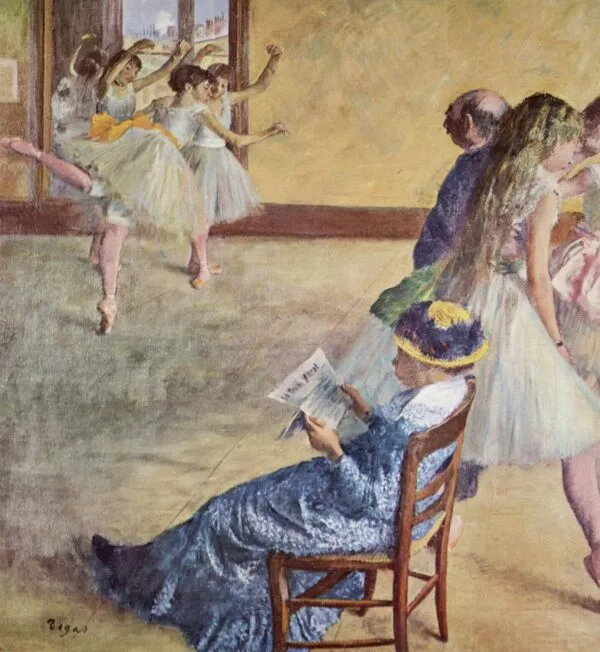
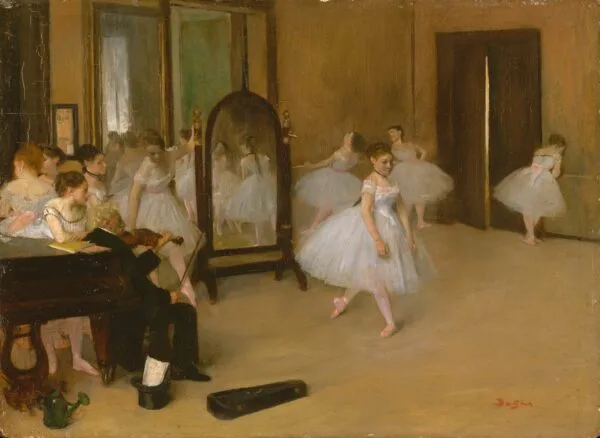
The ballet is Degas’s largest subject, and every canvas catches it differently. The Dancing Class and The Ballet Class show the same rehearsal in a room instead of on the stage, with the master among the girls; Dance Rehearsal in the Foyer moves the same moment into the practice room. How Degas watched the ballet from the stalls, over the heads of the strings, is shown by Ballet at the Paris Opéra at the Art Institute of Chicago, while Ballet Dancers at the National Gallery in London shows the same subject in colour.
How is our hand-painted version made?
With a brush and oil colours, not a printer, and here the technique of the original is the same as ours. Every one of our canvases is made layer after layer, and in this scene it is the narrow range that is demanding: when everything sits in brown and cream, any error of value shows at once. The skirts have to stay translucent and the stage warm enough not to turn grey. Every reproduction is made afresh and no two copies are ever quite the same, because the hand does not repeat the same stroke twice; every hand-painted copy is therefore its own. For this work we have no photographs of our finished canvases, so we show and describe none here. The photograph of your canvas reaches you before dispatch.
Which size for which wall?
If you do not know which: 80 x 65 cm – that is effectively the size of the original, which measures 65 x 81,5 cm. The 50 x 40 and 60 x 50 cm sizes are for a smaller room or a hallway, where the individual figures already become hard to tell apart. The 70 x 60 and 80 x 65 cm sizes are the most usual choice above a chest of drawers or a desk. The 90 x 70 and 100 x 80 cm sizes are for a larger wall, where the empty stage at the lower right really opens out and the scene breathes. The 180 x 150 cm size is for the wall above a sofa or a long wall, where the dancers stand close to life size; a large painting of this kind needs a few metres of distance. Measure your chosen size on the wall with a paper cut-out first; with a landscape format the mistake is usually made in the width. None of the sizes is held in stock as a finished item: every copy is made to order and stays a single piece.
Custom size, stretcher bar and frame
If none of the seven sizes suits your wall, we paint to your measurements and keep the proportions of the scene, so that the empty stage at the lower right keeps its space and the cluster at the left is not squeezed; that is our painting made to order. Every copy is delivered stretched on a wooden bar, ready to hang. For the frame, use our 3D application: on this motif it shows every moulding profile we carry, so you can compare gold, silver, black, white and natural wood – it is for choosing a frame and nothing else. If you want to see how the work looks on your own wall, that is our separate room-placement service.
Delivery and guarantee
Every copy is made to order in our studio in Slovenia, so allow 15 to 45 days depending on the size you choose; for the largest sizes the time is usually at the upper end. We send it stretched and protected for transport, framed if you chose a frame, to sixteen countries in the European Union, without customs duties. You receive a photograph of the finished work for approval before dispatch, and our returns policy applies to every order. The whole range is in the Edgar Degas gallery, and the painter’s life is described in our article about Edgar Degas.
Frequently asked questions
What is happening in the scene?
A rehearsal, not a performance. Some of the dancers are practising, some are waiting, one is tying her shoe and one is stretching.
Why is the work almost without colour?
Because it was painted that way. The scene is carried in browns, ochres and creams; without costumes and stage light, only the movement of bodies is left.
Who is the dark figure at the right?
A man seated at the edge of the stage, the only spectator in the scene. Degas did not name him, and neither do we.
What is the empty space at the lower right?
The stage. Its wide arc takes up nearly a third of the canvas and carries the whole composition.
How many dancers are there?
About fifteen, arranged as a cluster at the left, a single figure in the centre and a line at the right.
Where is the original located?
In the Musée d’Orsay in Paris, under the inventory number RF 1978.
How large is the original?
65 by 81,5 cm. Our 80 x 65 cm size is effectively the same.
Is this a print?
No. The work is painted by hand in oil colours; the brushstrokes are visible and can be felt.
Which size should I choose?
Above a chest of drawers usually 80 x 65 cm, for a smaller room 60 x 50 cm. The size guide is above.
Can I have a size that is not listed?
Yes, we paint to measure and keep the proportions of the scene while doing it.
Is it suitable as a gift?
Yes, especially for a dancer or for someone who likes quiet, light scenes. Because every copy is made to order, allow for the making time; if you would rather leave the choice to them, there is our gift voucher.
- Subject: dancers rehearsing on an almost empty stage, a cluster at the left, a single figure in the centre, a line at the right
- Original: Edgar Degas, an oil painting on canvas, 65 x 81,5 cm, Musée d’Orsay in Paris (RF 1978)
- Ours: hand-painted in oil, seven sizes from 50 x 40 to 180 x 150 cm, stretched and framed on request
- Worth knowing: the empty stage at the lower right takes up nearly a third of the canvas – almost nobody risked that much emptiness in those years