





Description
Stylized Flowers is a 1908 painting by Egon Schiele: a tall, faceted plant in violets and deep purples with small orange accents on thin stems, set against a shimmering ground of silver and gold. The original, 65.5 x 65.5 cm, is in the Leopold Museum in Vienna. We paint it by hand in oils on canvas at the size you choose, and before dispatch we send you a photograph of the finished work for approval.
| Title: | Stylized Flowers |
| Other titles: | Stylized Flowers in Front of Decorative Background · Stilisierte Blumen vor dekorativem Hintergrund |
| Painter: | Egon Schiele (1890–1918) |
| Year: | 1908, signed and dated lower right “SCHIELE. EGON 1908” |
| Original size (width × height): | 65.5 cm x 65.5 cm |
| Original technique: | Oil, silver and gold pigments on canvas |
| Style: | Art Nouveau |
| Location: | Leopold Museum, Vienna (inv. 474) |
| Our reproduction: | hand-painted oil on canvas, 13 sizes from 50 x 50 cm to 160 x 160 cm, or a made-to-measure size |
Stylized Flowers – Egon Schiele
What does the painting show?
A single tall plant rises from the lower edge almost to the top of the square. Its body is built from broad, angular planes in lilac, violet and near-black purple, stacked like folded paper or cut stone, with a few dark openings between them. Thin grey-violet stems climb out of it on both sides and at the top, carrying small pointed orange shapes. The ground behind is flat and decorative: an upper field of silvery olive-grey with a metallic shimmer, crossed in the lower half by a broad horizontal band of gold, with further gold bars at the lower right and grey-green areas below. At the lower right, in small block letters, the Austrian painter signed SCHIELE EGON and added the year 1908.
Why do people love it?
Because it is so bold for a student work. The colour chord is simple and strong: violet against gold, with the orange as a spark, and the metallic ground changes as the light moves across it. The plant is not a botanical study but a figure, upright and sculptural, almost like a person standing in a room. For anyone who loves Vienna around 1900, it catches the moment when Schiele still spoke Klimt’s decorative language and was already reaching past it.
Where does it sit among Schiele’s works?
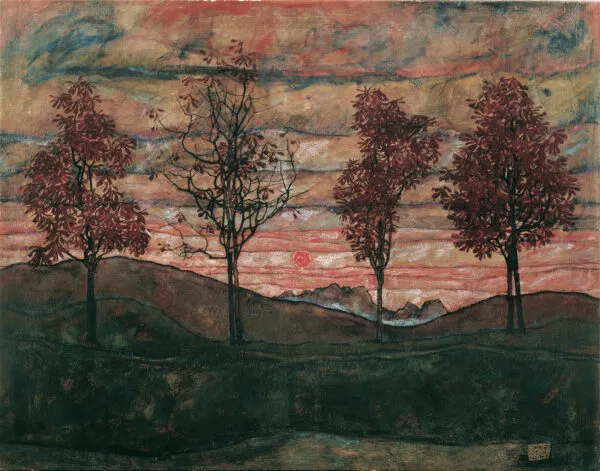
At the very start of his career, while he was still a student at the Vienna Academy. A few years later the same upright, isolated form had become his own language, as in Self-Portrait with Physalis of 1912; his later plants and trees, such as Small Tree in Late Autumn and Four Trees, keep his interest in slender, upright forms. The full selection is in the Egon Schiele gallery, and there is more on his life in our article about Egon Schiele.
How is our hand-painted version made?
Each copy is a hand-painted painting made for your order, not a print: one of our painters builds it up in oils, stroke by stroke. Our copy is oil on canvas. The hardest part here is the ground: the silvery and golden fields have to keep their slight shimmer and their flat, even surface, so that the plant stands out against them as clearly as in the original. The planes of the plant need clean edges and several distinct violets, from an almost white lilac to near black. When the work is finished we photograph it and send you the photograph for approval, and only then does it ship. We have not yet photographed this work in our workshop; photographs will be added to this page once we have them.
Which size for which wall?
The original measures 65.5 x 65.5 cm, so our 65 x 65 cm is almost exactly its size. The smaller 50 x 50 cm or 60 x 60 cm suit a hallway, a bedroom or a wall of shelves; in a living room above a sofa or a sideboard, 90 x 90 cm or 100 x 100 cm carry the violet and gold across the room; for a large wall or an entrance hall there are the sizes from 130 x 130 cm to 160 x 160 cm. A canvas painting with a gold-toned ground likes warm light and a calm, light-coloured wall. Hang it with the centre at eye level, about 145–150 cm from the floor.
Custom size, stretcher bar and frame
If none of the thirteen sizes suits your wall, we paint the work to your own measurement. If you choose “YES” under the Stretcher option, the canvas comes stretched on a wooden stretcher bar, ready to hang. Our 3D application is for choosing a frame only. The frame is chosen separately and need not be part of the order.
Delivery and guarantee
We paint to order and deliver to sixteen countries in the European Union, among them Slovenia, Croatia, Austria, Italy, Hungary, Germany and France; the United Kingdom and Ireland are not currently among them. The work arrives protectively packed and, if you chose “YES” under Stretcher, stretched on a stretcher bar. Before dispatch we send you a photograph of the finished work to approve. Production time depends on the size and on the studio’s workload. Every order is covered by our Returns and Refund Policy.
Frequently asked questions
When did Schiele paint it?
In 1908, while he was a student at the Vienna Academy of Fine Arts, at the age of seventeen or eighteen. He signed and dated it at the lower right: SCHIELE. EGON 1908.
Why does it look like Klimt?
At that time Schiele was still very close to Gustav Klimt. The square canvas was a favourite format of Jugendstil and of Klimt’s landscapes, and the flat, ornamental ground with silver and gold follows his example. According to the Leopold Museum, the upright silhouette of the plant already points ahead to the figure paintings of 1909–10, in which Schiele broke with Klimt’s style.
Which flower is it?
The titles do not name a species; the museum calls them simply stylized flowers in front of a decorative background. The leaves are deliberately unnatural, in colour as well as in form: the museum describes them as caught while wilting, bulging around the stem.
Where is the original?
In the Leopold Museum in Vienna, under inventory number 474. It is painted in oil with silver and gold pigments on a square canvas of 65.5 x 65.5 cm.
Who owned it before the Leopold Museum?
The museum’s provenance begins with an undated auction at the Dorotheum in Vienna and then names Max Morgenstern in Vienna and London from 1930, Hertha Morgenstern in London from 1946 and Bob Morton in Preston, England, from 1962. Rudolf Leopold held it from 1970, and in 1994 it passed to the Leopold Museum Private Foundation.
Does it work as a gift?
Yes; if you are unsure which size to choose, there is a gift voucher.