


Description
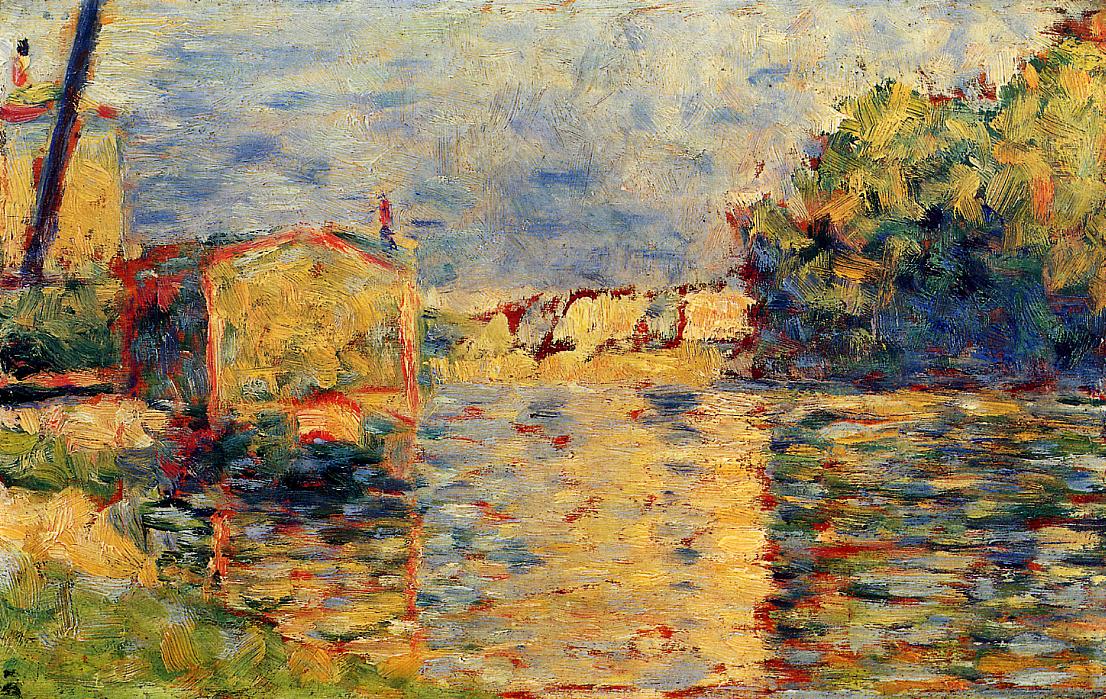
Banks of the Seine near Courbevoie is a painting by Georges Seurat from c. 1883: a calm river catching the light, a small house by the water on the left, perhaps a boathouse, dense trees on the right, and in the distance a bright bank with low walls. The original, oil paint on a small panel, measures just 24.8 x 15.9 cm and is held by The Hyde Collection in Glens Falls, New York, under number 1971.45. We make it as a canvas painting, painted by hand in oils, in five sizes or to your own measurements; before dispatch you receive a photograph of the finished work for approval.
| Title: | Banks of the Seine near Courbevoie |
| Other titles: | Banks of the Seine near Courbevoie – the title the museum itself uses |
| Painter: | Georges Seurat (1859–1891) |
| Year painted: | c. 1883 |
| Original size: | 24.8 cm x 15.9 cm |
| Original technique: | Oil on panel |
| Painting style: | Short, broad, criss-crossing brushstrokes of pure colour |
| Located at: | The Hyde Collection, Glens Falls, New York (inv. no. 1971.45) |
| Our reproduction: | hand-painted oil on canvas, 5 sizes from 25 x 16 cm to 80 x 50 cm, custom size on request |
Banks of the Seine near Courbevoie – Georges Seurat
What does the painting show?
A river and its bank, with no people in the foreground. Calm, bright water fills the lower half, with a broad band of reflection in the middle that spreads into horizontal patches towards the bottom edge. On the left, by the water, stands a small house with light, yellowish walls and a red-edged roof; on its ridge is a tiny upright shape, perhaps a little flag or an ornament. Below it a dark reflection lies in the water, and at the waterline a reddish arch shows, perhaps an entrance or an opening into a boathouse. Further left a tall, dark pole, perhaps a mast, slants up towards the top edge beside the edge of a light building, and at the very top left a tiny red and white mark that could be a flag. At lower left a grassy bank slopes down. On the right a dense mass of trees and bushes, reaching down to the water, takes up almost a third of the painting. In the middle, between house and trees, a bright far bank with low walls or houses, touched with reddish accents, stretches into the distance. Above is the sky, bluish grey and threaded with light strokes.
What is on the panel?
A small horizontal panel, 15.9 cm high and 24.8 cm wide, as the museum record states; framed, it measures 28.9 x 37.5 cm. Seurat painted it in short, broad strokes that cross in every direction: dense and restless in the trees, horizontal in the water, long and slightly slanting in the sky. The colours sit side by side, green beside blue, yellow beside red, and do not blend into flat areas. The red dots and dashes scattered across the water and along the outline of the house are especially lively. Anyone expecting the pointillism of even, round dots from Seurat will find quick, relaxed painting here, in which the strokes are still elongated and of different sizes. The photograph in this listing has strong colours; colours on screen may differ from the original, so take them as a guide, not a sample.
Why does this painting matter?
Because in a small format it shows how the French painter Georges Seurat builds a scene from strokes of colour alone. There is no story on the panel and no precise detail; the house, the trees and the bank are suggested with a few decisive strokes, while the water is made of patches of light and reflection. The composition is simple and clear: the darker mass of trees on the right balances the house and the pole on the left, and between them the eye drifts off into the bright distance. The museum record dates it to c. 1883. For a buyer it is a fresh, sunny river landscape that keeps all the liveliness of quick painting.
What does the painting mean?
Summer calm by the river. The water is smooth, no one is in sight, the small house stands quietly on the bank, and the trees cast a shade in which you can almost imagine the cool. The painting tells no story; it catches a moment of light on water. The eye first falls on the bright band of reflection in the middle, then travels to the house and the trees and comes to rest in the distance. At home it feels warm and bright; its greens, blues and yellows go well with wood, white walls, linen and plants, especially in rooms where you want a sense of summer all year round.
What place does it have among Seurat’s works?
The place in the title also appears in the titles of other Seurat paintings we offer. The Bridge at Courbevoie is held by The Courtauld Gallery in London, and the title of The Seine at Courbevoie names the same place and the same river. The river is also the subject of View of the Seine, held by the Metropolitan Museum of Art in New York. Beside them, Banks of the Seine near Courbevoie is a small panel on which the scene is caught in a few strokes. For several of Seurat’s river scenes on one wall, it can hang next to any of them.
How is our hand-painted version made?
With a brush and oil paint, never with a printer. Our painter works from an image of the original and first lays out the large areas: the water, the trees on the right, the house and the pole on the left, and the bright bank in the distance. These are then filled with short, crossing strokes, horizontal in the water and restless in the foliage, while the red dots are kept clean and separate. A pointillist technique with even, round dots would be the wrong choice here, because the original has none; we follow the quick, broad strokes you see on the panel. We take particular care with the bright band of reflection in the middle, which must stay luminous without looking empty. Because everything is done by hand, no two canvases are ever quite the same, and every hand-painted copy is one of a kind. We have no photographs of our own of a finished canvas of this subject yet; when we first paint it, we will photograph it and publish the photographs here.
Which size for which wall?
If you are not sure which to choose, take 60 x 40 cm. Closest to the original is our smallest size, 25 x 16 cm: the original measures 24.8 x 15.9 cm, and ours is 0.2 cm wider and 0.1 cm taller. The horizontal format sits well above a narrow chest of drawers or a desk, or in a group of smaller works. 25 x 16 cm is for shelves, bedside tables and small corners where you look at the painting up close; 50 x 30 and 60 x 40 cm are the most popular choices for a hallway or bedroom; 70 x 45 and 80 x 50 cm hold their own above a bed or sofa and show the brushstrokes at full strength. Every oil painting reproduction of this subject is made to order.
Custom size, stretcher bar and frame
If none of the five sizes suits your wall, we paint to your measurements, up to 80 x 50 cm, and keep the proportions of the original, so that the house, the trees and the water stay in balance; that is our custom size painting service. You can order the painting in three forms: as a rolled canvas without a stretcher, stretched on a wooden stretcher bar and ready to hang, or framed; you choose the form when you order. You choose a frame in our 3D app, which shows gold, silver, black, white and wooden profiles on this subject; the app is for choosing the frame only. Seeing the painting on your own wall is a separate service, our room visualisation.
Delivery and guarantee
We paint each canvas to order in our studio in Slovenia, so allow 15 to 45 days depending on the size. It is shipped in the form you chose when ordering — rolled, stretched or framed — protected for transport, within Slovenia and across the EU with no customs duty. Before dispatch you receive a photograph of the finished work for approval, and our returns policy applies to every order. All of Seurat’s subjects are in the Georges Seurat gallery, and our article about Georges Seurat explains how to tell a good fine art reproduction of a famous painting.
Frequently asked questions
Where is the original?
In The Hyde Collection in Glens Falls, New York, under number 1971.45. The museum lists it with the line »The Hyde Collection Trust, 1952«.
Are there people in the painting?
Not in the foreground. The tiny shapes on the ridge of the house and at top left beside the pole could be little flags or ornaments; the museum record does not explain them.
How big is the original?
Very small: 24.8 cm wide and 15.9 cm high, 37.5 x 28.9 cm framed. The museum gives the measurements the other way round, height before width.
Is this a print?
No. It is hand-painted oil on canvas; the brushstrokes are visible and can be felt.
Which size should I choose?
For a hallway or bedroom, 60 x 40 cm; for the size closest to the original, 25 x 16 cm. The detailed guide is above.
Can I have a size that is not on the list?
Yes. We paint to measure and keep the side ratio of the original.
Is this neo-impressionism?
The museum record does not assign the painting to a movement, so neither do we. What is visible is a surface of short strokes of pure colour placed side by side.
Why is the painting so small?
The museum record does not say. It states only that it is painted in oil on a panel measuring 15.9 x 24.8 cm.
Is the original for sale?
No. The panel is in the museum’s collection and is not for sale, but we can paint its subject by hand for your home.
How high should I hang it?
With its centre at eye level, about 145–150 cm from the floor; hang the smaller sizes lower, nearer to where you sit.
Is it a good gift?
Yes, especially for someone who loves rivers, water and summer landscapes. If you would rather leave the choice to the recipient, there is our gift voucher.
- Subject: a calm river with reflections, a small house by the water, dense trees and a bright bank in the distance – c. 1883
- Original: 24.8 x 15.9 cm, oil paint on panel, The Hyde Collection, Glens Falls, New York (inv. no. 1971.45)
- Ours: hand-painted, five sizes from 25 x 16 to 80 x 50 cm, as a rolled canvas, stretched or framed — your choice
- Worth knowing: the panel the original is painted on is smaller than a sheet of A4 paper