







































Description
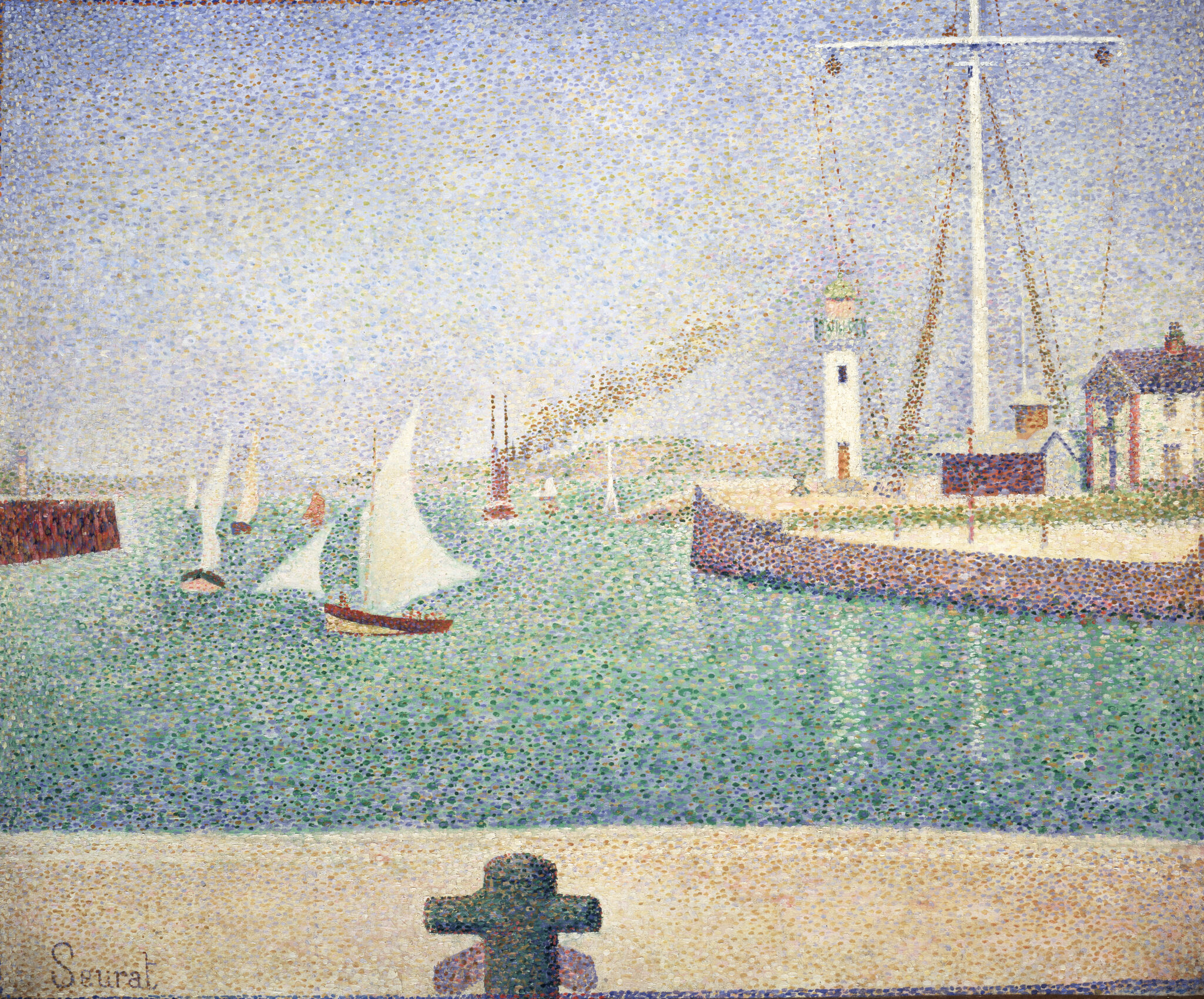
Entrance to the Port of Honfleur is a painting by Georges Seurat from 1886: across wide, greenish water we look towards the harbour entrance, where sailing boats are under way; a white lighthouse stands on the jetty at right, and a dark mooring bollard sits in the foreground. The original, oil paint on canvas, measures 65.1 x 54.3 cm and is held by the Barnes Foundation in Philadelphia under number BF942. We make it as a canvas painting, hand-painted in oils, in eight sizes or to your own measurements, and before dispatch you receive a photograph of the finished work for approval.
| Title: | Entrance to the Port of Honfleur |
| Other titles: | »Entrance of The Port of Honfleur (Entrée du port d’Honfleur)« |
| Painter: | Georges Seurat (1859–1891) |
| Year painted: | 1886 |
| Original size: | 65.1 cm x 54.3 cm |
| Original technique: | Oil on canvas |
| Painting style: | Small dots of pure colour placed side by side |
| Located at: | Barnes Foundation, Philadelphia (inv. no. BF942) |
| Our reproduction: | hand-painted oil on canvas, 8 sizes from 46 x 38 cm to 150 x 120 cm, custom size on request |
Entrance to the Port of Honfleur – Georges Seurat
What does the painting show?
A view across the water to the harbour entrance. Across the foreground runs a light, sand-coloured band of jetty or shore, with a dark, squat mooring bollard and its short shadow in the middle. Behind it, greenish water fills almost half the painting. On the left the end of a reddish-brown jetty juts out of the water. On the right a long, low jetty carries a slender white lighthouse with a lantern, a small dark building and a house with a steep roof and chimneys. In front of the lighthouse rises a tall white mast with rigging and a yard, reaching almost to the top edge. White-sailed boats move across the water; in the largest, red-hulled one left of centre sits a tiny figure. Further back are smaller sails, a reddish sail and a steamer whose smoke trails in a long diagonal band across the middle towards the lighthouse. On the horizon rises a low, pale, hilly coast. A light, even sky fills the upper half.
What is on the canvas?
A horizontal canvas covered entirely with dots of colour. Seurat paints here not with strokes but with thousands of small dots of almost equal size, set close together; the sky, the water, the jetties, the sails and even the steamer’s smoke are all made this way. Today this is called pointillism. The water is built from green, blue and light dots, the sky from pale blue, pink and yellowish ones, the foreground band from warm ochres and pinks. Close up you see only dots; a few steps back they merge into water, light and air. Darker dots draw the edges of things: the bollard, the hulls, the jetties and the lighthouse. Below the right-hand jetty the mast and lighthouse show as pale reflections in the water. At lower left a signature, »Seurat«, is visible in the photograph; the museum record does not describe it. The museum gives the size as 54.3 x 65.1 cm (21 3/8 x 25 5/8 in.), height before width. Colours on screen may differ from the original, so treat them as a guide, not a sample.
Why does this painting matter?
Because it shows how the French painter Georges Seurat builds a whole lively scene out of dots alone: water, boats, lighthouse, houses and smoke. Nothing is drawn with a line, yet everything is legible. The composition is just as clear: horizontal bands of jetty, water, horizon and sky lie one above another, crossed by three upright forms: the bollard at bottom centre, and the lighthouse and the tall mast on the right. The sailing boats are on the left half, the lighthouse and mast on the right, so neither side dominates. For a buyer it is a subject that holds the eye: at first a bright day in a harbour, then, on a second look, the tiny figure in the boat, the reflections and the band of smoke linking the two sides.
What does the painting mean?
A bright, calm day by the sea in which something is nevertheless happening. The viewer stands on the jetty, just behind the bollard, as if waiting for a boat. Ahead, sailing boats come or go and the steamer leaves smoke behind it, while on the right the lighthouse and the houses stand motionless. Movement and stillness meet in one painting. With its light sky and greenish water it feels fresh and airy, and at home it goes well with white and pale walls, blue and green fabrics, wood and plants, especially where you want a hint of the sea.
What place does it have among Seurat’s works?
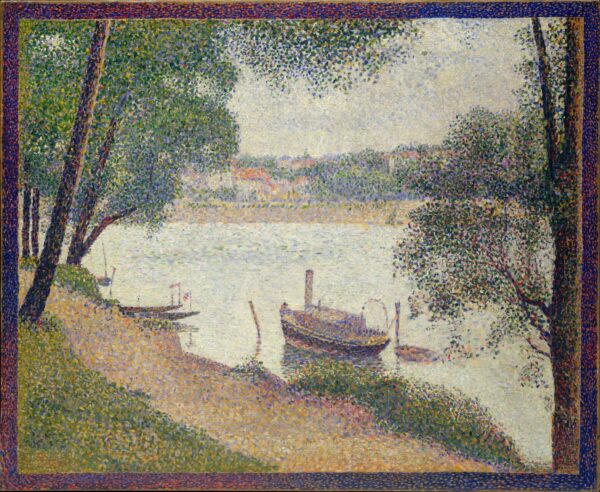
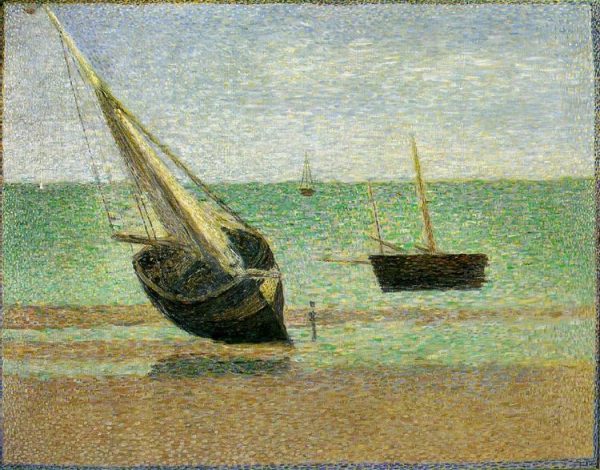
The museum record dates it to 1886 and lists it as »Entrance of The Port of Honfleur (Entrée du port d’Honfleur)«. Honfleur is also in the title of Evening, Honfleur, held by the Museum of Modern Art (MoMA) in New York. Judging by their titles, water and coast are the subject of two more paintings we offer: Boats, Low Tide, Grandcamp and The Channel at Gravelines, Evening, also at MoMA in New York. If you want several Seurat waterside scenes, this one can hang beside any of them; a bright daytime view pairs well with paintings that carry evening in their titles.
How is our hand-painted version made?
With a brush and oil paint, never by machine. Our painter works from an image of the original and builds the surface from small dots, as in the photograph: first the main areas, jetty, water, horizon and sky, then colour dot by dot. A pointillist technique calls for patience here, because the thin rigging of the mast, the tiny figure in the boat and the smoke drifting towards the lighthouse must all be painted in dots too. The white sails and the lighthouse must stand out from the greenish water, and the light sky must stay airy without looking empty. Because everything is done by hand, no two canvases are ever quite the same, and every hand-painted copy remains one of a kind. We have no photographs of our own of a finished canvas of this subject yet; when we first paint it, we will photograph it and publish the photographs here.
Which size for which wall?
If you are not sure which to choose, take 60 x 50 cm. It is the size closest to the original: the original measures 65.1 x 54.3 cm, and ours is 5.1 cm narrower and 4.3 cm lower. The next size up, 70 x 60 cm, is 4.9 cm wider and 5.7 cm taller; choose it for a painting slightly larger than the original. The format is horizontal, so it fits above a sofa, a chest of drawers or a bed. 46 x 38 and 50 x 40 cm suit smaller walls, hallways and work corners; 60 x 50 and 70 x 60 cm fill a bedroom or dining-room wall on their own; at 80 x 65 and 90 x 75 cm the dots and sailing boats read well even from a distance; 120 x 100 and 150 x 120 cm are for large living rooms, where the harbour becomes almost a window onto the sea. Every oil painting reproduction of this subject is made to order.
Custom size, stretcher bar and frame
If none of the eight sizes suits your wall, we paint to your measurements and keep the proportions of the original, so that the lighthouse, the mast and the bollard stay in place; that is our custom size painting service. You can order the painting in three forms: as a rolled canvas without a stretcher, stretched on a wooden stretcher bar and ready to hang, or framed; you choose the form when you order. You choose a frame in our 3D app, which shows gold, silver, black, white and wooden profiles on this subject; the app is for choosing the frame only. To see the painting on your own wall, there is our separate room-visualisation service.
Delivery and guarantee
We paint each canvas to order in our studio in Slovenia, so allow 15 to 45 days depending on the size. It is shipped in the form you chose when ordering — rolled, stretched or framed — protected for transport, within Slovenia and across the EU with no customs duty. Before dispatch you receive a photograph of the finished work for approval, and our returns policy applies to every order. All of Seurat’s subjects are in the Georges Seurat gallery, and our article about Georges Seurat explains when a fine art reproduction of a famous painting is truly good.
Frequently asked questions
Where is the original?
In the Barnes Foundation in Philadelphia, under number BF942. According to the museum record it was painted in oils on canvas in 1886.
What is the dark object in the foreground?
A mooring bollard on the jetty from which we are looking. It stands dead centre on the bottom edge, the darkest shape in the painting.
Is »Entrée du port d’Honfleur« the same work?
Yes. It is the French title the museum gives in brackets after the English one; Entrance to the Port of Honfleur is our English title for the same canvas.
Is this a print?
No. It is hand-painted oil on canvas; the dots and brushstrokes are visible and can be felt.
Which size should I choose?
60 x 50 cm, the size closest to the original. The detailed guide is above.
Can I have a size that is not on the list?
Yes. We paint to measure and keep the side ratio of the original.
Is this neo-impressionism?
The museum record does not assign the painting to a movement, so neither do we. What is visible is a surface of small dots of pure colour placed side by side.
Is the painting signed?
Yes. A signature, »Seurat«, is visible at lower left in the photograph. The museum record does not mention it.
Is the original for sale?
No. The canvas is in the museum’s collection and is not for sale; we can paint it by hand for your home.
How high should I hang it?
With its centre at eye level, about 145–150 cm from the floor; hang the smaller sizes lower, nearer to where you sit.
Is it a good gift?
Yes, especially for someone who loves the sea, harbours and sailing. If you would rather leave the choice to the recipient, there is our gift voucher.
- Subject: a harbour entrance with sailing boats, a white lighthouse, a tall mast and a mooring bollard in the foreground – 1886
- Original: 65.1 x 54.3 cm, oil paint on canvas, Barnes Foundation, Philadelphia (inv. no. BF942)
- Ours: hand-painted, eight sizes from 46 x 38 to 150 x 120 cm, as a rolled canvas, stretched or framed — your choice
- Worth knowing: even the steamer’s smoke is painted in dots alone; at lower left a signature, »Seurat«, is visible in the photograph