Description
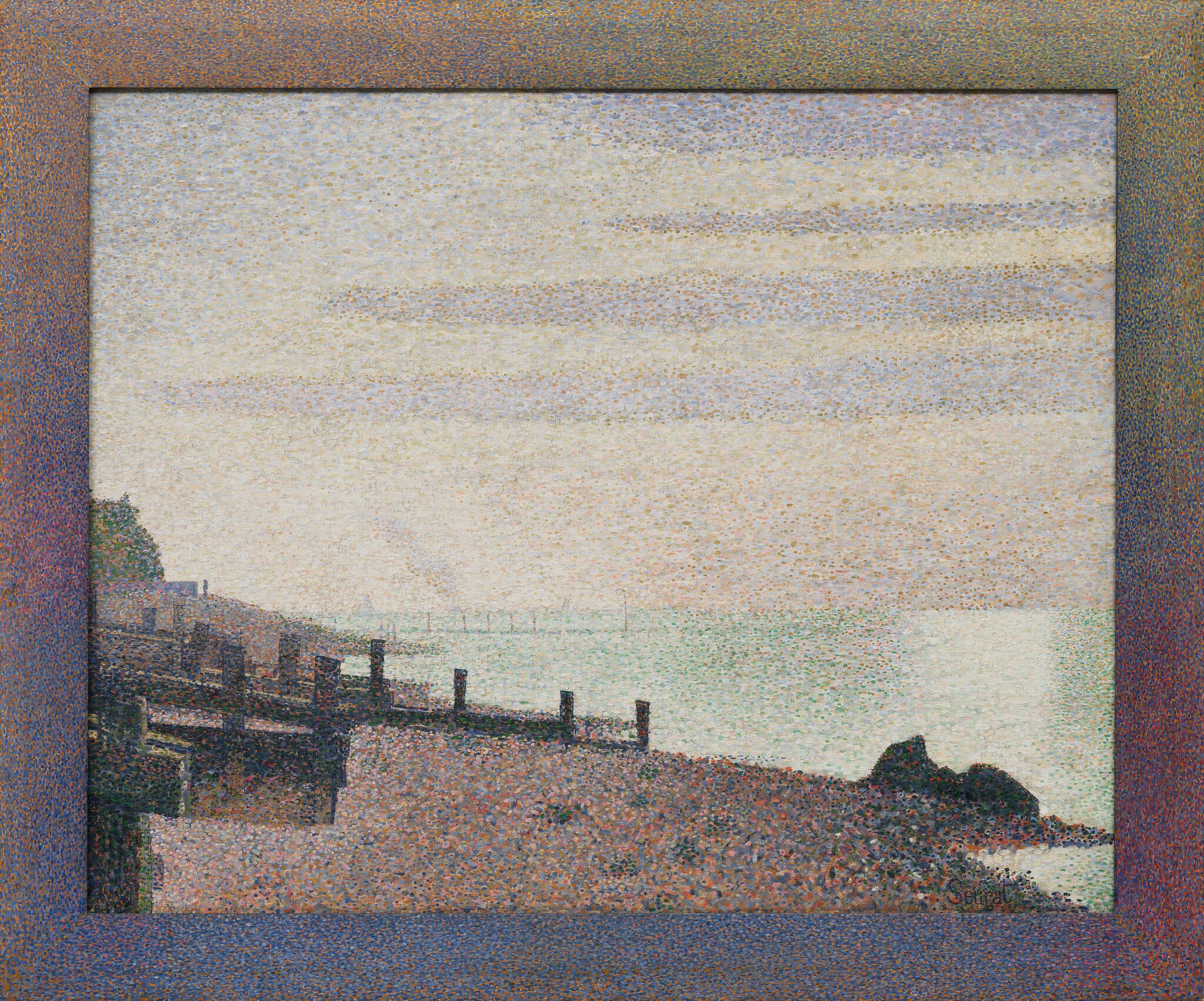
Evening, Honfleur is Seurat’s quiet evening scene on the Normandy coast, painted in the summer of 1886, the year he finished the Grande Jatte. The original measures 94 x 78.3 centimetres including its painted frame and is held in New York by The Museum of Modern Art under inventory number 266.1957. From us it is painted entirely by hand, oil on canvas, in eight sizes or to your own measurements, and before dispatch you receive a photograph of the finished work for approval.
| Title: | Evening, Honfleur |
| Other titles: | Soir, Honfleur · Embouchure de la Seine (Honfleur), Soir |
| Painter: | Georges Seurat (1859–1891) |
| Year painted: | 1886 |
| Original size: | 94 cm x 78.3 cm (including frame) |
| Original technique: | Oil on canvas, with painted wood frame |
| Painting style: | Pointillism |
| Located at: | The Museum of Modern Art, New York (inv. no. 266.1957, Floor 5, Gallery 501) |
| Our reproduction: | hand-painted oil on canvas, 8 sizes from 70 x 55 cm to 246 x 197 cm, custom size on request |
Evening, Honfleur – Georges Seurat
What is in the painting?
An empty beach at dusk. Sand in the foreground, a few wooden breakwaters, calm water, and a sky that takes up more than half the canvas. There are almost no people. The museum describes the scene as hushed and still: the vast sky and tranquil sea give it a sense of spaciousness and at the same time a peculiar visual density, while long lines of cloud echo the breakwaters on the beach – signs of human life and order. The horizontals of sand, water and sky are broken only by the verticals of the posts.
What happened in the summer of 1886?
The painter went to the coast. The museum notes that Seurat spent the summer of 1886 in the resort town of Honfleur on the northern French coast, a region of turbulent seas and rugged shorelines that had long attracted painters. His evening scene, however, is anything but turbulent. In the same year he finished Sunday Afternoon on the Island of La Grande Jatte, and after that large, crowded canvas the shoreline reads like an exhalation.
The frame he painted himself
This work has a frame that belongs to the work. The museum gives the medium as oil paint on canvas with a painted wood frame, and explains that Seurat added the wooden frame later, hand-painting it in the same Pointillist technique to suggest the image extending past the boundaries of the canvas. In the frame’s upper-right corner, in the museum’s words, the dots grow lighter, extending the glow of the setting sun. That is why the museum gives the measurement including the frame, and why we give it that way too.
Why does it feel so calm?
Because of the proportions and because of the method. Sky and sea take most of the surface, the horizon is low and straight, and there is only a handful of verticals. The museum records that Seurat applied at least twenty-five colours to this canvas in thousands of individual dots – so the calm does not come from emptiness but from an extraordinarily dense, even working. A canvas painting made that way is not still because nothing is happening in it, but because the same thing is happening everywhere in it.
What happened to the original?
The museum publishes the whole route in its provenance research project. In 1891 the canvas was in the artist’s estate, with Madeleine Knobloch in Paris; in 1892 it was acquired by the poet and critic Gustave Kahn, who lived between 1859 and 1936. Before 1923 it was with Victor Claessens in Waereghem, near Brussels, and in 1929 it passed by inheritance to his son Armand Claessens. In 1937 it was sold to Wildenstein Galleries in New York, and in November 1938 to Adele R. and David M. Levy. In 1957 the work came to The Museum of Modern Art as the gift of Mrs. David M. Levy. The museum also gives both great catalogue numbers and the Les XX exhibition in Brussels in 1892, where the work appeared as “Embouchure de la Seine (Honfleur), Soir” and belonged at the time to Kahn. That ownership history is the museum’s; we add nothing to it.
Where does it sit in Seurat’s work?
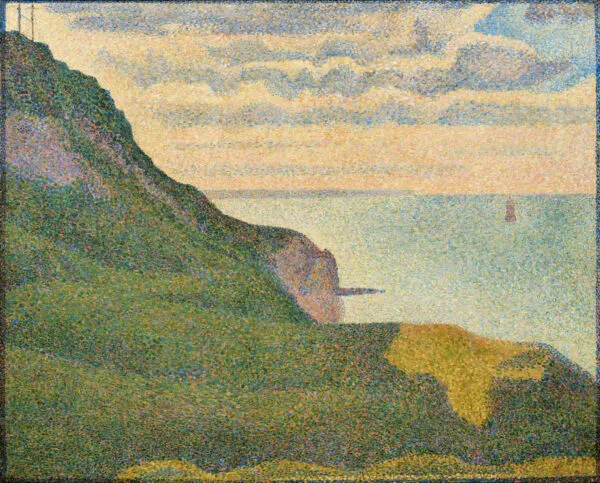
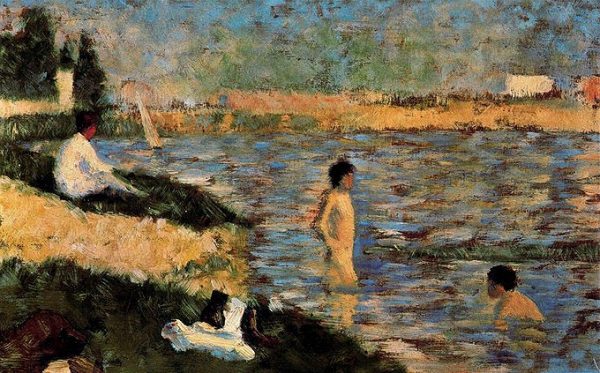
Among the coastal works he painted every summer. In our Seurat gallery we carry The Channel of Gravelines, Grand Fort-Philippe and Seascape at Port-en-Bessin, both from the same run of summer stays on the coast, and Bathers at Asnières, the first large canvas. The summit of that road is held by the Art Institute of Chicago. Pointillism is at its height here, and neo-impressionism as a movement had only just been given its name.
How is our hand-painted version made?
By hand and with a brush, never with a printer. Our painter works in oil paint on linen, and on this subject the hardest part is exactly what looks easiest: the large, almost empty fields of sky and water, which have to stay alive. If the dots grow too large the sky falls apart into a pattern; if they stay too small it turns smooth and dead. Every hand-painted copy is therefore one of a kind and no two are quite alike; this is not an oil painting reproduction printed onto canvas but a painting made from scratch. Before dispatch we photograph the piece and send you the photograph for approval.
We hold no studio photographs of the finished work for this subject at present. When it is next painted we will photograph it and the shots will appear on this page.
We do not imitate the painted frame: our version is the painting on canvas, and the frame is chosen separately. That is also why the measurement the museum gives, which includes the frame, is a little larger than the painted surface alone.
Which size for which wall?
If you do not know which: 120 x 100 cm. The original measures 94 x 78.3 cm with its frame and is in fact smaller than our second rung; the nearest to it is 100 x 80 cm, and our smallest size, 70 x 55 cm, is smaller than the original. The format is horizontal, close to a 6 : 5 ratio, and so it asks for a quiet, wide wall: 70 x 55 and 100 x 80 cm for an office or a hallway, 120 x 100 and 140 x 110 cm work as a standalone piece above a sofa, 160 x 130 and 180 x 140 cm want a wall of their own, and 200 x 160 and 246 x 197 cm are for large rooms, where the sky gets its proper measure. Every fine art reproduction of this subject is made to order.
Custom size, stretcher bar and frame
If none of the eight sizes fits your wall, we paint the work to your measurements and keep the ratio of the original so the horizon is never stretched; that is our custom size painting service. You can order the painting in three forms: as a rolled canvas without a stretcher, stretched on a wooden stretcher bar and ready to hang, or framed; you choose the form when you order. You choose the frame in our 3D frame viewer: on this subject it shows every frame profile we carry, so you can compare gold, silver, black, white and natural wood — it is for choosing a frame and nothing else. To see how the work will look on your own wall, use our separate room-visualisation service.
Delivery and guarantee
Every copy is made to order in our studio in Slovenia, so allow 15 to 45 days depending on the size you choose. We ship it in the form you chose when ordering — rolled, stretched or framed — protected for transport, across the EU, customs-free. Before dispatch you receive a photograph of the finished work for approval, and our returns policy applies to every order. The full range by this painter is in the Georges Seurat gallery, and his summer coastal works are described in our article about Georges Seurat, which also explains what separates a good famous painting copy from a poor one.
Frequently asked questions
Where is the original?
In New York, at The Museum of Modern Art, under inventory number 266.1957. The museum states that the work is on view on Floor 5, in Gallery 501.
What year is the work from?
The museum dates it to 1886 — a single year, with no “circa” and no span, and that is how we give it.
Why is the measurement given with the frame?
Because the frame belongs to the work. The museum gives 78.3 x 94 cm and states expressly that this is including the frame; since Seurat painted the frame himself, the museum counts it as part of the work. Our version is the painting on canvas, and the frame is chosen separately.
Did he really paint the frame as well?
Yes. The museum records that he added the wooden frame later and hand-painted it in the same technique so the image would reach past the edge of the canvas; in the upper-right corner the dots grow lighter and extend the glow of the sun.
How many colours are in the work?
The museum gives at least twenty-five, applied in thousands of individual dots.
Which size should I choose?
For a living room, 120 x 100 cm; if you want the size closest to the original, choose 100 x 80 cm. The full size guide is above.
Can I have a size that is not listed?
Yes. We paint to measure, keeping the side ratio of the original.
Is this a print?
No. The work is painted by hand in oil on linen; the strokes are visible and can be felt, which a print cannot imitate.
How is it delivered?
In the form you chose (rolled, stretched on a stretcher or framed), 15 to 45 days after you approve the photograph of the finished work.
Is the original for sale?
No. The canvas is in the public collection of The Museum of Modern Art and is not for sale; a hand-painted canvas is the only way to have the subject at home.
Is it suitable as a gift?
Very. A coastal evening is a quiet subject that suits almost any room and sits well against light walls. If you would rather leave the choice to the person receiving it, there is a gift voucher.
- Subject: an empty Normandy beach at dusk – sand, breakwaters, calm water and sky across half the canvas
- Original: 94 x 78.3 cm including frame, oil paint on canvas with a painted wood frame, The Museum of Modern Art, New York (266.1957)
- Ours: hand-painted in oil on linen, eight sizes from 70 x 55 to 246 x 197 cm, as a rolled canvas, stretched or framed — your choice
- Worth knowing: this French painter painted the frame too – in its upper-right corner the dots grow lighter and extend the glow of the sun