



Description
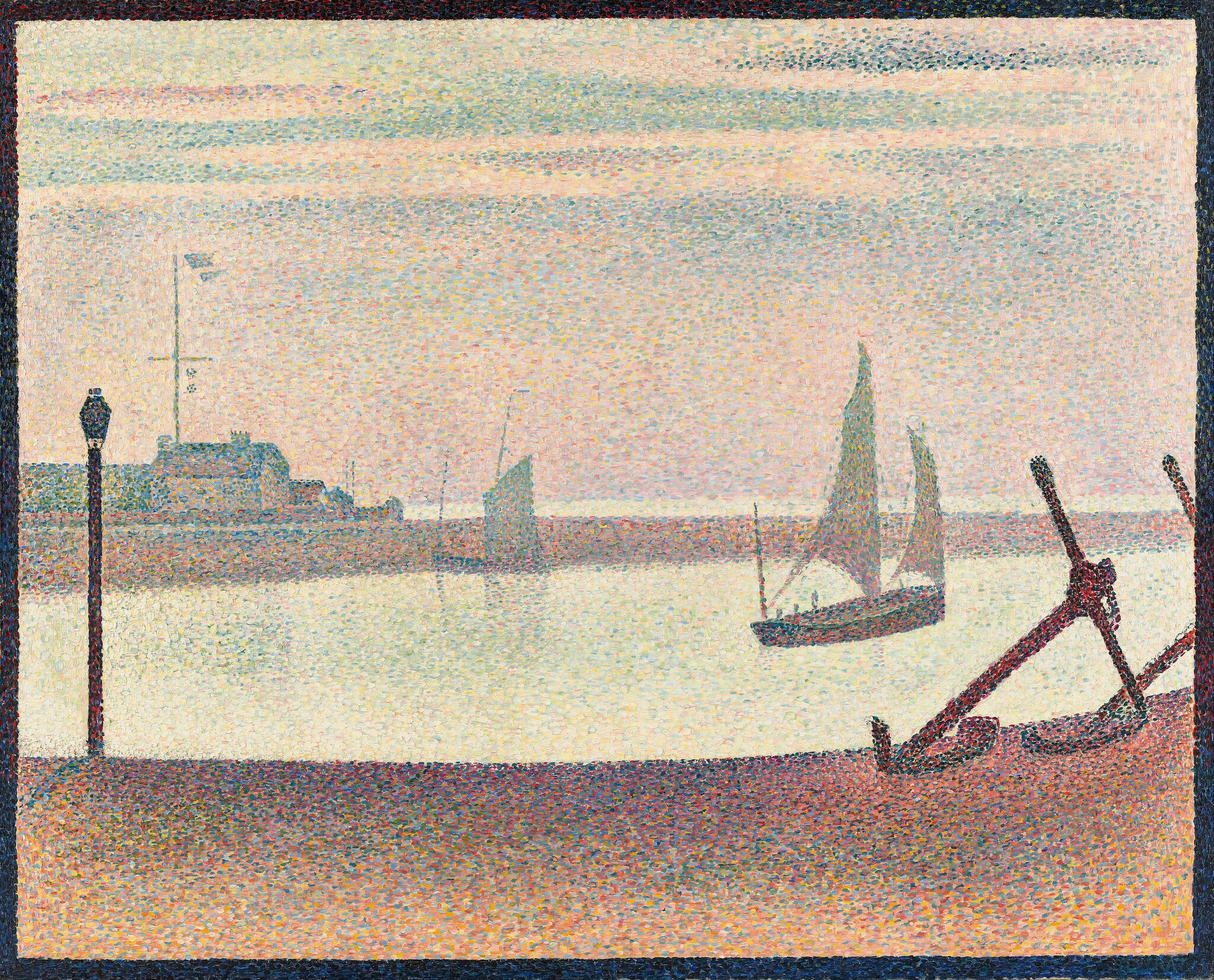
The Channel at Gravelines, Evening was painted in the summer of 1890, in the last year of Seurat’s work. The original measures 81.9 x 65.4 centimetres, is oil on canvas, and is held in New York by The Museum of Modern Art under object number 785.1963. From us it is painted entirely by hand, in eight sizes or to your own measurements, and before dispatch you receive a photograph of the finished work for approval.
| Title: | The Channel at Gravelines, Evening |
| Other titles: | The Channel at Gravelines, Evening – the museum’s own title |
| Painter: | Georges Seurat (Paris 1859–1891) |
| Year painted: | summer 1890 |
| Original size: | 81.9 cm x 65.4 cm |
| Original technique: | Oil on canvas |
| Painting style: | Pointillism, the last year of the painter’s work; neo-impressionism |
| Located at: | The Museum of Modern Art, New York (object no. 785.1963, Gift of Mr. and Mrs. William A. M. Burden, 1963) |
| Our reproduction: | hand-painted oil on canvas, 8 sizes from 70 x 55 cm to 246 x 197 cm, custom size on request |
The Channel at Gravelines, Evening – Georges Seurat
What is on the canvas?
A channel at dusk. Gravelines is a small port in northern France near the Belgian border, and Seurat went there in the summer of 1890. The museum dates the work the same way: summer 1890 — not just a year but a season.
A canvas painting from that last summer is quiet to the limit. The water lies flat, the bank withdraws, the light fails. Pointillism is fully formed here — the colour stands in fine dots, and it is exactly those that make the air over the channel look as though the light were pulling slowly back. The method is at its height in these last canvases.
The last series: four canvases from Gravelines
That summer Seurat painted four views of the same channel. It was his last coastal series; he died in March 1891, aged thirty-one.
Two of those four are in our Seurat gallery: The Channel of Gravelines, Grand Fort-Philippe, held by the National Gallery in London, and The Channel of Gravelines, Petit Fort-Philippe from Indianapolis. Anyone who wants to see where Seurat’s sea began should look at Boats, Low Tide, Grandcamp, and at how he had painted an evening before this, Evening, Honfleur.
The chain of owners, as the museum publishes it
The Museum of Modern Art includes this work in its Provenance Research Project and publishes the whole chain of owners with thirteen footnotes. Because it publishes it, we set it out here — and everything that follows is the museum’s record and not a conclusion of ours.
After the painter’s death the work was in the estate administered by Madeleine Knobloch. In 1892 it was bought by the widow Sylvie Monnom of Brussels, then passed to Marie Monnom and Théo van Rysselberghe, with whom it stayed from 1904 until at least 1909. Then the Galerie Druet in Paris in 1913, Félix Fénéon, and the Galerie Alfred Flechtheim in Düsseldorf.
In 1918 Rolf de Maré bought it through Gösta A. Olson of Stockholm and kept it until at least 1936. Then the Paris dealer Paul Rosenberg bought it — and there the chain breaks.
1941 to 1948: confiscation and return
The museum records the following. During the German occupation the work was confiscated in 1941 by the ERR, the Einsatzstab Reichsleiter Rosenberg. In April 1942 Hermann Goering’s agent Andreas Hofer traded it to Hans Wendland and Theodor Fischer in Lucerne, in exchange for objects acquired for the Goering collection.
In 1945 Fischer turned it over, at the request of the Swiss government, to the collecting point at the Kunstmuseum Bern. In June 1948 it was returned to Paul Rosenberg, by then in New York, and in October of the same year William A. M. Burden bought it. In 1963 it came to the museum as his gift.
We set this history down because the institution that holds the work publishes it itself and in full. The picture we sell as a hand-painted copy has that history behind it, and it belongs here and not only in a museum catalogue.
Where do two of the museum’s own entries disagree?
On one point the museum contradicts itself. Its provenance text says the work was in the painter’s estate in Paris in 1881; the footnote to that same entry points to the seventh Salon des Artistes Indépendants of 1891, the year Seurat died. A work of summer 1890 did not exist in 1881.
So we give the estate without a year. Where an institution is not agreed with itself we would rather stop than pick one of its two numbers — as with other works in our Seurat gallery where two museum fields do not match.
We have corrected the object number too. Until now this page carried 785.1963.a-b; the museum’s own dataset and its own page both give 785.1963, with no suffix. What the museum publishes is what counts.
A few names from that chain
Two names in the chain are no accident. Félix Fénéon is the critic who coined the word neo-impressionism for this painting; Théo van Rysselberghe was a Belgian painter who took up Seurat’s method. The work hung for years, then, with people who knew what they were looking at.
One more detail. In its footnotes the museum cites de Hauke’s catalogue Seurat et son oeuvre of 1961 — the very catalogue this shelf twice could not reach, when The Seine at Courbevoie was left with no year and no size. The same book, a different museum.
How is our hand-painted version made?
By hand and with a brush, never with a printer. Our painter works in oil colours on canvas, and with this subject the hardest thing is to keep the stillness: this is a scene with no incident, and if the colour livens up it loses its silence. That is why every copy is one of a kind and no two are quite alike.
For this subject we have no studio photographs of our own yet. When we next paint it, we will photograph it, and the photographs will appear on this page. What holds meanwhile holds for every oil painting reproduction we make: before dispatch you receive a photograph of the very canvas painted for you, and it leaves only once you have approved it.
Which size for which wall?
The original measures 81.9 x 65.4 centimetres, width first and then height, the way we give measurements everywhere. The format is landscape but only moderately drawn out.
None of our eight sizes matches the original. The closest is 70 x 55 cm and it is a little smaller — which is the other way round from the two neighbouring Gravelines canvases, where the closest size is larger. For a living room we suggest 100 x 80 or 120 x 100 cm; 140 x 110 and 160 x 130 cm fill a larger wall; 180 x 140, 200 x 160 and 246 x 197 cm are for rooms where the dots can spread out and breathe.
Custom size, stretcher and frame
If none of the eight sizes fits your wall, we paint to your measurements and keep the ratio of the original, so the scene is never stretched; that is our custom size painting. You can order the painting in three forms: as a rolled canvas without a stretcher, stretched on a wooden stretcher and ready to hang, or framed; you choose the form when you order.
You choose the frame in our 3D frame viewer. With a dusky, quiet scene a frame turns loud very quickly: a narrow, unassuming one leaves the work its room. Our separate room-placement service shows how it will look on your own wall.
Delivery and guarantee
Every copy is made to order in our studio in Slovenia, so allow 15 to 45 days depending on size. We ship it in the form you chose when ordering — rolled, stretched or framed — protected, across the EU, customs-free. You approve a photograph first, and our returns policy applies. The full range by this painter is in the Georges Seurat gallery, and his work is described in our article on Georges Seurat. A fine art reproduction of a famous painting is always made here the same way.
Frequently asked questions
Where is the original?
In New York, at The Museum of Modern Art, object number 785.1963. It came to the museum in 1963 as the gift of Mr. and Mrs. William A. M. Burden.
What year is it from?
The museum gives summer 1890 – a year and a season, so that is how we give it.
How big is the original?
The museum gives 65.4 x 81.9 centimetres by height and width, which in our width-by-height notation is 81.9 x 65.4 cm.
How many of these channel views are there?
Four. The museum and the catalogues treat them as Seurat’s last coastal series; two of the four are in our Seurat gallery.
Was the work confiscated during the war?
Yes. The museum publishes that it was confiscated by the ERR in 1941, traded in 1942 through Goering’s agent, and returned to Paul Rosenberg in 1948.
Why do you not give a year for the estate?
Because the museum’s text and its own footnote differ by ten years. Where an institution is not agreed with itself, we stop.
Why is the object number different from before?
Because we corrected it against the museum’s own record: 785.1963, without the a-b suffix.
Which size should I choose?
For a living room, 100 x 80 cm. The closest to the original is 70 x 55 cm, though it is a little smaller.
Can I have a size that is not on the list?
Yes. We paint to measure and keep the ratio of the sides of the original.
Is this a print?
No. The work is painted by hand in oil colours; the strokes can be seen and felt, which a print cannot imitate.
Is it suitable as a gift?
Yes. The subject is quiet and light and suits any room. To leave the choice to the recipient, there is a gift voucher.
- Subject: the channel at Gravelines at dusk, summer 1890 – Seurat’s last coastal series
- Original: 81.9 x 65.4 cm, oil, The Museum of Modern Art, New York (785.1963)
- Our version: a hand-painted canvas, eight sizes from 70 x 55 to 246 x 197 cm
- Important: this French painter died in March 1891 – this canvas is from his last summer