








Description
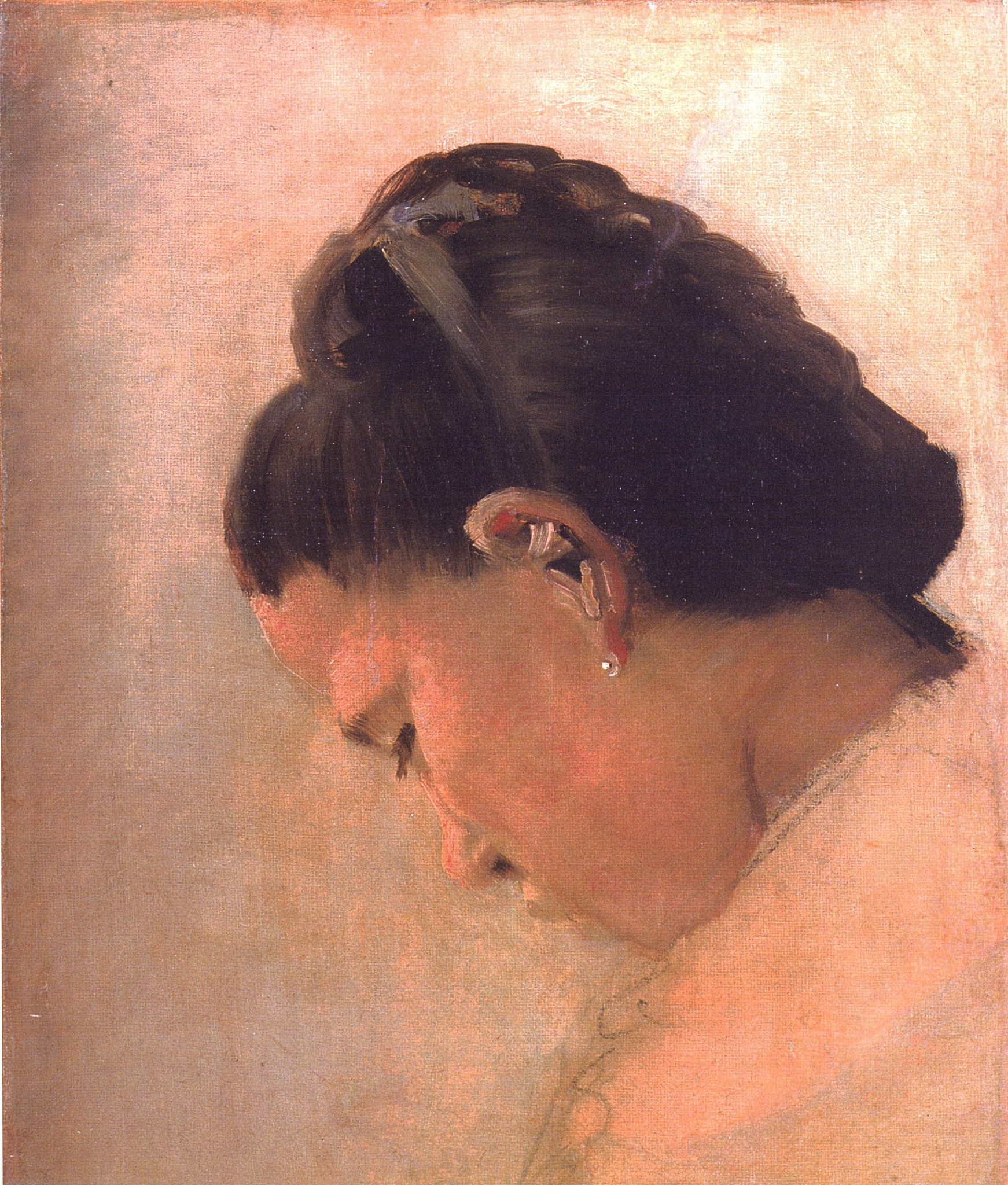
Head of a Young Girl is a painting by Seurat from about 1877–1879, done in oil and chalk on canvas: a young girl with dark, pinned-up hair and a pearl earring bows her head; we see her face in profile, her gaze turned downwards. The original, 25.08 x 30.48 cm, is held by Dumbarton Oaks in Washington under number HC.P.1935.16.(O). We make it as a canvas painting, hand-painted in oils, in eight portrait-format sizes or to your own measurements, and before dispatch you receive a photograph of the finished work to approve.
| Title: | Head of a Young Girl |
| Other titles: | »Tête de jeune fille« (Head of a Young Girl) – the title the museum itself uses |
| Painter: | Georges Seurat (1859–1891) |
| Year painted: | about 1877–1879 |
| Original size: | 25.08 cm x 30.48 cm |
| Original technique: | Oil and chalk on canvas |
| Painting style: | Early work – smooth, soft strokes, before the dots |
| Located at: | Dumbarton Oaks, Washington (inv. no. HC.P.1935.16.(O)) |
| Our reproduction: | hand-painted in oils on canvas, 8 sizes from 38 x 45 cm to 120 x 140 cm, custom sizes on request |
Head of a Young Girl – Georges Seurat
Who is in the painting?
A young girl whom the museum record does not name; the title tells us only that this is the head of a young girl. We see her from the side, her head bent well forward and down, her eyes lowered and almost closed. Her dark hair is combed back and gathered into a full coil at the nape of her neck, with a pale ribbon running across it. A small pearl earring gleams at her ear. At the lower right her neck and shoulder in a light-coloured dress are just suggested, and a few tiny buttons can be made out along the edge of the collar. Who she was and why she is so lost in thought, the record does not say, so we do not guess either.
What is on the canvas?
An upright canvas only a little over 25 cm wide. The head fills the upper and middle part of the picture; everything else is a calm, warm background in pinkish beige tones, slightly lighter in the upper right. In places the weave of the canvas shows through the background, a sign that the paint was applied thinly. The hair is painted in broader, dark strokes lit by brown glints. The face, ear and neck are in warm skin tones, the cheek and ear faintly flushed with red, while the shadow beneath the face shifts into cooler, greyish tones. The museum gives the technique as oil and chalk on canvas.
Why does this painting matter?
Because it shows Seurat before he became the painter of dots. The museum dates the work to about 1877–1879, when the French painter, born in 1859, was around twenty years old. There are no tiny points of colour here: the strokes are soft and smooth and melt into one another. The pointillism Seurat is known for cannot be seen in this painting. That is exactly what makes it precious: it shows how closely Seurat was already observing light on skin and hair in those years. For a buyer, above all, it is a quiet, tender portrait in warm tones.
What does the scene mean?
Nothing happens in the painting, and that is its charm. The girl bends her head as if reading, sewing or deep in thought, but the picture does not show which; we see only the head, the ear with its earring and the soft light on her face. The viewer is given a moment of concentration, not a story. At home a painting like this calms a room: the warm pink tones go well with wood, white walls and soft light, so it belongs in a bedroom, a reading corner or a study.
What happened to the original?
The museum publishes the painting’s history. It was first in the collection of the painter’s brother-in-law, Léon Appert (1837–1925), in Paris, at least until 1908–1909 and probably until his death in 1925. By inheritance it passed to his son, Léopold Appert, in Paris, from 1925 (the record marks this year with a question mark) to 1927. By 1927 at the latest it had been sold to the Paris dealer Étienne Bignou. From 23 July 1929 until 1935 it was owned jointly by Bignou and the New York dealers M. Knoedler and Co. (no. A 906). On 19 November 1935 Mildred Barnes and Robert Woods Bliss of Washington bought it from M. Knoedler & Co., Inc.; according to the record, the object file holds an invoice stamped PAID. It stayed in their collection from 19 November 1935 to 29 November 1940 and today belongs to the house collection of Dumbarton Oaks Research Library and Collection. Every detail here is summarised from the museum’s record.
What place does this painting have among Seurat’s works?
It is one of his early works, painted without dots. From the same years we also offer Angelica Chained to the Rock, a copy after Ingres from 1878, held by the Norton Simon Museum in Pasadena. Among the Seurat subjects in our range are also Vase of Flowers and Young Woman Powdering Herself. Anyone looking for Seurat’s neo-impressionism will not find it in this painting; this head is painted in soft, blended strokes.
How is our hand-painted version made?
With a brush and oil paint, never with a printer. Our painter works from a high-resolution image of the original and keeps what makes this painting special: the soft, blended strokes, the dark hair with its brown glints, the warm skin and the thin, airy background. A pointillist technique would be wrong here, because the original does not use it, so we do not “improve” it with dots. Because every canvas is made by hand, no two are ever quite the same, and every hand-painted copy remains one of a kind. We have not yet photographed a finished canvas of this subject; we will do so when we paint it for the first time and publish the photographs here.
Which size suits which wall?
If you are not sure which to choose, take 50 x 60 cm. The original measures 25.08 x 30.48 cm and is smaller than every size we offer. The closest to it is our smallest size, 38 x 45 cm, which is 12.92 cm wider and 14.52 cm taller than the original. The format is upright, so the painting sits well on a narrow wall, between two windows or above a bedside table. 38 x 45 and 50 x 60 cm suit a bedroom, hallway or reading corner; 60 x 70 and 70 x 85 cm stand on their own above a chest of drawers or a desk; 80 x 100 and 90 x 110 cm are living-room sizes, while 100 x 120 and 120 x 140 cm turn this intimate head into the centrepiece of a room. Every fine art reproduction of this subject is made to order.
Custom size, stretcher bar and frame
If none of the eight sizes fits your wall, we paint to your measurements and keep the proportions of the original, so the head and the background stay in balance; that is our custom size painting service. You can order the painting in three forms: as a rolled canvas without a stretcher, stretched on a wooden stretcher bar and ready to hang, or framed; you choose the form when you order. You choose the frame in our 3D app, which shows gold, silver, black, white and wooden profiles on this subject; it serves only for choosing a frame. To see the painting on your own wall, you can order our separate room-visualisation service.
Delivery and guarantee
Every piece is painted to order in our studio in Slovenia, so allow 15 to 45 days, depending on the size. We send it in the form you chose when ordering — rolled, stretched or framed — protected for transport, within Slovenia and across the EU free of customs duty. Before dispatch you receive a photograph of the finished work to approve, and every order is covered by our returns policy. All of Seurat’s subjects can be found in the Georges Seurat gallery, and our article about Georges Seurat also explains what a good reproduction of a famous painting should be.
Frequently asked questions
Where is the original?
In Washington, in the house collection of Dumbarton Oaks, under number HC.P.1935.16.(O).
Who is the girl in the painting?
The museum record does not name her; the title describes her only as a young girl.
Is the painting made of dots?
No. It is an early work with soft, blended strokes; the dots that Seurat is known for do not appear here yet.
What is the original made of?
The museum gives oil and chalk on canvas. Our version is painted in oil paint on canvas.
Is this a print?
No. The work is painted by hand, in oil on canvas; the brushstrokes can be seen and felt.
Which size should I choose?
For a bedroom or hallway, 50 x 60 cm; for the size closest to the original, 38 x 45 cm. The detailed guide is above.
Can I have a size that is not on the list?
Yes, we paint to measure and keep the side ratio of the original.
Do you have photographs of an already painted canvas?
Not yet. We will photograph this subject when we first paint it; before dispatch, though, you always receive a photograph of your own order.
Is the original for sale?
No. The painting is in the collection of Dumbarton Oaks in Washington and is not for sale, but its subject can hang in your home as our hand-painted version.
How high should I hang it?
With its centre at eye level, about 145–150 cm from the floor. Hang smaller sizes lower, closer to where you sit.
Is it suitable as a gift?
Yes, a gentle portrait pleases almost anyone. If you would rather leave the choice to the person receiving it, there is our gift voucher.
- Subject: the bowed head of a young girl with pinned-up dark hair and a pearl at her ear – about 1877–1879
- Original: 25.08 x 30.48 cm, oil and chalk on canvas, Dumbarton Oaks, Washington (inv. no. HC.P.1935.16.(O))
- Ours: a hand-painted oil painting reproduction, eight sizes from 38 x 45 to 120 x 140 cm, as a rolled canvas, stretched on a stretcher bar or framed — your choice
- Worth knowing: an early Seurat painted without dots, in oil and chalk