



Description
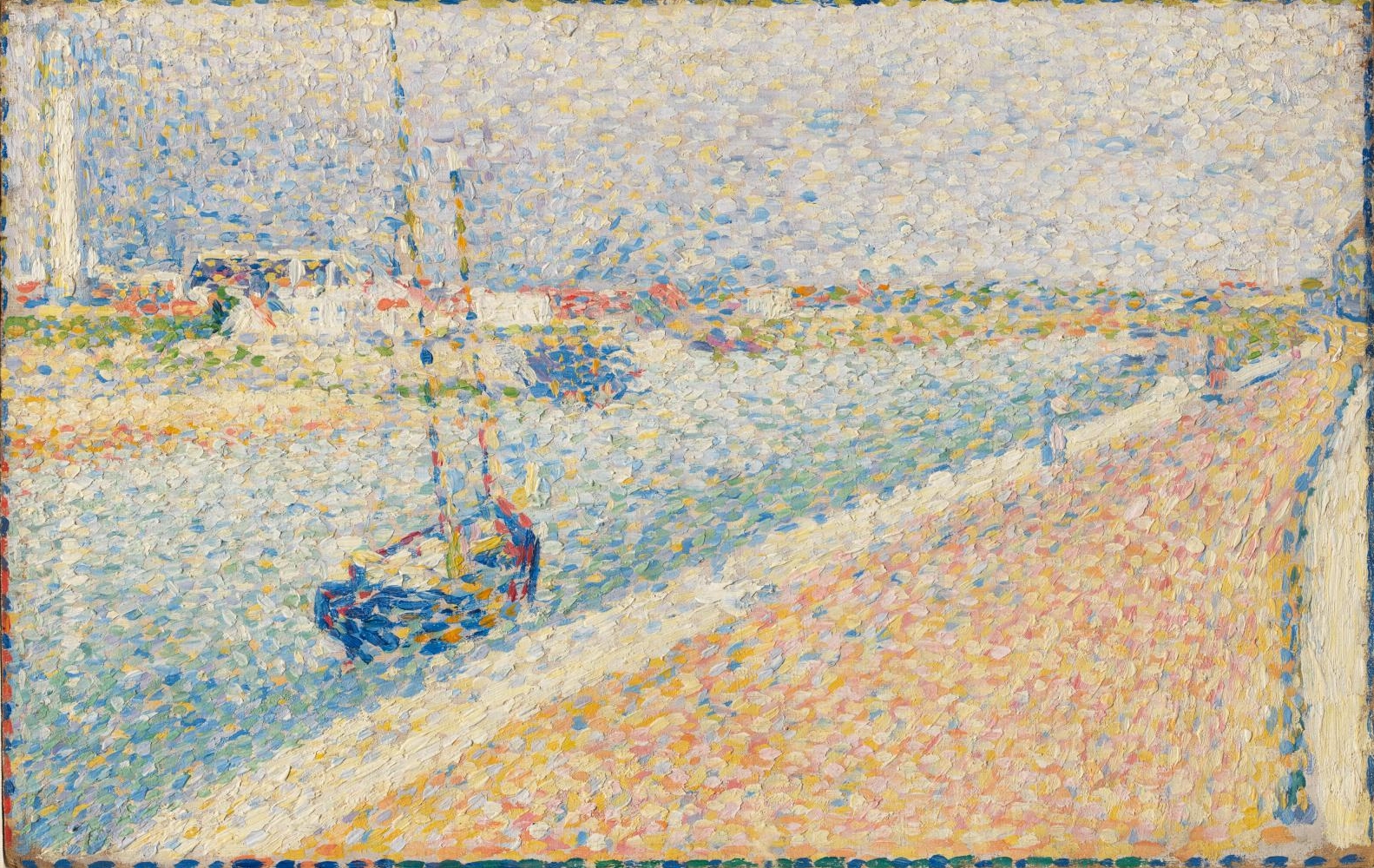
Study for The Channel of Gravelines, Petit Fort-Philippe is Seurat’s oil study on panel from 1890: a blue channel runs diagonally away towards the horizon, a dark boat with a tall mast is moored in it, a bright pink-orange jetty runs along the right, and a white lighthouse rises at upper left. The original, 25.08 x 15.88 cm, is held by The Nelson-Atkins Museum of Art in Kansas City under number 2015.13.22. We make it as a painting hand-painted in oils on canvas, in seven sizes or to your own measurements, and before dispatch you receive a photograph of the finished work to approve.
| Title: | Study for The Channel of Gravelines, Petit Fort-Philippe |
| Other titles: | »Study for The Channel of Gravelines, Petit Fort Philippe« (the museum’s spelling); »Le chenal de Gravelines, Petit-Fort-Philippe« |
| Painter: | Georges Seurat (1859–1891) |
| Year painted: | 1890 |
| Original size: | 25.08 cm x 15.88 cm |
| Original technique: | Oil on panel |
| Painting style: | Oil study – tiny dots and short strokes ahead of the finished painting |
| Located at: | The Nelson-Atkins Museum of Art, Kansas City (inv. no. 2015.13.22) |
| Our reproduction: | hand-painted in oils on canvas, 7 sizes from 25 x 16 cm to 120 x 75 cm, custom sizes on request |
Study for The Channel of Gravelines, Petit Fort-Philippe – Georges Seurat
What does the painting show?
The harbour channel at Petit Fort-Philippe, as the museum’s title names it. No figure in the study can be recognised; the water is the main character. The channel, painted in pale blue and white dots, stretches across the left and middle of the panel and narrows into the distance. At front left a dark blue boat with a tall mast is moored in it, and further back another dark shape on the water looks like a second boat. To the right of the water runs a broad jetty in pink, orange and yellow dots, separated from the channel by the bright white line of its edge. On the far bank is a low row of houses with reddish roofs, and at the far left a tall white lighthouse rises above them. The sky takes up almost half the picture and is made of pale cream, blue and pink dots.
What is on the panel?
According to the museum record, oil on a horizontal panel measuring 25.08 x 15.88 cm. The paint is applied in tiny rounded dots and short strokes, close enough to merge into light from a distance yet distinct up close. Along the edges runs a dark dotted border, painted by Seurat himself and part of the work, so our painting keeps it uncropped. The touches are denser and lighter in the sky, warmer on the jetty and cool in the water. The line of the jetty’s edge and the boat’s mast are drawn a little more firmly and give the calm surface a backbone. The museum also notes that the panel is currently on view in its gallery 127.
Why does this study matter?
Because, as its title says, it is a study for a finished painting of the same channel. The French painter, whom the museum lists with the dates 1859–1891, painted it in 1890. On this small panel he gathered the whole scene into a very small space: the slanting jetty, the water, the moored boat and the lighthouse on the horizon. The tiny dots the study is built from are what we now call pointillism. For an art lover it is a small, bright scene showing how a work of art comes into being.
What does the scene mean?
A quiet day by the channel, with no story and no people. The boat lies still at its mooring, the water is smooth, the sky bright. The museum record offers no interpretation, so we do not invent one: the painting shows a place and its light, and its charm lies in that simplicity. At home it feels fresh and airy; the blue water and warm jetty bring light into a room, and the white lighthouse in the corner gives the eye somewhere to go.
What happened to the original?
The museum publishes the panel’s full history, which we give as it does. From 1890 until 29 March 1891 it was with the artist in Paris. In 1891 it was probably inherited by Ernestine Seurat or Madeleine Knoblock. Ernestine Seurat or Madeleine Knoblock gave it to Maximilien Luce (1858–1941) in Paris, who had it from 1891 until at least January 1934; in a note the museum adds that it is unclear whether it was still with him when he died or had already passed to an heir. It then probably passed by inheritance to his nephew Édouard Alexandre Bouin (1897–1988) of Paris and La Celle-Saint-Cloud, who held it from 6 February 1941 at the latest until 6 December 1978 at the latest. By 6 December 1978 his son Jean Bouin-Luce had received it by inheritance. At his sale at Sotheby Parke Bernet in London on 6 December 1978, as lot 216, it was bought by the Fujii Gallery in Tokyo, which kept it until at least 25 November 1990. Through the dealers Richard L. Feigen and Co. it was bought by Marion and Henry Bloch, who owned it from 10 July 1996 to 15 June 2015. In 2015 they gave it to The Nelson-Atkins Museum of Art.
What place does this study have among Seurat’s works?
It is a study for the painting The Channel of Gravelines, Petit Fort-Philippe, held by the Indianapolis Museum of Art at Newfields. That museum, as we note on the painting’s page, classes it as neo-impressionism. We also offer two more paintings of the same channel, both dated 1890: The Channel of Gravelines, Grand Fort-Philippe and The Channel at Gravelines, Evening. All three are separate products in our range, as is this study.
How is our hand-painted version made?
With a brush and oil paint, never with a printer. Our painter works from a high-resolution image of the original and sets the dots one by one, as on the panel: dense in the sky, warm on the jetty, cool in the water. The pointillist technique is not ornament here but the very structure of the painting, so we never simplify it into smooth areas. We also paint Seurat’s dark dotted border along the edges, because it belongs to the work. As everything is done by hand, no two canvases are exactly alike, and every hand-painted copy is unique. We have no studio photographs of a finished painting of this subject yet; we will take them the first time we paint it and publish them here.
Which size suits which wall?
If you are not sure which to choose, take 60 x 40 cm. Our smallest size, 25 x 16 cm, is the closest to the original: the original measures 25.08 x 15.88 cm, so ours is 0.08 cm narrower and 0.12 cm taller. The format is horizontal, in a ratio close to 8 : 5, so it sits nicely above a narrow chest of drawers or a bed, or in a group of smaller works. 50 x 30 and 60 x 40 cm suit a hallway or bedroom; 70 x 45 and 80 x 50 cm hold their own above a desk; 90 x 60 cm is a living-room size, and 120 x 75 cm, our largest size for this subject, turns the small study into a large, bright painting. Every canvas painting of this subject is made to order.
Custom size, stretcher bar and frame
If none of the seven sizes suits your wall, we paint to your measurements, up to 120 x 75 cm, and keep the proportions of the original, so the jetty, channel and lighthouse stay in balance; that is our custom size painting service. You can order the painting in three forms: as a rolled canvas without a stretcher, stretched on a wooden stretcher bar and ready to hang, or framed; you choose the form when you order. You choose the frame in our 3D app, which shows gold, silver, black, white and wooden profiles on this subject; its only purpose is choosing a frame. To see the painting on your own wall, you can order our separate room-visualisation service.
Delivery and guarantee
Each piece is painted to order in our studio in Slovenia, so allow 15 to 45 days, depending on the size. It ships in the form you chose when ordering — rolled, stretched or framed — protected for transport, within Slovenia and across the EU with no customs duty. Before dispatch you receive a photograph of the finished work to approve, and our returns policy covers every order. All of Seurat’s subjects are in the Georges Seurat gallery, and our article about Georges Seurat also explains what makes a good reproduction of a famous painting.
Frequently asked questions
Where is the original?
At The Nelson-Atkins Museum of Art in Kansas City, under number 2015.13.22, as a gift of Henry W. and Marion H. Bloch.
Are there people in the study?
No recognisable figures; just the channel, the moored boat, the jetty, the houses on the bank and the lighthouse.
Is this the same work as the finished painting of the channel?
No. This is a small study on panel, 25.08 x 15.88 cm; the finished painting is a canvas in Indianapolis. We offer both, as separate products.
Is this a print?
No. The work is painted by hand, in oil on canvas; the brushstrokes can be seen and felt.
Which size should I choose?
For a hallway or bedroom, 60 x 40 cm; closest to the original, 25 x 16 cm. The detailed guide is above.
Can I have a size that is not on the list?
Yes, we paint to measure, up to 120 x 75 cm, and keep the side ratio of the original.
What is the dark edge around the scene?
A dotted border painted by Seurat that belongs to the panel; we keep it in our painting.
Who owned the panel before the museum?
Among others, Maximilien Luce, the Fujii Gallery in Tokyo, and Marion and Henry Bloch, who gave it to the museum in 2015.
Is the original for sale?
No. The panel is in the museum’s public collection in Kansas City and is not for sale, but you can bring its subject home as our hand-painted version.
How high should I hang it?
With its centre at eye level, about 145–150 cm from the floor. Hang smaller sizes lower, closer to where you sit.
Is it suitable as a gift?
Yes, a bright scene by the water is a welcome gift. If you would rather let the recipient choose, there is our gift voucher. Every fine art reproduction we make is painted by hand.
- Subject: a harbour channel with a moored boat, a jetty and a white lighthouse – 1890
- Original: 25.08 x 15.88 cm, oil on panel, The Nelson-Atkins Museum of Art, Kansas City (inv. no. 2015.13.22)
- Ours: a hand-painted oil painting reproduction, seven sizes from 25 x 16 to 120 x 75 cm, as a rolled canvas, stretched on a stretcher bar or framed — your choice
- Worth knowing: Seurat’s dark dotted border along the edges of the panel belongs to the work, and we paint it too