














Description
| Title: | Quai d’Ivry |
| Other titles: | Quai d’Ivry (catalogue) |
| Painter: | Henri Rousseau |
| Year painted: | not confirmed with the museum |
| Original size: | 46.1 cm x 55 cm (height x width, as published) |
| Original technique: | oil on canvas |
| Painting style: | naive art (primitivism) |
| Held at: | Artizon Museum, Tokyo, Japan (as published) |
| Our reproduction: | hand-painted oil on canvas, ten sizes or a size made to order |
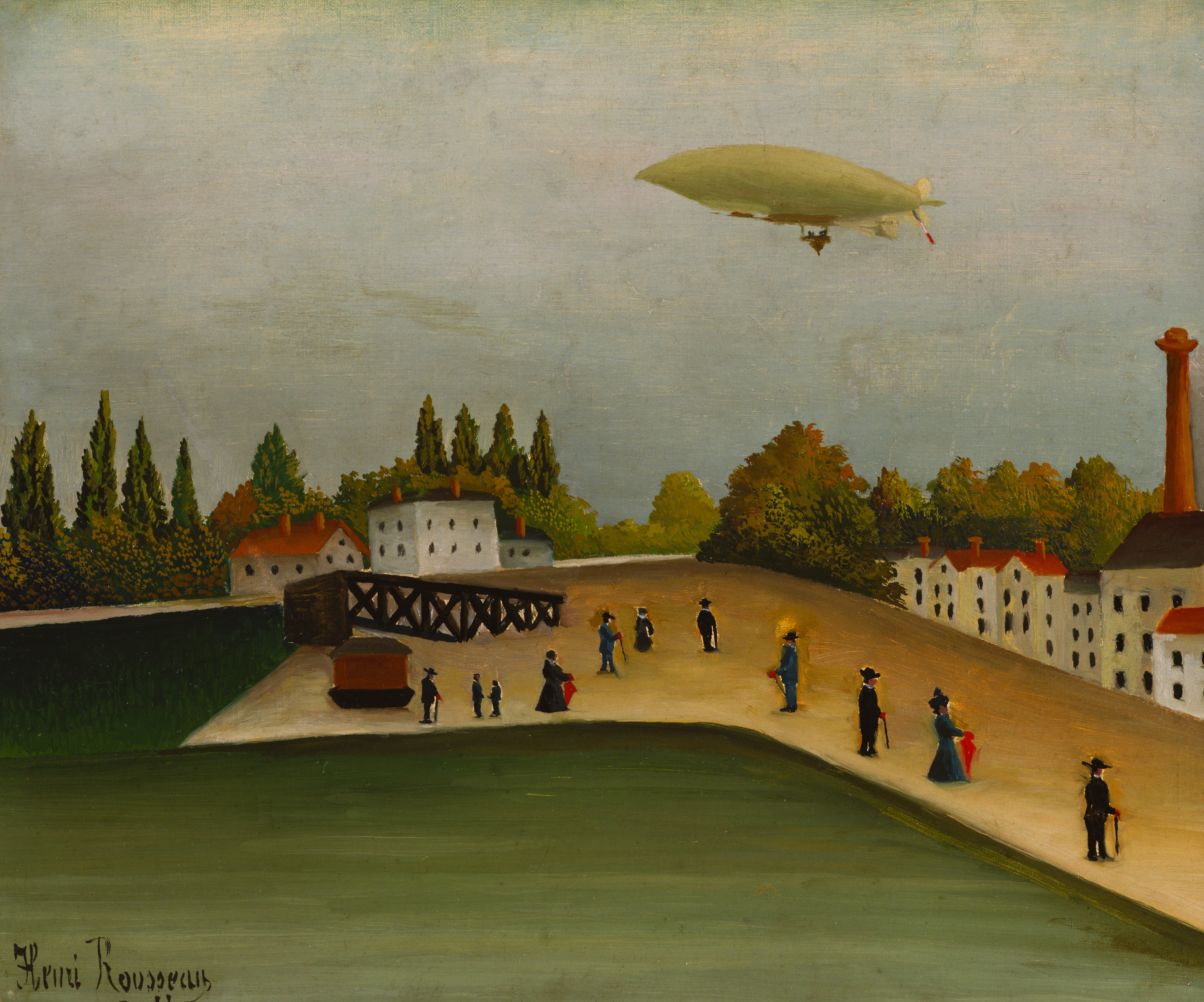
Quai d’Ivry is a painting by Henri Rousseau, oil on canvas; according to published records it is held by the Artizon Museum in Tokyo. What you see: a riverside quay with strollers in dark clothes and red umbrellas, white houses, a tall factory chimney, and above it all a large airship in a grey sky. We paint it by hand in oils, in ten sizes or to measure, and send you a photograph of the finished painting before dispatch.
Quai d’Ivry
What is on the canvas?
High in the grey sky floats a long, pale airship with a gondola under its hull. Below, a sandy quay spreads across the painting, and small figures stroll along it: men in black with hats and canes, women in long dresses with red umbrellas. At the left stands a small brown wooden hut, with a dark trussed footbridge behind it. In the background stand white houses with red roofs, slender poplars and autumn trees, and at the right rises a tall brick factory chimney. The lower part of the painting is a broad green river. The signature, Henri Rousseau, is at the lower left. Another of Rousseau’s flying machines, a balloon, is in View of the Clichy Bridge at Asnières.
What does the painting mean?
Rousseau brings two worlds together here: a quiet promenade by the river and the signs of a new age, the factory chimney and the airship floating over the town like a silent fish. The strollers do not look up and walk on, as if the wonder in the sky were already an everyday thing. We could not read the museum’s own entry, so we give no year and do not guess which airship is shown. Another Rousseau bridge on the Seine with flying machines is View of the Bridge at Sèvres.
Which size suits which room?
The published size of the original is 46.1 cm high and 55 cm wide; 66 x 55 cm keeps its proportion most exactly. Ten sizes are available: 66 x 55, 70 x 60, 79 x 64, 90 x 72, 95 x 76, 100 x 81, 110 x 88, 115 x 93, 120 x 102 and 130 x 110 cm. The light, calm landscape with its small figures suits a living or dining room from 100 x 81 cm upward; for a study or a hallway 66 x 55 or 79 x 64 cm is enough. Above a sofa the painting usually takes about two thirds of the width of the furniture; above a bed it should stay narrower than the headboard. Custom sizes are ordered through the made-to-order painting page, where you enter the width and height; we suggest keeping the proportion of the original and changing only the scale. Rousseau’s Paris on the Seine is also View of the Eiffel Tower and the Trocadéro.
How is the painting made, and does it come framed?
Your canvas is begun only after you order it, and is painted by hand in oils in our workshop in Slovenia, at the size you choose. The painter lays in the grey sky and the airship first, then the trees, the houses and the chimney, then the quay and the river, and last the hut, the footbridge and every small figure one by one. We do not print, and no machine application is used, so no two versions are exactly alike. The canvas is stretched on a wooden frame and arrives ready to hang; a picture frame is not included in the price and is chosen separately. Before packing we photograph the finished painting and send you the photograph for approval; only then does it travel. A Paris island on the Seine by the same painter is View of the Île de la Cité, Paris. The whole collection is in the Henri Rousseau gallery.
How is it delivered, and what do we guarantee?
We deliver to Slovenia, Croatia, Italy, Austria, Hungary and Germany. Depending on its size, the canvas travels rolled in a rigid tube or stretched on its frame, always in protective wrapping and as a tracked parcel. The making time depends on the size and is confirmed when you order. We guarantee that every painting is painted by hand and that you see a photograph of the finished work before dispatch; if anything in it is not as you wish, we correct it before it leaves the workshop.
Frequently asked questions
Where is the original kept?
According to published records, at the Artizon Museum in Tokyo; we could not read the museum’s own entry, so we do not link to it.
When was it painted?
We could not check the year with the museum, so we give none.
Is a frame included?
No. The canvas is stretched on a wooden frame and ready to hang without a picture frame; a frame can be chosen separately.
Is this a print?
No. It is painted by hand in oils, and the layers of paint can be seen and felt.
Is the painting suitable as a gift?
Yes, especially for someone who loves Paris, early flying machines and calm scenes by the water. If you would rather the recipient chose, there is a gift voucher.
- Subject: strollers on a riverside quay, white houses, a factory chimney and a large airship in a grey sky.
- Original: oil on canvas, 46.1 x 55 cm (as published), Artizon Museum, Tokyo; year not confirmed.
- Our version: hand-painted oil, ten sizes from 66 x 55 to 130 x 110 cm or to measure, unframed, photograph before dispatch.
- Of note: the strollers pay no attention to the airship above them, as if it were already an everyday thing.