Description
A Modern Olympia – the canvas its own owner painted a second time
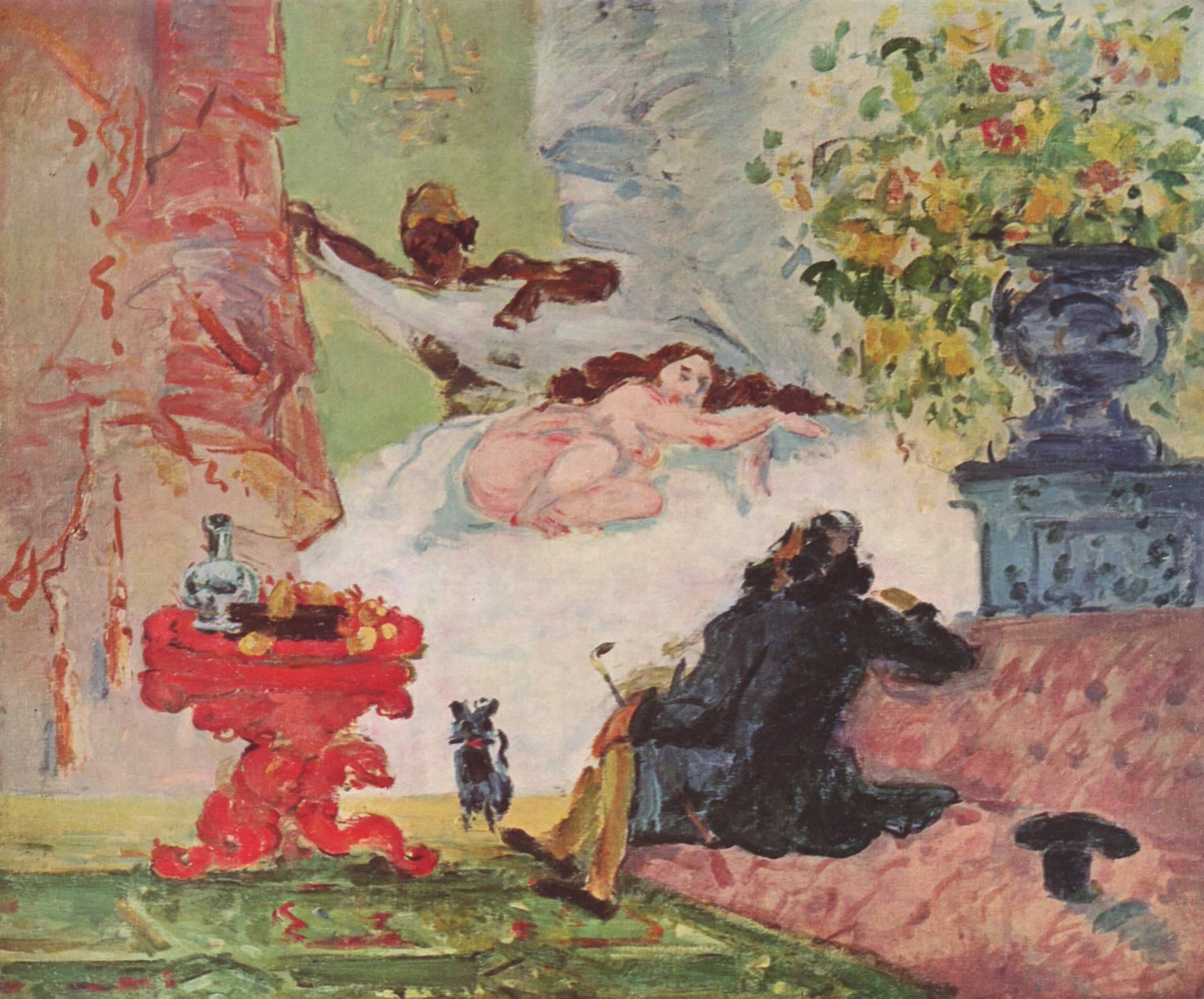
On white drapery in the middle of the canvas a female nude reclines, and above her a servant with a raised arm draws back the cloth. At the lower right a bearded man in a dark coat is seated; a top hat stands on the step beside him and a small black dog in front of him. To the left there is a red table with fruit and a glass carafe, at the upper right a blue-grey vase of flowers, and along the left edge a heavy pink curtain falls. The hand-painted painting on canvas reproduces this work by Cézanne of 1873–74, which in the original measures 46 × 55 centimetres and is kept under inventory number RF 1951 31 at the Musée d’Orsay in Paris.
The owner who painted his own canvas again
The canvas belonged for decades to the physician Paul Gachet of Auvers-sur-Oise – and Gachet copied it himself. He painted under the artist’s name Paul van Ryssel, and after this canvas he made an oil copy of his own and a drawing in pen and ink. Another copy, a watercolour, and a drypoint as well, are the work of Blanche Derousse. In 1999 an exhibition at the Grand Palais in Paris brought the original and these copies together: the catalogue printed them side by side on pages 36 to 43, with a technical comparison. The same work therefore exists from five hands in four media, and the original was listed there as number 1.
Who Doctor Gachet was
The 1999 exhibition carried his name: Un ami de Cézanne et de Van Gogh: le docteur Gachet – a friend of Cézanne and of Van Gogh, Doctor Gachet. It ran at the Grand Palais from 28 January to 26 April 1999, then travelled to the Metropolitan Museum of Art in New York, where from 25 May to 15 August 1999 it was called Cézanne to Van Gogh: The Collection of Doctor Gachet, and from 24 September to 5 December 1999 to the Van Gogh Museum in Amsterdam. On the physician’s death the canvas passed to his son, Paul Gachet junior.
Number 43 in the catalogue of 1874
From 15 April to 15 May 1874 the Première exposition de la Société anonyme des artistes peintres, sculpteurs, graveurs was held in the photographic studio of Nadar, at 35 boulevard des Capucines in Paris. This canvas stood there as number 43, with the addition Esquisse, that is a sketch, lent by Doctor Gachet. Under the preceding number, 42, hung The House of the Hanged Man at Auvers-sur-Oise, lent by the painter himself. A hundred and fifty years later the work returned to that exhibition: it was number 80 in Paris 1874: Inventer l’impressionnisme at the Musée d’Orsay from 26 March to 14 July 2024, and then at the National Gallery of Art in Washington from 8 September 2024 to 20 January 2025.
Two notices in the Paris press, both from 1874
Two papers came to speak of the exhibition within a fortnight. Louis Leroy published on 25 April 1874 in the satirical paper Le Charivari a text entitled L’exposition des impressionnistes; on page 80 the work is listed as Moderne Olympia. Marc de Montifaud published on 1 May 1874 in the magazine L’Artiste the text Exposition du boulevard des Capucines; there, on page 310, the same canvas is listed as L’Olympia. The record before us gives the author, the title, the paper, the date, the page and the name under which the work appears – but it does not say what either of them wrote about it, and we shall not fill that in. The names have grown to nine: Ambroise Vollard published it in 1914 as La Nouvelle Olympia and in 1921 as Die neue Olympia.
Seventy-seven years with one family
The provenance is short and unusually quiet. The catalogue lists Doctor Paul Gachet at Auvers-sur-Oise, then his son Paul Gachet junior, and in 1951 the Musée du Louvre in Paris with the note gift of Paul Gachet. From 1951 to 1986 the canvas stood in the Louvre’s galerie du Jeu de Paume, and in 1986 it passed to the Musée d’Orsay. In this whole chain not one dealer and not one auction appears: from the painter’s studio to the state the work passed through a single family, and as a gift.
Whom the catalogue counts among the people shown
The list of headings for this canvas is rich for once and runs to five entries. Among the still-life objects it names the vase, among the figure compositions the still-life in figure composition, among the historical and allegorical motifs the Olympia, and among the animals the dog. The fifth entry is the strangest: among the people it enters Cezanne (in figure composition). The catalogue’s own index therefore says that the bearded man seated at the lower right, watching the scene, is the painter himself.
It is a warm work tuned to pink and green and full of movement, which takes daylight and larger walls well. There are fifteen sizes to choose from, from 50 × 41 to 180 × 149 centimetres, all measurements in centimetres, with in-between measurements on request, and the effect of the chosen frame shown in advance by our 3D application. From Auvers comes Turn in the Road at Auvers-sur-Oise as well, and among the early figure compositions there is The Murder.
- Subject: A Modern Olympia, Paul Cézanne, 1873–1874, Musée d’Orsay, Paris
- Technique: hand-painted painting, oil on canvas, reproduction
- Sizes: 15 dimensions, custom size on request
- Of note: the owner of the canvas, the physician Paul Gachet, made a copy of it himself under the artist’s name Paul van Ryssel, and in 1999 a catalogue printed the original and the copies side by side with a technical comparison