



Description
The Mill on the Couleuvre near Pontoise – a landscape you can check on the spot
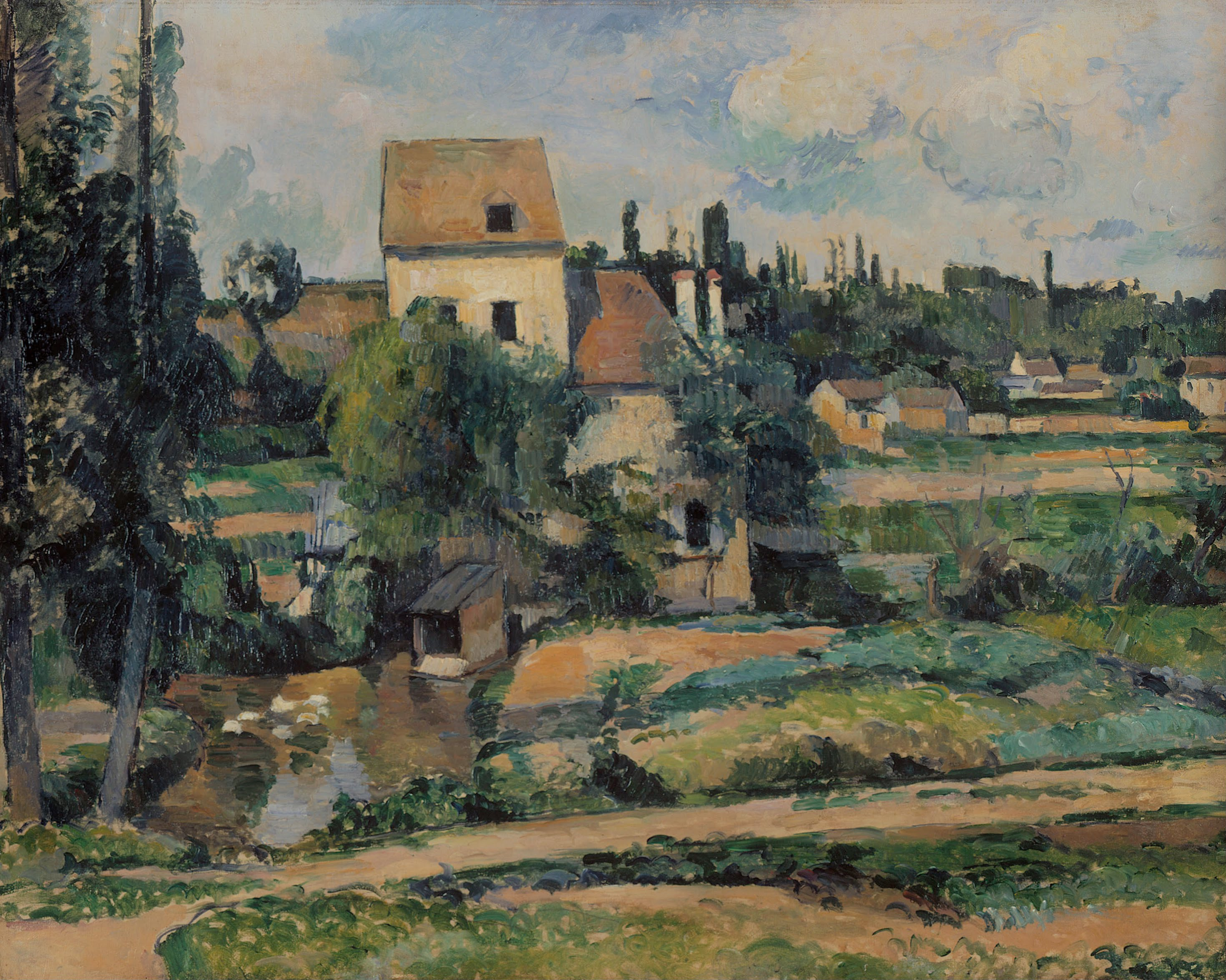
A tall mill with a pale façade and a steep ochre roof stands among greenery beside the water, a little left of the centre of the canvas. Below it lies a low wooden hut, and white ducks swim on the stream. A pinkish road runs along the whole lower edge, village roofs and a line of poplars stand to the right, and at the left edge two bare trunks rise into the sky. The hand-painted painting on canvas reproduces this work by Cézanne of 1881, which in the original measures 72.5 × 90 centimetres and is kept under inventory number A I 606 at the Alte Nationalgalerie in Berlin.
The mill has a name, a street and is still standing
Most of Cézanne’s landscapes are a view; this one is an address. The Berlin museum record names the building – it is le Moulin des Étannets, one of many mills in this grain-milling district – names the street that according to the record probably runs behind it, the Rue des Deux Ponts, and states that the structure survives today. The record goes further: in the strict frontal view the windows can be counted, and even the duck hut in the foreground can be recognised in an old photograph. The motif, the museum says, is rendered surprisingly faithfully, although the building appears strongly drawn up in height. That the canvas can be compared with the place is a habit of scholarship too: in the literature list for entry FWN 158 John Rewald appears three times – in Cézanne et Zola (1936), in Cézanne, sa vie, son œuvre (1939) and in the magazine Art News of 15 February 1944 – and each time the work is printed together with a photograph of the motif.
Pissarro painted the same mill at least twice
The canvas was made during a half-year stay at Pontoise near Paris, close to the older friend Camille Pissarro, who a few years earlier had set Cézanne on the impressionist road. The museum notes that Pissarro painted this same watermill at least twice. The ducks are unusual in this body of work, because Cézanne otherwise excluded living creatures from his landscapes; the museum cautiously suggests that they may be a greeting to Pissarro, who loved everyday motifs. Cézanne revered him to the last: in a letter to Émile Bernard of 1905 he called him modest and colossal. In 2005 and 2006 the work was number 93 in the exhibition Pioneering Modern Painting: Cézanne & Pissarro 1865–1885 at the Museum of Modern Art in New York.
From the colour seller to a Berlin museum
The first known owner is Julien Tanguy (1825–1894), a Paris dealer in artists’ supplies – the canvas first belonged to the man who sold the paint. After him the museum record lists the painter Jacques-Émile Blanche (1861–1942), whom the catalogue raisonné leaves out of its own chain, then the poet and writer Robert de Bonnières (1850–1905), and from 1890 to 1897 the gallery of Paul Durand-Ruel in Paris. Precisely those years with the dealer were the subject of the exhibition Paul Durand-Ruel: Le Pari de l’Impressionnisme, held in 2014 and 2015 at the Musée du Luxembourg in Paris, where the work was listed as number 6.
July 1897: a purchase and a gift at once
The canvas reached Berlin in July 1897, nine years before the painter died. Exactly how, the record states twice and each time differently. The provenance says the work was bought for the Nationalgalerie by Hugo von Tschudi (1851–1911), art historian and director of the gallery; the acquisition field says instead that in 1897 it was the gift of a Berlin friend of the arts, whose name, Wilhelm Staudt, stands only in brackets. The catalogue raisonné carries a third version: Gift of William Staudt, with the first name anglicised. A purchase, a gift, an unnamed lover of art, a Wilhelm in brackets and an English William – for a single event in a single year. Why there are two forms neither the museum nor the catalogue explains, and we will not guess at it.
Brussels, January 1890: the first exhibition
The museum text signed by Claude Keisch records that this work is among those Cézanne let out of his hands soon after they were made and allowed to be exhibited. The record confirms it: in January 1890 the canvas hung in the Palais des Beaux-Arts in Brussels at the exhibition of the group Les XX, as number 1, under the title Etude de Paysage, lent by de Bonnières. From February to April 1906 it was number 34 at the international exhibition of the Bremen Kunstverein, this time as Landschaft and as a loan from the Royal National Gallery in Berlin.
An exhibition whose title the record does not explain
Between 2 November 1958 and 12 April 1959 the canvas was number 131 in an exhibition at the Nationalgalerie in Berlin entitled Schätze der Weltkultur von der Sowjetunion gerettet – treasures of world culture saved by the Soviet Union. It was listed there as Die Mühle von Pontoise. That is all the record says: the title of the exhibition, the dates, the number. Where the canvas was in the years before that show and how it came to be in it is not written in the sources before us, and so we shall not fill it in.
What Berlin first called it
The museum bought a Cézanne early but named him cautiously. On 27 January 1898 Hans Mackowsky listed the work in the magazine Kunstchronik among the gallery’s new acquisitions, in column 198, as Freilichtstudie, an open-air study. In the Catalogue of the Royal National Gallery in Berlin, published by Max Jordan in 1901, it is entered on page 275 under number 743 as Landschaft, Studie – landscape, study. Georges Rivière in 1923 called it Bourgade dans les arbres and dated it to 1879. Only much later did the title that names the river and the town take hold. In 1996 and 1997 the work was number 59 in the exhibition Manet bis Van Gogh: Hugo von Tschudi und der Kampf um die Moderne.
It is a quiet, middling-dark work tuned to green and ochre, which takes daylight and large walls well. We paint it in fifteen sizes, from 50 × 40 to 180 × 144 centimetres, intermediate measurements we stretch on a made-to-measure stretcher frame, and how it will look in the chosen frame is shown in advance by our 3D application. Pissarro was also the first owner of the Still Life with Soup Tureen, and from the same Oise valley come The House of the Hanged Man at Auvers-sur-Oise and Turn in the Road at Auvers-sur-Oise.
- Subject: The Mill on the Couleuvre near Pontoise, Paul Cézanne, 1881, Alte Nationalgalerie, Berlin
- Technique: hand-painted painting, oil on canvas, reproduction
- Sizes: 15 dimensions, custom size on request
- Of note: the museum record names the mill, gives the street behind it and states that the building still stands, while the duck hut in the painting can be recognised in an old photograph