







































Description
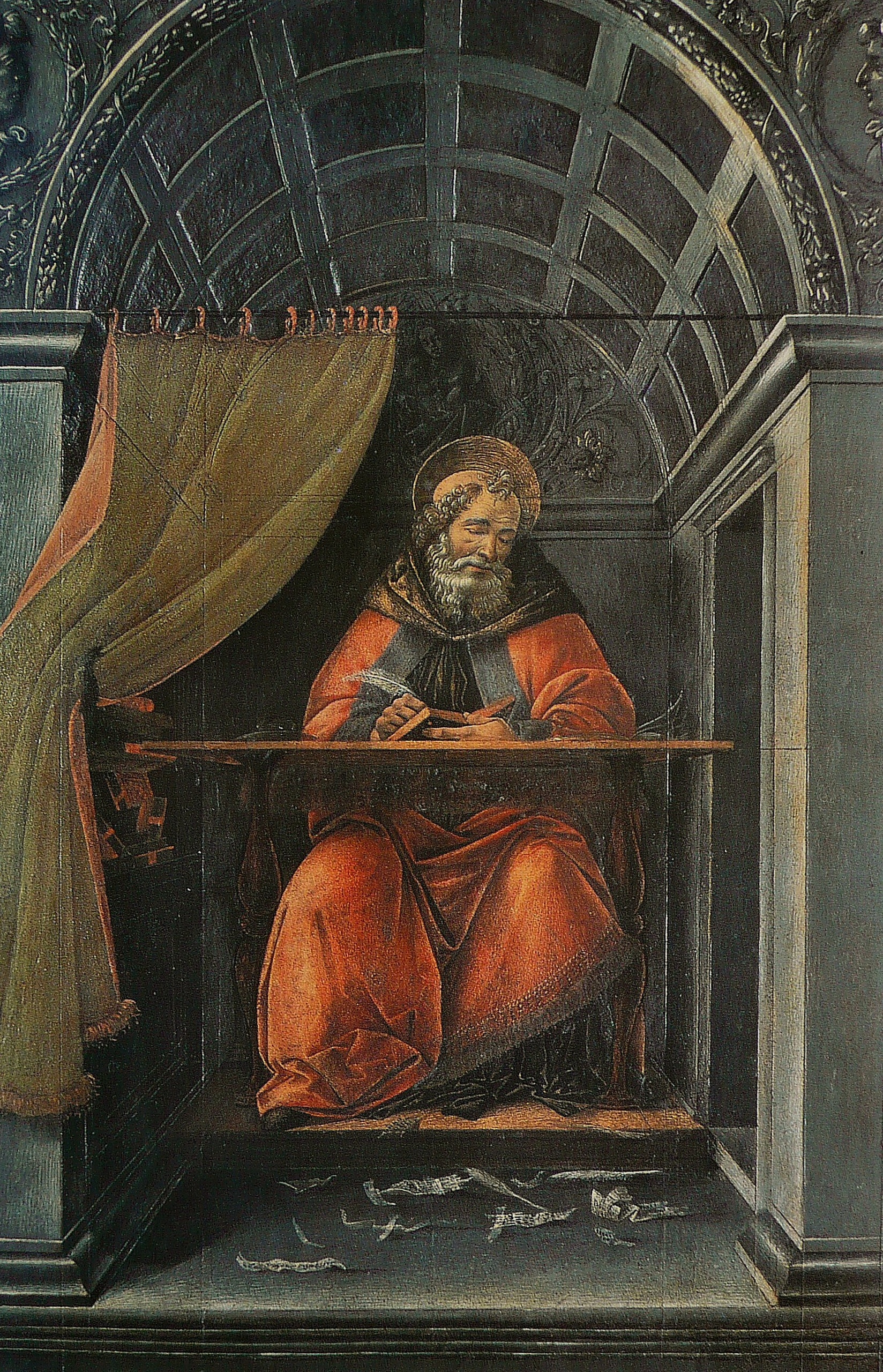
Saint Augustine in His Cell is a small panel Sandro Botticelli painted around 1490–1494: the saint writes with a quill at his desk in a narrow stone cell under a coffered vault, an olive-green curtain is drawn back to the left, and torn, crumpled sheets lie on the floor. The original, tempera on panel measuring just 41 x 27 cm, is in the Uffizi Gallery in Florence. Our painter paints it for you by hand in oil on canvas, in 8 portrait sizes from 29 x 46 to 128 x 191 cm or made to measure, and every size is larger than the panel in Florence. You see a photograph of your finished Saint Augustine before it leaves us.
| Title: | Saint Augustine in His Cell |
| Other titles: | Sant’Agostino nello studio (Italian title) · Sveti Avguštin v celici (Slovene title) |
| Painter: | Sandro Botticelli (c. 1445–1510) |
| Year painted: | c. 1490–1494 |
| Original size: | 41 cm x 27 cm (height x width) |
| Original technique: | Tempera on panel |
| Painting style: | Early Renaissance |
| Located at: | Uffizi Gallery, Florence, Italy |
| Our reproduction: | Hand-painted in oil on canvas, 8 sizes or made to measure |
Saint Augustine in His Cell – Sandro Botticelli
What does Saint Augustine in His Cell show?
A barrel vault with square coffers curves over the cell, closed at the front by a round arch carved with a garland of leaves. Beside the arch, in laurel wreaths, two medallions show male profiles; in the lunette at the back a shallow relief shows the Madonna and Child.
In the middle the saint sits on a tall seat on a wooden platform: white beard, curly hair, golden halo. Over a dark monastic scapular he wears a bright red cloak that falls in broad folds to the floor. His right hand guides the quill, his left holds a sheet, and his eyes rest on the text.
On the left an olive-green curtain with a red lining and fringe hangs from rings, pushed aside as if someone had just opened it. A door opens on the right, and opposite it stands a shelf of books. Torn sheets and worn quills lie before the platform, catching the eye on the dark stone almost as much as the red cloak.
What does this quiet scene mean?
Augustine is shown as a writer and thinker. There is no miracle or vision, as in the predella of the San Marco Altarpiece, only focused work at the desk.
His clothes combine two roles: the red cloak is a bishop’s, the dark scapular points to the order of hermits named after him. Ronald Lightbown therefore suggested that an Augustinian hermit of Santo Spirito in Florence ordered the panel.
The Madonna in the lunette is read as a nod to the saint’s writings on the mother of Christ. The medallions may show the emperors Arcadius and Honorius, Augustine’s contemporaries.
Why is this little panel so admired?
The coffers shrink towards the back, the edges of the walls run to the rear wall, and although the panel is only 41 centimetres high, we look into a real room. Yet it is deliberately not built to human size: the saint could not stand up and the door is too small for him, so every glance stays on the writer.
The panel belongs to the last decade of the 15th century. The English article calls it Saint Augustine in His Study and links it, like many of the painter’s late works, to the preaching of Girolamo Savonarola. Herbert Horne saw in the head and hands the same nervous line as in Calumny of Apelles.
Its small size points to private prayer and viewing up close. The Wikipedia article on the panel, written in English, gives a short account of it.
Where is the original, and how did it get there?
The original has been in the Uffizi Gallery in Florence since 1779. Before that it belonged to the patron Bernardo Vecchietti; Giorgio Vasari saw it in his house and gave it to Filippo Lippi, while in 1584 Vincenzo Borghini described it at the villa Il Riposo as a very fine work by Botticelli.
The wrong attribution lasted until the late 19th century. Giovanni Morelli was the first to argue firmly for Botticelli in 1890, Herbert Horne followed in 1908, and no one doubts it today.
Do not confuse it with the large fresco of Saint Augustine in the Florentine church of Ognissanti, painted by Botticelli a decade earlier for the Vespucci family. That is a different, far larger work, and not one we offer.
Saint Augustine in His Cell or another Botticelli?
Saint Augustine in His Cell is a canvas painting for anyone who loves quiet, books and a precisely built space. Its tall, narrow format suits a study, a library or a slim wall beside a door.
Equally monumental architecture fills Cestello Annunciation of 1489–1490, with which scholars compare the walls and vault of this cell. Another carefully built room frames The Annunciation (Glasgow).
For another small devotional panel from his late years, choose The Last Communion of Saint Jerome, where monks hold up the old saint. All our famous Botticelli paintings are together on the Sandro Botticelli page.
How do we hand-paint Saint Augustine in His Cell?
Botticelli’s original is not an oil painting but tempera on a wooden panel of 41 x 27 cm. Our painter works in oil on canvas, layer by layer, so this Sandro Botticelli reproduction stays flexible: it can be rolled, stretched on a stretcher bar or framed.
He first fixes the arch, coffers and wall edges in a fine drawing, then lays in the greys of the stone. Next come the green curtain and the red cloak, built in several layers so the folds gain weight, and a fine brush finishes the face, halo, quill and sheets.
Which size suits which wall?
In short: small sizes for a desk or narrow wall, middle sizes for a hallway or study, the largest for a living room or stairwell.
We paint Saint Augustine in His Cell in 8 portrait sizes (width x height): 29 x 46, 38 x 55, 42 x 65, 55 x 85, 70 x 110, 81 x 120, 100 x 155 and 128 x 191 cm. The original measures only 27 x 41 cm (width x height), so every one of our sizes is larger: 29 x 46 cm only slightly, 128 x 191 cm almost five times on each side.
The 29 x 46 and 38 x 55 cm sizes sit above a desk or between two windows, where you see them up close; 42 x 65 and 55 x 85 cm suit a hallway or bedroom. As a painting for the living room it works from 70 x 110 cm upwards, and the two largest sizes are for a tall wall or a stairwell.
Can I have another size, and which frame should I choose?
Yes. For other proportions the saint, desk and curtain stay whole and we adjust the strip of floor or the edge of the vault, so this oil painting reproduction still shows the whole cell. Send us your custom size and we will come back with a price and a date for your Augustine.
Your Saint Augustine travels rolled in a tube, stretched on a stretcher bar or framed. The stretching, framing and careful packing of your panel copy are done by our workshop in Slovenia. You pick a moulding to suit the grey stone and red cloak in our 3D app; a view of the painting on your own wall is a separate service.
When will your Saint Augustine arrive?
Your Saint Augustine is ready to ship 15 to 45 working days after you confirm the order. Once the last sheet on the floor is painted, we send you a photograph and make any change you ask for before packing.
Within Slovenia and the EU you pay no customs duty, and our returns policy applies to every order.
A writer at his desk is a fine gift for someone who likes to read, write or teach. If you are unsure which size to pick, give a gift voucher and let them choose for themselves.
Frequently asked questions
Where does Botticelli’s original hang?
In the Uffizi Gallery in Florence, where it has been since 1779.
Is it a print?
No. It is a hand-painted copy that our painter brushes in oil on canvas.
How big is the original panel?
41 x 27 cm (height x width); even our smallest size, 29 x 46 cm, is a little larger.
Will you paint the saint in his cell in an unlisted size?
Yes. Tell us the width and height you want and we will reply with a price and a date.
How long will I wait for Saint Augustine, and how does he travel?
15 to 45 working days until dispatch; then he travels rolled, stretched or framed.
Will it suit a study or a library?
Yes. A writer among books and papers seems made for a room where you read and work.
Why are there crumpled sheets on the floor?
They show the effort of writing: the saint has thrown away what did not satisfy him, and time enters the scene.
Is it the same work as the fresco in Ognissanti?
No. The fresco is earlier and much larger; our painting follows the small panel in the Uffizi.
- Subject: Augustine writes at his desk in a narrow stone cell under a coffered vault, beside a drawn-back green curtain, with crumpled sheets on the floor.
- Original: tempera on panel, c. 1490–1494, 41 x 27 cm, Uffizi Gallery, Florence.
- Ours: hand-painted in oil on canvas, 8 sizes from 29 x 46 to 128 x 191 cm, or made to measure; all larger than the original.
- Worth knowing: Vasari thought it was by Filippo Lippi; it was firmly given back to Botticelli only in the late 19th century.