







































Description
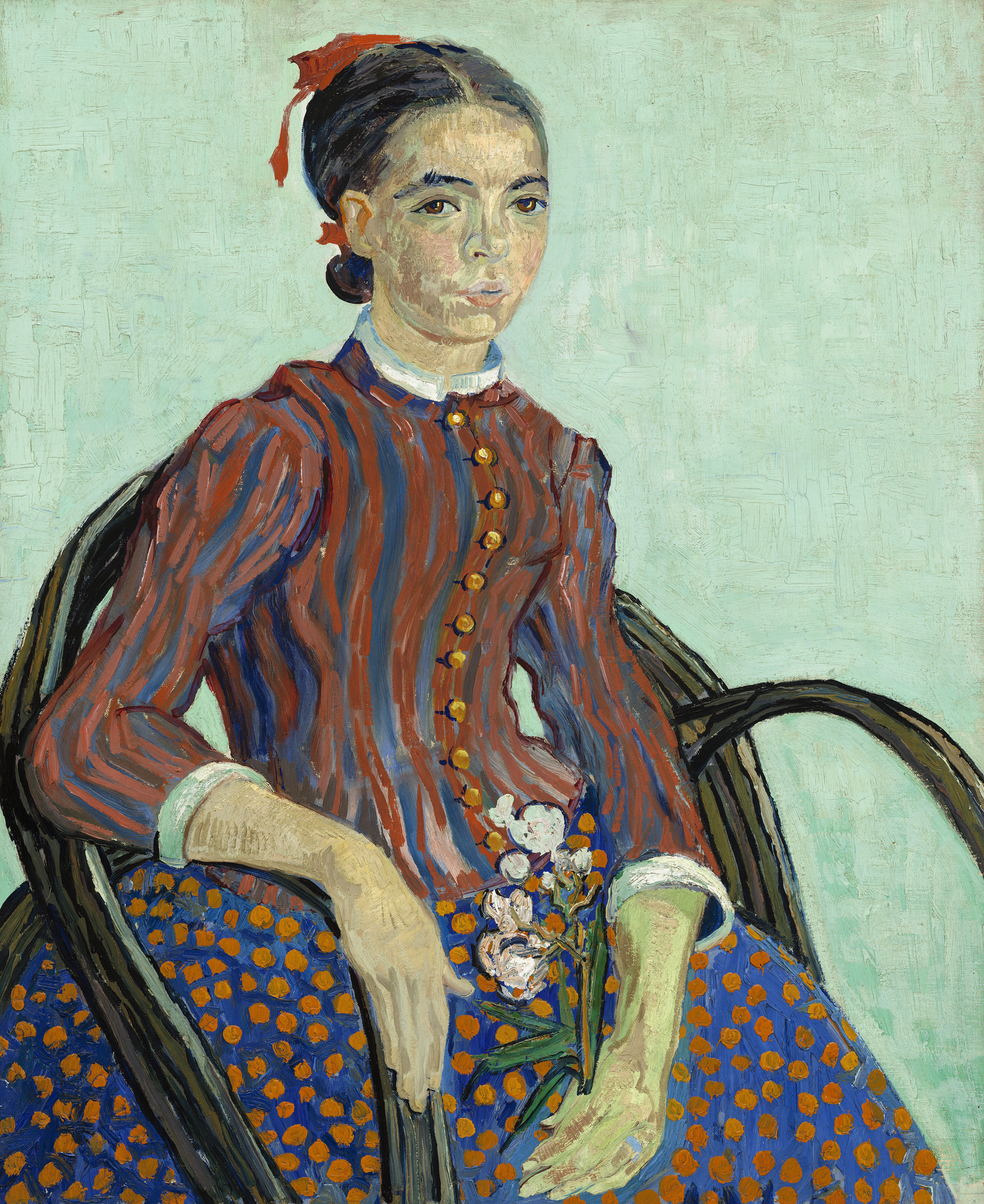
La Mousmé is the portrait Vincent van Gogh painted in Arles in 1888 of a young Provençal girl he called a mousmé: she sits in a cane armchair in a red-and-blue striped jacket and a blue skirt with orange dots, holding a sprig of oleander, against a pale green background. The original, oil on canvas, measures 73.3 x 60.3 cm and is in the National Gallery of Art in Washington. We paint it by hand in oil on canvas, in 16 sizes from 40 x 50 to 135 x 160 cm or to your own measurements, and send you a photograph of the finished painting for approval before dispatch.
| Title: | La Mousmé |
| Other titles: | La Mousmé, Sitting in a Cane Chair · La Mousmé seduta |
| Painter: | Vincent van Gogh (1853–1890) |
| Year painted: | 1888, Arles |
| Original size: | 73.3 cm x 60.3 cm |
| Original technique: | Oil on canvas |
| Painting style: | Post-Impressionism |
| Located at: | National Gallery of Art, Washington (acc. no. 1963.10.151) |
| Our reproduction: | Hand-painted oil on canvas, 16 sizes or made to measure |
La Mousmé – Vincent van Gogh
What does La Mousmé show?
A young girl sits in a cane armchair, seen from her head down to just above the knees. The chair is turned to our right, but she turns her face to look straight at us. Her dark hair is parted in the middle and tied with a red ribbon, and the skin of her face and hands is touched with green. Her right arm, on our left, rests along the dark, curved arm of the chair.
Her jacket is high-necked and striped in brick red and deep blue, with a row of round orange-gold buttons down the front, a white collar and white cuffs at the forearms. The skirt fills the lower half of the canvas: deep blue, covered with orange dots. In her other hand, resting in her lap on our right, she holds a sprig of oleander with light pink flowers and green leaves. Behind her is an even field of pale green.
Why did Van Gogh call her a mousmé?
The word comes from a book. The National Gallery of Art writes that the title of the portrait comes from a French novel about Japan, in which the mousmé is a young woman described as innocent and pure. The English Wikipedia article on La Mousmé names the novel, Pierre Loti’s Madame Chrysanthème, and quotes Van Gogh’s letter to his brother Theo: ‘It took me a whole week … but I had to reserve my mental energy to do the mousmé well. A mousmé is a Japanese girl – Provençal in this case – twelve to fourteen years old.’
So the girl in the chair is not Japanese. In his own words she is a Provençal girl, and the Japanese word is the name he gave her. Wikipedia adds that his greatest attention went to her face, to which he gave the colouring of a girl from Arles, but with a Japanese influence.
What does La Mousmé mean?
It belongs to Van Gogh’s dream of finding Japan in Provence. Wikipedia writes that he painted it in 1888 while living in Arles, which he called ‘the Japan of the south’, in the hope that his time there would bring the simple yet dramatic expression of Japanese art into his work. The National Gallery of Art writes that he found the inspiration for this portrait in the bold complementary colours and contrasting patterns of the Japanese woodblock prints he collected.
The flowers carry meaning too, in Wikipedia’s reading: the girl’s posture mimics that of the oleander, and the flowering oleander, like the girl, is in the blossoming stage of life. Of portrait studies such as this one, Van Gogh wrote, as Wikipedia quotes him, that they were ‘the only thing in painting that excites me to the depths of my soul, and which makes me feel the infinite more than anything else’.
Where is the original today?
The original is in the National Gallery of Art in Washington, which lists it as La Mousmé by Vincent van Gogh, 1888, oil on canvas, 73.3 cm high and 60.3 cm wide, Chester Dale Collection, under the accession number 1963.10.151.
The museum’s provenance traces how it got there. The painting first belonged to the artist’s sister-in-law Johanna van Gogh-Bonger of Amsterdam, who sold it in May 1909. Later owners include the Paris collector Alphonse Kann, by 1917, and J.B. Stang in Oslo. On 21 May 1929 it was sold to the New York collector Chester Dale, and it came to the National Gallery of Art with his bequest in 1963.
La Mousmé or another Van Gogh – which should you choose?
First, which Mousmé this is. Wikipedia lists several drawings of the same subject; the one we paint is the oil painting in the National Gallery of Art, with the girl seated in a cane armchair and holding a sprig of oleander.
If you would like a companion portrait, four from our range go with it. Portrait of Joseph Roulin is Van Gogh’s portrait of the postman Joseph Roulin, whom he painted in Arles. L’Arlésienne shows Madame Ginoux of Arles with books. The Zouave is his portrait of a soldier of the Zouave regiment, painted in Arles in 1888, and The Italian Woman comes from his Paris years. Choose La Mousmé for a young face among bright patterns on a calm ground.
How is our hand-painted version of La Mousmé made?
The painter first draws the figure, the curves of the chair and the outline of the skirt, and checks the proportions against the original. Then comes the pale green background, laid in visible strokes, after it the striped jacket, the dotted skirt and the dark arms of the chair, and last the face, the hands and the oleander. Our oil painting reproduction is painted by hand on canvas, with real impasto: the paint goes on thickly, so the brushstrokes stand up from the canvas as they do in the original and catch the light.
On this painting the relief shows most in the stripes of the jacket, in the round orange dots of the skirt and in the patchy touches of the skin. A print is completely flat; on our painting every brushstroke stands out in real paint.
Every painting is a hand-painted copy made for your order, so no two are quite the same.
Which size for which wall?
Short answer: 40 x 50 or 55 x 66 cm for a narrow wall in a hallway or a bedroom, 64 x 80 or 80 x 100 cm above a chest of drawers or a desk, and 100 x 120 or 120 x 140 cm above a sofa or on a large wall.
There are 16 sizes: 40 x 50, 55 x 66, 60 x 70, 64 x 80, 70 x 85, 75 x 90, 80 x 100, 85 x 105, 90 x 110, 93 x 115, 100 x 120, 105 x 125, 110 x 130, 120 x 140, 127 x 150 and 135 x 160 cm (width x height). The original is about 60 cm wide and 73 cm high, so our 60 x 70 cm size is close to the size of the original, and 64 x 80 cm is a little larger with similar proportions. A painting for the living room should cover about two thirds of the width of the furniture below it.
Hang it with the centre of the canvas about 150 cm above the floor, so that the girl’s face is close to your own eye level. Above a sofa, a bed or a sideboard, leave 20 to 30 cm between the top of the furniture and the bottom of the canvas.
What if I need a custom size or a frame?
If none of the 16 sizes fits your wall, we paint it to measure in any width and height you need. Send us the width and height you want and we will quote you a price and a delivery time. Every painting we make is mounted on a wooden stretcher, ready to hang.
Our 3D app shows each of our frame profiles on this painting, so you can compare gold, silver, black, white and natural wood. The app is for choosing the frame only. To see the painting on your own wall, use our separate room placement service. A gold frame picks up the orange of the dots and the buttons, while a dark wood or black one repeats the dark arms of the chair and the deep blue of the skirt.
How does delivery work, and what is the guarantee?
Every painting is made to order in our studio in Slovenia, so allow 15 to 45 days depending on the size you choose. We ship it on its stretcher, carefully packed (and framed, if you chose a frame), across the EU with no customs duty. Before dispatch we send you a photograph of the finished painting to approve, and we correct anything that is not right. Our returns policy applies to every order.
You will find more of Van Gogh’s famous works among all our Vincent van Gogh paintings, and more about the painter in our article on Vincent van Gogh. If it is a present and you are not sure of the size, a wall art voucher lets the recipient choose.
Frequently asked questions
Where is the original of La Mousmé today?
In the National Gallery of Art in Washington. The museum lists it as La Mousmé, 1888, oil on canvas, 73.3 x 60.3 cm, Chester Dale Collection, accession number 1963.10.151. The New York collector Chester Dale bought it in 1929, and it came to the museum with his bequest in 1963.
What does the word mousmé mean?
A young Japanese girl, in the sense Van Gogh took from Pierre Loti’s novel Madame Chrysanthème. In his letter to Theo, quoted by Wikipedia, he wrote that a mousmé is a Japanese girl, Provençal in this case, twelve to fourteen years old. The National Gallery of Art adds that in the novel the mousmé is a young woman described as innocent and pure.
When and where did Van Gogh paint La Mousmé?
In Arles, in the south of France, in 1888. The National Gallery of Art dates it to 1888, and Wikipedia places it in his time in Arles, the town he called the Japan of the south. He told his brother that it took him a whole week, and that he had to save his mental energy to paint her well.
What flower is the girl holding in La Mousmé?
Oleander. The National Gallery of Art describes a sprig of blooming oleander, with light pink flowers and green leaves, in the hand that rests in her lap. Wikipedia reads it as part of the meaning: her posture mimics that of the oleander, and the flowering oleander, like the girl, is in the blossoming stage of life.
Are there other versions of La Mousmé?
There are drawings of the same girl. Wikipedia lists several drawings for this painting, among them a seated Mousmé in the Pushkin Museum in Moscow. The work we paint is the oil on canvas in the National Gallery of Art in Washington, from 1888, with the girl in a cane armchair holding a sprig of oleander.
How big is the original of La Mousmé?
73.3 cm high and 60.3 cm wide, according to the National Gallery of Art: a mid-sized upright portrait. Our 60 x 70 cm size comes close to the original, and 64 x 80 cm is slightly larger. If you want the girl smaller or larger, there are 16 sizes from 40 x 50 to 135 x 160 cm, and custom sizes in any proportions.
Which size of La Mousmé suits a living room?
Above a sofa, choose 100 x 120 or 120 x 140 cm, so that the canvas painting holds its own on a large wall and the stripes and dots can be read from across the room. On a narrower wall, beside a bookcase or above a sideboard, 64 x 80 or 80 x 100 cm works well. For a small room, 55 x 66 cm keeps the face clear.
Does your copy of La Mousmé have the raised brushstrokes of the original?
Yes. We paint it in impasto, building up each brushstroke in thick oil, so the surface is raised like Van Gogh’s original. You see this best in the stripes of the jacket, in the orange dots of the skirt and in the strokes of the pale green background, where the relief catches the light from the side.
- Subject: a young Provençal girl in a cane armchair, in a red-and-blue striped jacket and a blue skirt with orange dots, holding a sprig of oleander.
- Original: 1888, Arles, oil on canvas, 73.3 x 60.3 cm, National Gallery of Art, Washington.
- Ours: a Van Gogh reproduction painted by hand in oil on canvas, in 16 sizes from 40 x 50 to 135 x 160 cm or made to measure.
- Worth knowing: our 3D app shows every frame profile on this portrait, so you can choose the frame before you order.