







































Description
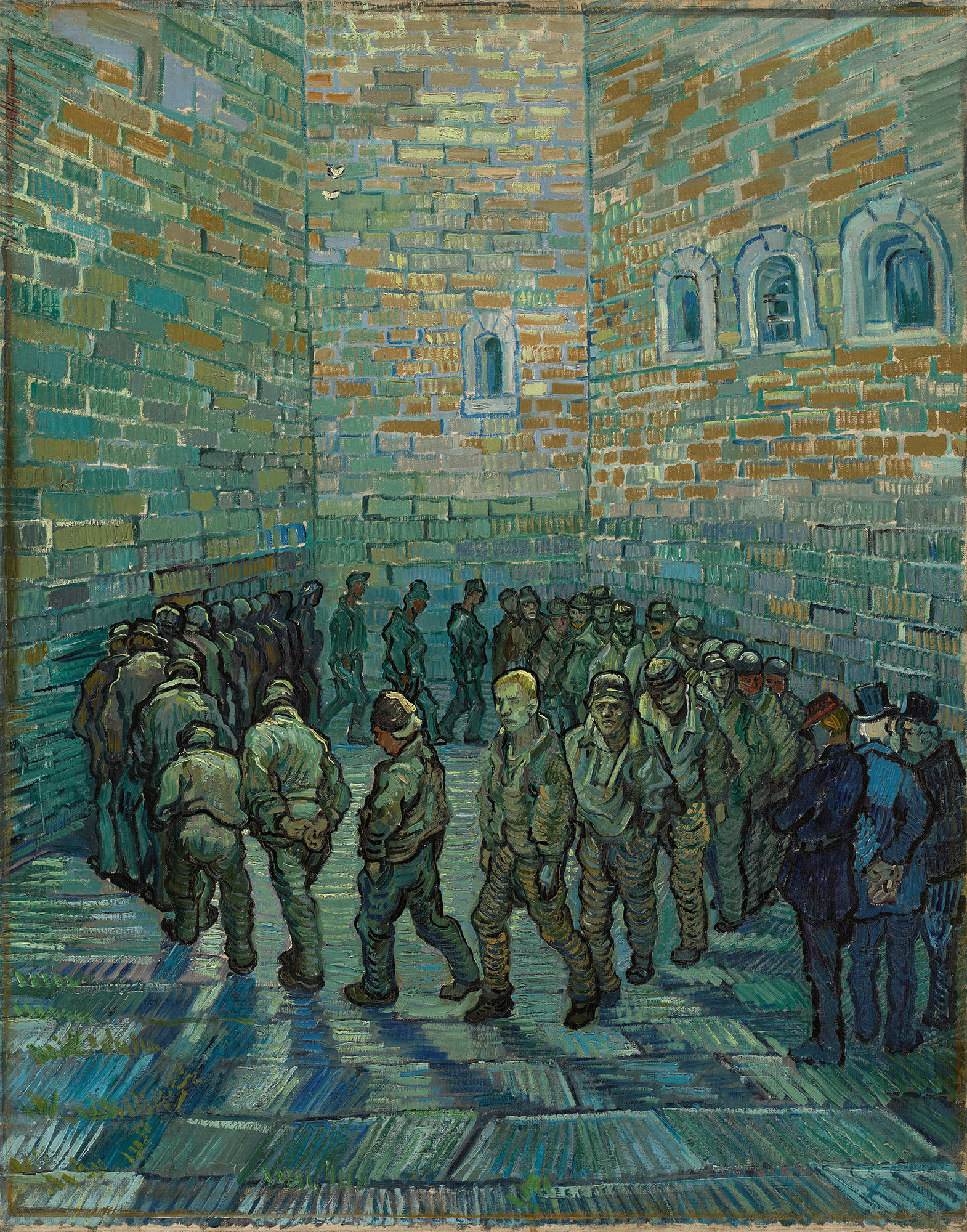
Prisoners’ Round (after Doré) is the painting Vincent van Gogh made in February 1890 at the asylum in Saint-Rémy-de-Provence, after an engraving by Gustave Doré: a line of prisoners walking in a circle at the bottom of a narrow prison yard, shut in by high blue-green brick walls, while three men in hats stand watching on the right. The original measures 80 x 64 cm and hangs in the Pushkin Museum in Moscow. We paint it by hand in oil on canvas, in 16 sizes from 40 x 50 to 127 x 160 cm or to your own measurements, and send you a photograph of the finished painting for approval before dispatch.
| Title: | Prisoners’ Round (after Doré) |
| Other titles: | Prisoners’ Round (after Gustave Doré) · The Prisoners’ Round · Prisoners Exercising · Penitentiary (after Doré) |
| Painter: | Vincent van Gogh (1853–1890) |
| Year painted: | February 1890, Saint-Rémy-de-Provence |
| Original size: | 80 cm x 64 cm |
| Original technique: | Oil on canvas |
| Painting style: | Post-Impressionism |
| Located at: | Pushkin Museum, Moscow |
| Our reproduction: | Hand-painted oil on canvas, 16 sizes or made to measure |
Prisoners’ Round (after Doré) – Vincent van Gogh
What does Prisoners’ Round (after Doré) show?
A long line of prisoners in caps and grey-green clothes walks one behind the other in a tight circle, hands in their pockets or clasped behind their backs; their shadows fall across the paving. There is no sky at all: on every side the brick walls rise beyond the top of the canvas, with four small arched windows high up. On the right, apart from the circle, three men in hats and dark coats stand and watch, one of them in a top hat.
According to Wikipedia, the prisoners are paraded past detectives who are to remember their faces. The depths of the yard are painted in blues and greens, the better lit bricks above in touches of red and orange, and higher up two small white butterflies flutter against the wall. One prisoner at the front of the group, without a cap and with a paler face, has turned his head and looks out towards you.
Why did Van Gogh copy Doré’s prison yard?
Because he could not go out to paint. From May 1889 to May 1890 Van Gogh lived at the Saint-Paul asylum in Saint-Rémy, and for long stretches he could not go out to paint from life. The asylum’s director and his brother Theo encouraged him to keep painting, so he copied prints of other artists’ work, translating their black and white into his own colour.
The model was Newgate – Exercise Yard, an engraving by Gustave Doré published in 1872 in the book London: A Pilgrimage, which Doré made with the writer Blanchard Jerrold. Van Gogh worked from a wood engraving after it by Héliodore Pisan, printed in the Dutch magazine De Katholieke Illustratie. He drew grid lines on that print to help with the proportions; it is now in the Van Gogh Museum. On 12 February 1890 he wrote to Theo: “I’ve tried to copy Daumier’s Drinkers and Doré’s Penitentiary, it’s very difficult.” You can read the whole letter, with notes on the print, in the online edition of his letters.
What does Prisoners’ Round mean?
Van Gogh left no explanation, but the subject came close to his own life: painted in an asylum, the scene recalls his own detention and his isolation, a man alone in a circle of other men. The painter Émile Bernard saw it among the canvases hung around Van Gogh’s coffin in July 1890 and wrote of convicts walking in a circle surrounded by high prison walls, a canvas “of a terrifying ferocity” that was also symbolic of his end.
The prisoner who turns towards you carries much of that reading. Wikipedia notes that his features may resemble Vincent’s own, and the Italian Wikipedia article reports that some critics see in him a self-portrait. Take it as an interpretation, not a fact. What the painting shows for certain is the contrast between the endless circle below and the warm light and two butterflies at the top.
Where does the original hang?
The original hangs in the Pushkin Museum in Moscow. It is oil on canvas, 80 cm high and 64 cm wide, and it is listed in the catalogues of Van Gogh’s work as F669 and JH1885.
After Theo’s death in January 1891 it passed to his widow, Johanna van Gogh-Bonger, then to Willy Gretor, Maurice Fabre and Alexandre Berthier, Prince of Wagram. By 1909 it belonged to the Moscow collector Ivan Morozov. His collection was nationalised after the revolution and became part of the State Museum of New Western Art, and in 1948 the painting moved to the Pushkin Museum. It also inspired a prison scene in Stanley Kubrick’s 1971 film A Clockwork Orange. The story of the painting and its owners is told on Wikipedia.
Prisoners’ Round or another of his copies – which should you choose?
Prisoners’ Round belongs to a small group of paintings Van Gogh made at the asylum after other artists’ prints. Pietà (after Delacroix), painted in September 1889, follows a lithograph after Eugène Delacroix: the Virgin Mary mourning the dead Christ, in deep blue and gold. The Siesta goes back to Jean-François Millet: two harvesters asleep in the hay at midday, in yellow and blue. At Eternity’s Gate, from May 1890, reworks his own early lithograph of an old man by the fire.
Choose Prisoners’ Round for a serious subject with a story behind it, and The Siesta for a calm, sunny copy. For a landscape instead of a copy, there are Cypresses, painted in Saint-Rémy in 1889.
How is our hand-painted Prisoners’ Round made?
The painter first draws the yard, the circle of figures and the three men on the right, and checks the proportions against the original. Then come the brick walls in blue, green and touches of red, the paving with its long shadows, the prisoners one by one, the men in hats, and last the windows, the paler face at the front and the two white butterflies. Our oil painting reproduction is painted by hand on canvas, with real impasto: the paint goes on thickly, so the brushstrokes stand up from the canvas as they do in the original and catch the light.
On this painting the relief matters most on the walls, where every brick is a separate stroke, and on the paving. A print is completely flat; on our painting every brushstroke stands out in real paint.
Every painting is a hand-painted copy made for your order, so no two are quite the same.
Which size for which wall?
Short answer: 49 x 60 or 54 x 65 cm above a desk or a chest of drawers, 64 x 80 cm for the size of the original, 80 x 100 or 90 x 110 cm above a sofa, and 127 x 160 cm for a large empty wall. The upright format suits a narrow wall, the space between two windows, a hallway or a staircase.
There are 16 sizes: 40 x 50, 49 x 60, 50 x 62, 54 x 65, 60 x 70, 64 x 80, 70 x 90, 74 x 94, 80 x 100, 85 x 105, 90 x 110, 100 x 120, 105 x 125, 109 x 135, 120 x 150 and 127 x 160 cm (width x height). The original is 64 cm wide and 80 cm high, so our 64 x 80 cm size is exactly the size of the painting in Moscow. The blue-green colours suit a white or light grey wall. The subject is serious and suits a study, a library, an office or a hallway rather than a child’s room. A painting for the living room should cover about two thirds of the width of the furniture below it.
Hang it with the centre of the canvas about 150 cm above the floor. Above a sofa or a sideboard, leave 20 to 30 cm between the top of the furniture and the bottom of the canvas.
What if I need a custom size or a frame?
If none of the 16 sizes fits your wall, we paint it to measure. Keep the proportions close to the original, otherwise the yard and the figures get squeezed or stretched. Send us the width and height you want and we will quote you a price and a delivery time. Every painting we make is mounted on a wooden stretcher, ready to hang.
Our 3D app shows each of our frame profiles on this painting, so you can compare gold, silver, black, white and natural wood. The app is for choosing the frame only. To see the painting on your own wall, use our separate room placement service. A simple dark frame closes the yard like the walls themselves, and an old gold frame picks up the warm bricks at the top.
How does delivery work, and what is the guarantee?
Every painting is made to order in our studio in Slovenia, so allow 15 to 45 days depending on the size you choose. We ship it on its stretcher, carefully packed (and framed, if you chose a frame), across the EU with no customs duty. Before dispatch we send you a photograph of the finished painting to approve, and we correct anything that is not right. Our returns policy applies to every order.
You will find more of Van Gogh’s famous paintings in our Vincent van Gogh gallery, and there is more about the painter in our article on Vincent van Gogh. If you are giving it as a present and are not sure of the size, a wall art voucher lets the recipient choose.
Frequently asked questions
Where is Van Gogh’s Prisoners’ Round today?
In the Pushkin Museum in Moscow. It came there in 1948 from the State Museum of New Western Art, which had taken over the nationalised collection of Ivan Morozov, who owned the painting by 1909. It is not in the Van Gogh Museum in Amsterdam.
When and where did Van Gogh paint Prisoners’ Round?
In February 1890, at the Saint-Paul asylum near Saint-Rémy-de-Provence, where he lived from May 1889 to May 1890. On 12 February 1890 he told Theo in a letter that he had tried to copy Doré’s prison and that it was very difficult. He died in July of the same year, some five months later.
What is happening in Prisoners’ Round?
Prisoners are taking their exercise: a long line of men walks in a circle in a closed yard between high brick walls, with no sky in view. According to Wikipedia they are being paraded past detectives, the three men in hats on the right, so that the detectives would remember their faces.
Why did Van Gogh copy Doré for Prisoners’ Round?
Because at the asylum he could not go out to paint from life, and the director and Theo encouraged him to keep working. So he copied prints after other artists, among them Millet, Delacroix, Daumier and Doré. For this one he used a wood engraving after Doré by Héliodore Pisan from a Dutch magazine, with grid lines he drew on it himself.
Is Van Gogh himself in Prisoners’ Round?
Possibly, but it is not certain. The prisoner at the front of the group, without a cap and with a paler face, turns his head towards the viewer, and Wikipedia notes that his features may resemble Vincent’s. Some critics read him as a self-portrait. Van Gogh did not say so in his letters, so it remains an interpretation.
What is the meaning of Prisoners’ Round?
It is usually read as an image of confinement, painted by a man who was living in an asylum. Émile Bernard, who saw it beside Van Gogh’s coffin, called it a canvas of terrifying ferocity and symbolic of his end. Van Gogh himself only wrote that it was very difficult to copy.
How big is the original Prisoners’ Round?
The original is 80 cm high and 64 cm wide, an upright format. Our 64 x 80 cm size is exactly the same, so the painting on your wall is as large as the one in Moscow. There are 16 sizes from 40 x 50 up to 127 x 160 cm, and we also paint custom sizes for a particular wall.
Is Prisoners’ Round a good painting to give as a gift?
It is a serious gift rather than a cheerful one. It suits someone who knows Van Gogh’s life and letters, someone who knows Doré’s engravings of London, or anyone who wants a canvas painting with a story for a study, a library or an office. For a brighter present from the same asylum, Cypresses may fit better.
Does your Prisoners’ Round have the raised brushstrokes of the original?
Yes. We paint it in impasto, building up each brushstroke in thick oil, so the surface is raised like Van Gogh’s original. You see this best on the brick walls, where every brick is a separate stroke, and on the paving of the yard, where the relief catches the light.
- Subject: prisoners walking in a circle in a narrow yard between high blue-green brick walls, watched by three men in hats.
- Original: February 1890, Saint-Rémy, 80 x 64 cm, Pushkin Museum, Moscow.
- Ours: a Van Gogh reproduction painted by hand in oil on canvas, in 16 sizes from 40 x 50 to 127 x 160 cm or made to measure.