



Description
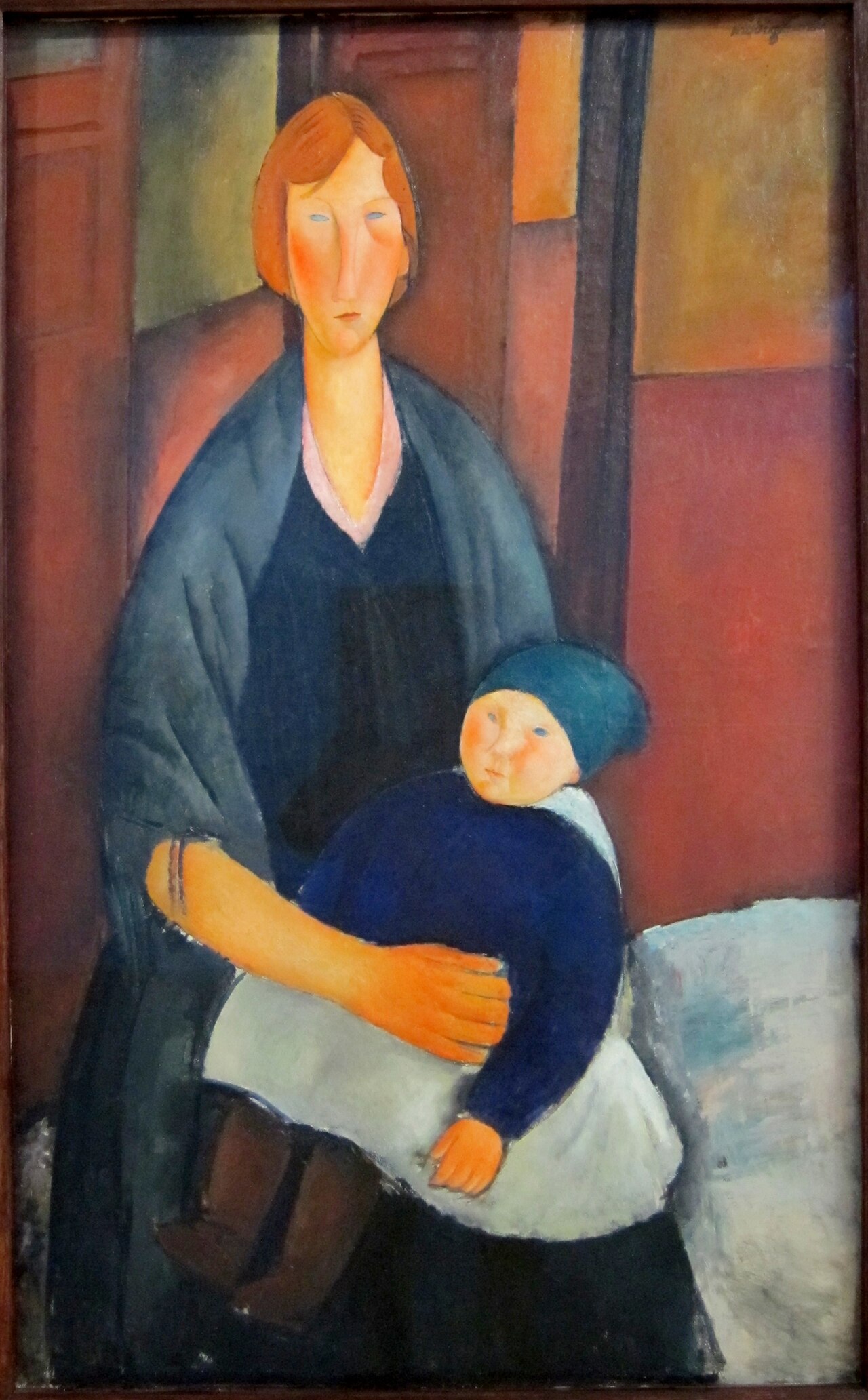
Motherhood is a canvas of 1919, painted for the French state’s modern art collection and hanging at the LaM in Villeneuve-d’Ascq, under the number AM 1994-425. A woman sits holding a small child on her lap, in a blue-grey coat over a dark bodice, against red and olive boards. With us it is made as a hand-painted copy, oil on canvas, to order, in eight sizes or in a size you give us; before dispatch we send you a photograph of the finished canvas.
| Title: | Motherhood |
| Other titles: | Maternité — Maternità — Seated Woman with Baby, the catalogue titles |
| Painter: | Amedeo Modigliani (1884–1920) |
| Year of creation: | 1919 — the museum’s year |
| Original size (width × height): | 81 × 129.8 cm — the museum’s measurement; the catalogues also print 73 × 116 and 81 × 130 |
| Original technique: | oil on canvas |
| Painting style: | expressionism, École de Paris |
| Located: | LaM, Villeneuve-d’Ascq (inv. AM 1994-425, Musée national d’art moderne, on deposit) |
| Our reproduction: | hand-painted copy, oil on canvas, eight sizes or a custom size |
Motherhood – Amedeo Modigliani
What is on the canvas?
A woman sits almost square to us with a small child on her lap. Her hair is reddish-blond, short and centre-parted, framing a very long oval face; there is a pink flush on each cheek, the eyes are pale blue almonds without pupils, the nose is one long line and the mouth is small and closed. Over a dark navy bodice with a V neck, where a pink chemise shows, she wears an open blue-grey coat that falls in two broad wings to the edges of the canvas. A long dark skirt fills the bottom, and brown boots appear at the lower left. Her bare right forearm comes round the child, the hand large and long-fingered, with two red bands at the wrist. The child wears a dark teal bonnet and a deep blue coat, with a white apron spread across both their laps; its face is round and pink and it looks straight out. Behind them the wall is built of uprights: brick red at the left, olive-grey behind her head, a dark post, ochre at the top right, a broad red field at the right and a pale blue-grey block low down. The signature is at the upper right.
A picture that belongs to one museum and hangs in another
The record carries two numbers, and they mean two different things. AM 1994-425 is the accession of the Musée national d’art moderne in Paris, which owns the painting; the second number is its deposit number at the LaM in Villeneuve-d’Ascq, where it actually hangs. The state acquired it in 1994 by dation, the French arrangement under which inheritance tax is paid in works of art rather than in money, and it had come to Lille before that in the donation of Geneviève and Jean Masurel. So the picture is in the north of France because a family gave a collection away, and it belongs to Paris because a tax bill was settled with a painting. The museum publishes it as public domain and puts its own photograph up; that photograph is taken in the gallery with the frame in shot, so we use it to describe the picture and not to measure it.
The record of the original, and three published sizes
The museum gives oil on canvas, 129.8 cm high by 81 wide, signed at the upper right — the third work running on this shelf to be signed in that corner. The catalogues do not agree with it or with each other: Pfannstiel and Ceroni print 116 × 73 cm, Patani and Parisot 130 × 81, and Lanthemann carries the work as number 418. We print the museum’s figure, because it is the only one of the three taken from the object by the people who hold it. The museum also corrects the literature in its own record: Scheiwiller’s Paris edition of 1928 reproduced the painting as being in the Netter collection, and the museum marks that flatly as an error. Of the seventy-six works on this shelf, exactly two show a woman holding an infant — this one and Gypsy Woman with Baby; a third child sits alone in L’Enfant gras. The work also has its own Wikidata entry. The whole selection is in the Amedeo Modigliani gallery, and we have written a longer article about the painter.
Where has the picture been?
The chain is short and unusually clean. It begins at the Galerie Léopold Zborowski in Paris — the ninth chain on this shelf to start with the dealer who is himself on it as Portrait of Léopold Zborowski. Roger Dutilleul, a Paris collector who bought from Zborowski and dealt with the École de Paris while its painters were still alive, had it by 1929 at the latest and kept it until 1956. It passed by inheritance to his nephew Jean Masurel, who held it until 1979 and then gave it, with the rest, to the museum at Lille Métropole; the dation of 1994 moved the title to Paris. Four owners in seventy-five years, and no saleroom in the list. It was shown early: the memorial retrospective at the Galerie Montaigne in Paris, 11 to 29 December 1920, eleven months after the painter died, where it was number 24. Later it travelled — Paris in 1981, Martigny, Düsseldorf and Zurich in 1991, the Musée du Luxembourg in 2002, Milan in 2003 — and in 2006 and 2007 it toured six museums in Japan. Another working woman of these years is on this shelf as Flower Vendor.
How is our hand-painted version made?
A painter paints it, with a brush, in oil on canvas, to your order. Every canvas painting takes some weeks, and each copy comes out slightly its own; that is the consequence of a person working rather than a machine. The picture is built from two blues that must not become one: the coat is a soft grey-blue, chalky and light, and the child’s coat is a deep saturated blue, and if the copyist warms the first or lightens the second the two figures merge. The whites are the second job — the apron across the lap is not white but a cool grey-white, and painting it clean kills the picture’s centre. The flesh is orange-cream against both blues, and the hand round the child is deliberately too large and too long, which is the drawing and not a fault to correct. The eyes are blank in both faces. Before dispatch you receive a photograph of the finished canvas and approve it. It is never a print.
Which size for which wall?
Here size and shape point at different rungs, so we give both. The original is 81 × 129.8 cm, and 80 × 130 cm is that to within a centimetre — the picture at its own scale, though rounding the width to 80 puts it 1.4 per cent from the original’s proportion. On proportion alone 50 × 80 cm and 100 × 160 cm are nearest at 0.15 per cent, with 73 × 116 cm at 0.8. We suggest 80 × 130 cm for a room where the painting is the subject, and 100 × 160 cm where it has to hold a large wall. It is a quiet, vertical, close-toned picture and it rewards being hung low enough to be looked at rather than up at. The blues carry on white, on warm grey and on pale green. A post-impressionist painting in a size that is not on the list is no trouble: we make it to order.
Frequently asked questions
Where is the original?
At the LaM in Villeneuve-d’Ascq, near Lille, on deposit from the Musée national d’art moderne in Paris, which owns it under the number AM 1994-425.
Who is the woman?
No record names her or the child. She is one of the working women Modigliani painted in his last year.
Why are there two inventory numbers?
Because one museum owns the painting and another shows it. The AM number is the owner’s; the second is the deposit number where it hangs.
How closely does it follow the original’s proportions?
The original measures 81 × 129.8 cm, and that is exactly the size we list: 80 x 130 cm. The proportions are the original’s, with no deviation. The catalogues do not agree on the size and give 81 × 129.8 cm; 73 × 116 cm; 81 × 130 cm; the comparison above starts from the first of them.
- Subject: a seated woman holding a small child, blue-grey coat over a dark bodice, white apron across the lap, red and olive boards behind
- Original: 81 × 129.8 cm, oil on canvas, 1919, Musée national d’art moderne, inv. AM 1994-425, on deposit at the LaM
- Ours: hand-painted oil on canvas, eight sizes or a custom size, with a photograph to approve before dispatch
- Worth knowing: the state acquired it in 1994 in payment of inheritance tax, and it was shown in the first memorial exhibition eleven months after Modigliani died
The eyes on this canvas are painted without pupils. We counted all 76 Modigliani works on this shelf: 53 are like that, 17 are not – work by work.