



Description
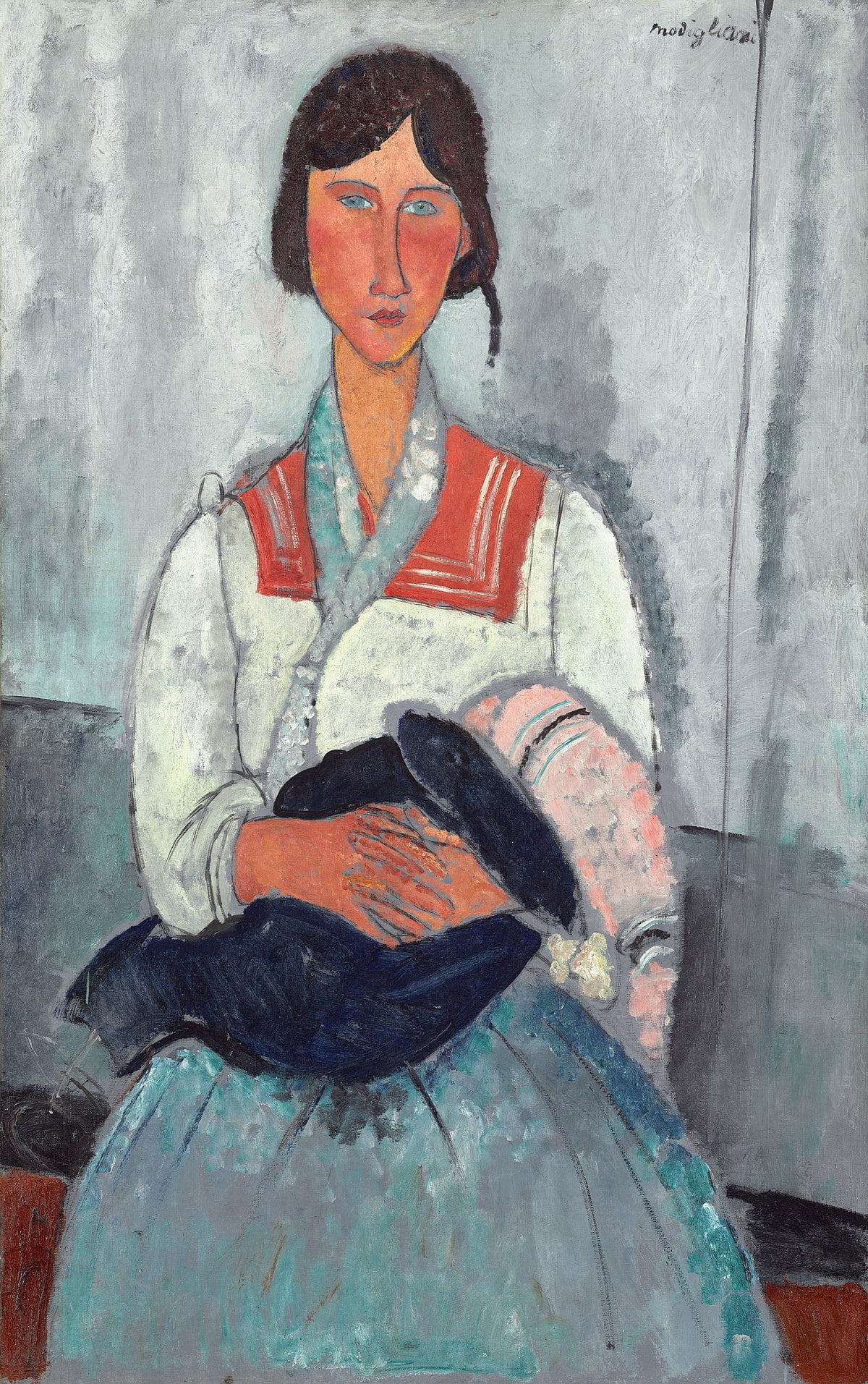
Gypsy Woman with Baby is an oil on canvas painted by Amedeo Modigliani in 1919; the original measures 115.9 × 73 cm and hangs in the National Gallery of Art in Washington under accession number 1963.10.174. It shows a young mother seated square to the viewer, holding a swaddled infant in her lap. Our canvas painting is a hand-painted copy of that work: an academy-trained painter makes it in oil on cotton canvas, in eight sizes from 40 × 65 cm to 120 × 190 cm or in the size you specify, and before dispatch we photograph it and send you the photograph for approval.
| Title: | Gypsy Woman with Baby |
| Other titles: | La Bohémienne · Zingara con bambino · Ciganka z dojenčkom |
| Painter: | Amedeo Modigliani (1884–1920) |
| Year: | 1919 |
| Original size (height × width): | 115.9 × 73 cm |
| Original technique: | Oil on canvas |
| Painting style: | Modern art, École de Paris |
| Where it is: | National Gallery of Art, Washington – catalogue entry (acc. 1963.10.174) |
| Our reproduction: | hand-painted oil on canvas, eight sizes from 40 × 65 cm to 120 × 190 cm, custom size on request |
Gypsy Woman with Baby – Amedeo Modigliani
Who is the woman on the canvas?
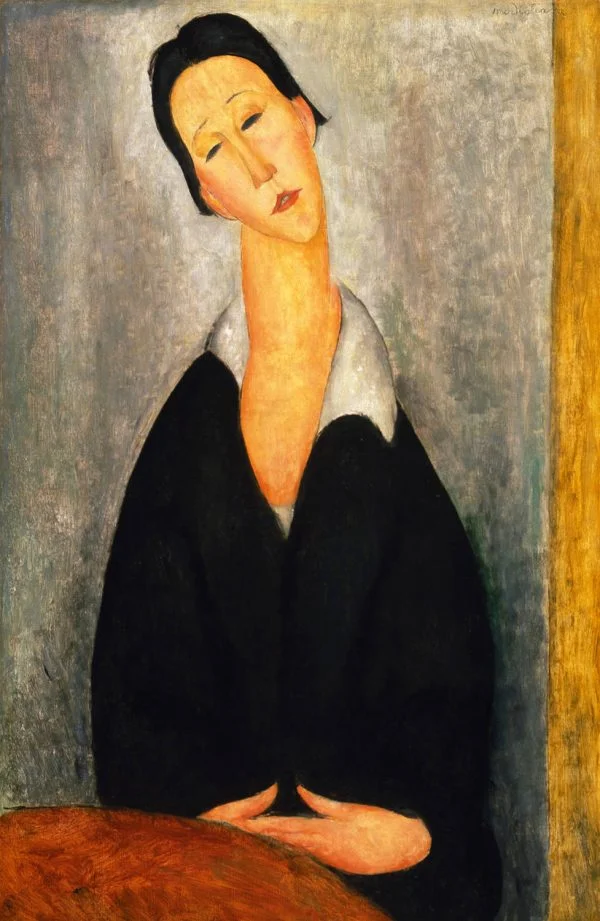
We do not know her name. The title names a type rather than a person, which is usual in Modigliani when the sitter was neither a patron nor a friend; the same is true of The Little Peasant and of Portrait of a Polish Woman. What we do know is when the work was made: in the painter’s last year, when he was already ill and working fast. Who she was, and whether the child was hers, the sources do not say. Where there is no name we do not invent one, and no story around her either — the work is precise enough without it.
What is on the canvas?
A young mother sits facing us and holds a swaddled infant in her lap. The child is painted as a dark blue mass enclosed by her arms — that blue is the darkest surface in the work, and every line of sight runs into it. She wears a white blouse with a coral bodice and a pale blue-green skirt that opens along the full width of the canvas at the bottom, so the figure stands as a triangle on a broad base. The face is elongated and calm and the neck long in his habitual way; the eyes are pale blue and softly painted, and they are not a matching pair: a dark pupil can be made out in the viewer’s right eye, while the left stays a flat field. The background is closed and neutral, with no objects in it. The canvas is large, nearly a metre twenty tall, and the figure nearly fills it: this is not a small intimate portrait but a life-size image.
Why does this work matter?
Because it is one of the few Modigliani works with two figures in it. Almost all his painting is the portrait of a single person; here there are two, and the relation between them is the only narrative the work allows. The mother does not look at the child and the child does not look at her: both are turned towards us, calmly and with no emotional explanation. Behind the form stand his years as a sculptor; behind the colour a Cézanne-like post-impressionist painting in which the body is built from planes rather than from details. In Paris Modigliani belonged to that circle of immigrant painters we now call the École de Paris. That the work ended up in the National Gallery of Art in Washington follows from American collecting in the 1920s and 1930s, when the painter was still half forgotten in Europe.
What does the work mean?
It means motherhood without a halo. The mother-and-child motif carries a thousand years of religious baggage in European painting; here all of that baggage has been set down. No nimbus, no gaze lifted to heaven, no tenderness the painter demands of the viewer. What remains is a woman holding a child and looking straight ahead — tired, calm and unexplained. It is exactly that reticence that gives the work a dignity the sentimental version of the same motif never reaches. If you take one thought away: painting a person without pity is often more respectful than painting them with it.
Is this the same work as Motherhood?
No. Motherhood is a different work with the same mother-and-child motif, so the two are easily confused; this canvas is larger and carries a title that names a type rather than a relationship. If you are looking for his other portraits of working women, see The Little Servant Girl, The Flower Vendor and Girl Standing in a Black Pinafore; for the nameless title, The Little Peasant is a close relative. The full choice among his painted women is in the Amedeo Modigliani gallery, and we have written a longer article about the painter; an encyclopaedia entry on this work can be read away from our pages.
How is our hand-painted version made?
The work is made by an academy-trained painter in oil on cotton canvas, stretched over a wooden frame. It is not a print and not a mechanical reproduction: every stroke is laid by hand, which is why your canvas always differs a little from our reference in brushwork and in the thickness of the paint. The painter begins with the background and the dark blue mass of the child, because that is what decides how light the blouse and the face will look; only then does he draw the mother’s contour and the long line of the neck. With a figure this large the order matters, because pale skin next to deep blue turns grey quickly if the ground is toned badly. When the paint is dry we photograph the work and send you the photograph for approval.
Which size for which wall?
For most homes the right choice is 73 × 116 cm — that size is exactly the original’s, so you receive a canvas at one-to-one proportions. The small ones, 40 × 65 and 50 × 80 cm, belong in a hallway or on a narrow wall between two doors. The medium ones, 60 × 100 and 80 × 130 cm, work above a sideboard or a sofa. The large ones, 90 × 140, 100 × 160 and 120 × 190 cm, want a free wall and at least three metres of viewing distance; at those sizes the figure is larger than life and the work takes over the room, which is a strong effect with a mother-and-child motif. The format is upright and tall, so it works where the wall is taller than it is wide — along a staircase, beside a door, or between two windows. Since the only dark surface is the child’s swaddling, the work will not carry a dark wall: that blue does its work against a light ground.
Custom size, stretcher and frame
If your wall asks for a size that is not on the list, we will make it. Give us the height and the width in centimetres; we check whether the proportion carries the original’s crop and tell you what changes at the edges — with this subject it shows first at the bottom, where the skirt opens across the full width and cannot be cut away without losing the triangular base of the figure. You can also choose whether it arrives stretched on a wooden frame, ready to hang, or rolled in a tube, which is cheaper to ship. This work is offered without a frame, so the framing is your choice. For placement we help with a visualisation, setting the work into a photograph of your wall before you buy. If you are looking for a work we do not carry, see our made-to-order paintings.
Delivery and guarantee
We deliver to your address, and the work travels protected, with the canvas held clear of the outer wall of the packaging. Lead time depends on the size and the workshop’s load: we estimate it when you order and tell you if it changes. We guarantee the workmanship and the materials: if the work arrives damaged or does not match the photograph you approved, we repair it or repaint it at our own cost. Because you see the work in a photograph before it ships, most questions are settled before the parcel leaves.
Frequently asked questions
Where is the original?
In the National Gallery of Art in Washington, under accession number 1963.10.174.
Who was the woman in the picture?
The sources do not name her. The title names a type rather than a person, and we do not invent a name.
Is Zingara con bambino the same work?
Yes. That is the Italian title of the same canvas; in French it also appears as La Bohémienne.
Is this a print?
No. Every canvas is painted by hand by a painter, in oil. We print nothing.
Which size should I choose?
If you cannot decide, take 73 × 116 cm, the size of the original. For a narrow hallway wall 40 × 65 cm, for a large wall 100 × 160 cm.
Can I have a size that is not on the list?
Yes. Give us the height and the width in centimetres; before we start we explain how the size affects the crop.
How does it arrive?
Stretched on a wooden frame and ready to hang, or rolled in a tube, whichever you choose. Both travel in protective packaging.
What is it about, in one sentence?
That a mother with her child needs no halo to deserve a large canvas.
Is the original for sale, and what is it worth?
It is not for sale. It belongs to a public museum collection, it is not on the market, and so we do not put a value on it.
How high should it hang?
With its centre about 145 cm above the floor. With a tall format it pays to hang it a little lower than instinct suggests, or the head ends up above comfortable eye level.
Does it work as a gift?
Yes, and among Modigliani’s subjects it is one of the few that can be given for the birth of a child without turning sentimental.
Why are the two eyes not the same?
They are not. A dark pupil can be made out in the viewer’s right eye, while the left stays a pale blue field. Both are softly painted, so the difference only shows close up. We counted all 76 works on this shelf: which ones have pupils and which do not.
How closely does it follow the original’s proportions?
The original measures 73 × 115.9 cm, and that is exactly the size we list: 73 x 116 cm. The proportions are the original’s, with no deviation.
- Subject: a young mother square to the viewer, a swaddled child as a dark blue mass in her lap, the skirt opening across the full width of the canvas
- Original: 115.9 × 73 cm, oil on canvas, 1919, National Gallery of Art, Washington (acc. 1963.10.174)
- Our version: hand-painted oil on canvas, eight sizes from 40 × 65 to 120 × 190 cm; the 73 × 116 cm size is one-to-one with the original
- Worth knowing: one of the few Modigliani canvases with two figures — and neither of them looks at the other