







Description
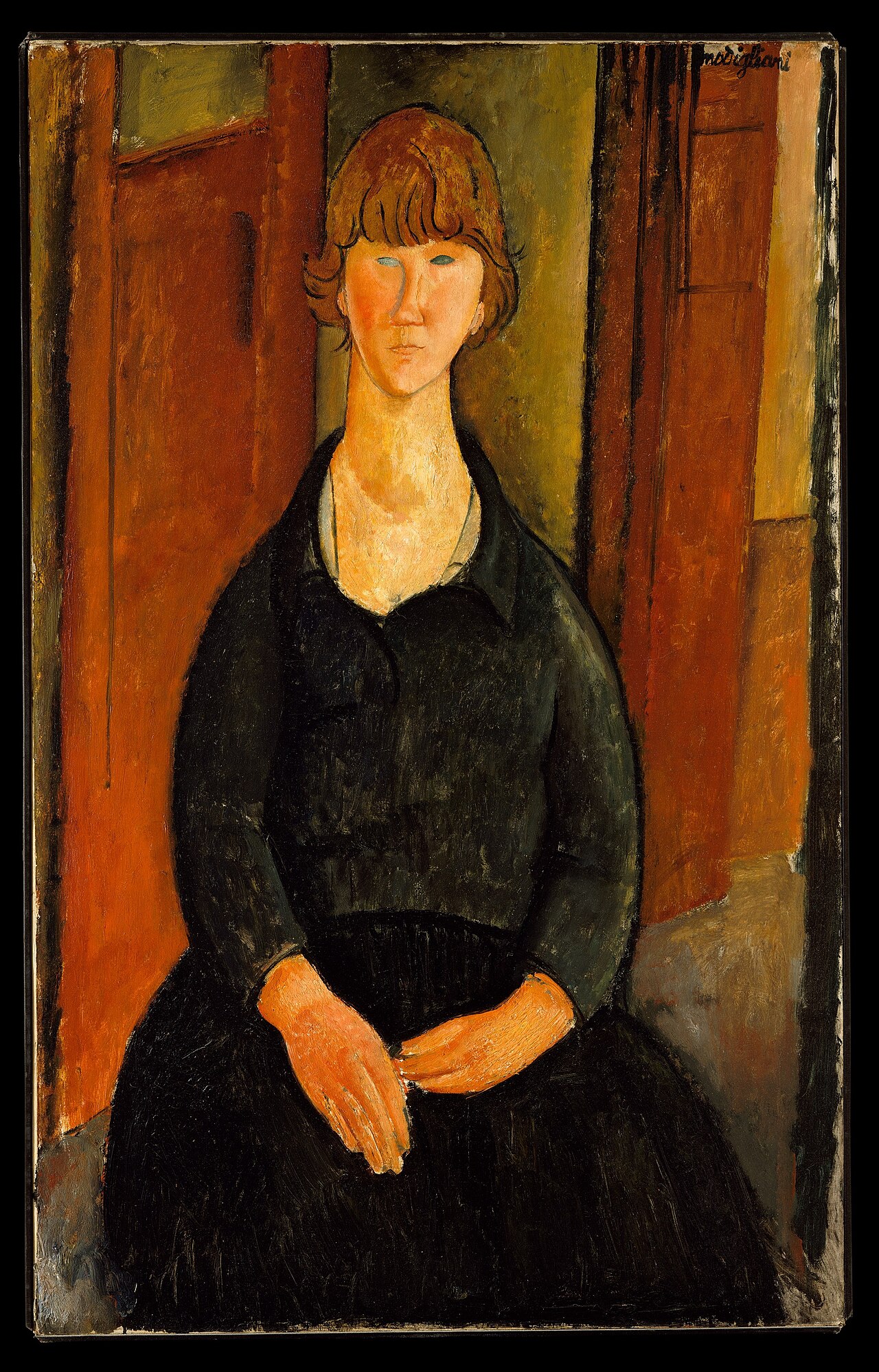
Flower Vendor is a canvas of 1919 in the Metropolitan Museum of Art in New York, under the number 1996.403.9. A young woman sits square to us in a near-black bodice and a long dark skirt, her hands loose in her lap, against rust-orange and olive-green boards. With us it is made as a hand-painted copy, oil on canvas, to order, in eight sizes or in a size you give us; before dispatch we send you a photograph of the finished canvas.
| Title: | Flower Vendor |
| Other titles: | La Marchande de fleurs — La Fioraia — Jeune femme assise, the catalogue titles |
| Painter: | Amedeo Modigliani (1884–1920) |
| Year of creation: | 1919 — the museum’s year; the older literature printed 1917 for forty years |
| Original size (width × height): | 73.7 × 116.8 cm (29 × 46 in.) |
| Original technique: | oil on canvas |
| Painting style: | expressionism, École de Paris |
| Located: | Metropolitan Museum of Art, New York (inv. 1996.403.9, bequest of Florene M. Schoenborn, 1995) |
| Our reproduction: | hand-painted copy, oil on canvas, eight sizes or a custom size |
Flower Vendor – Amedeo Modigliani
What is on the canvas?
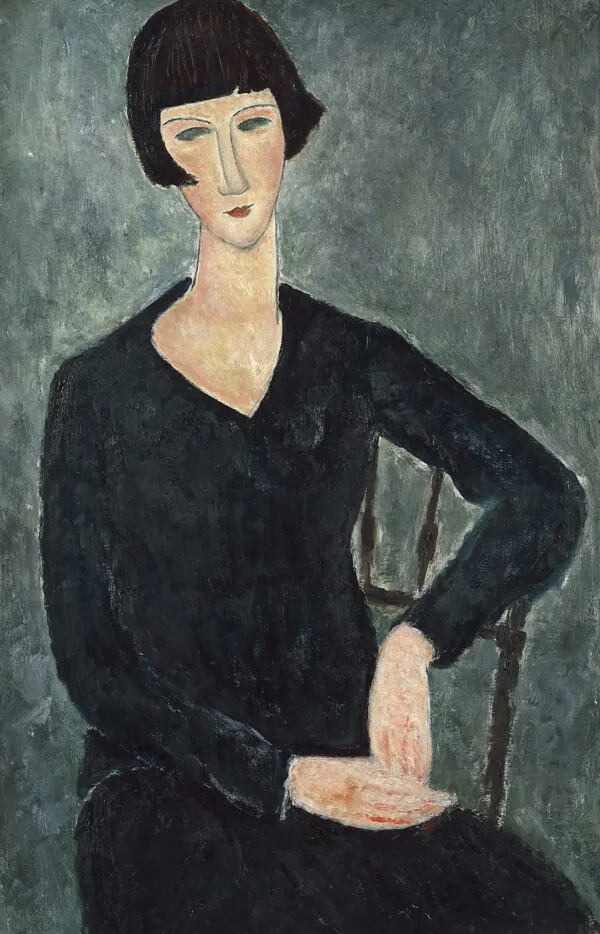
A young woman sits facing us, filling the canvas from the knees up. Her hair is chestnut, cut short, with a fringe low over the forehead curling in at the jaw. The face is a long oval in orange-cream with a warm flush along both cheeks, a small closed mouth, a nose drawn in one line, and eyes that are pale blue-green almonds with no pupils at all. The neck is long and bare. She wears a near-black bodice, blue-black rather than dead black, with a wide pointed collar; a pale blue-grey chemise shows in the opening at the throat. A long dark skirt fills the lower third, and her hands lie loose in her lap, one over the other, the fingers unclasped. Behind her the wall is built of vertical boards: a broad rust-orange band down the left, olive and yellow-green panels behind the head, and at the right a rust-red door with an ochre panel beside it. A grey block sits low at each side. The signature is in the upper right corner.
A title with no flowers in it
There are no flowers in this picture. She holds nothing; there is no basket, no bunch, no stall. The museum’s own subject terms are portraits and women, nothing horticultural. The catalogues noticed the same thing and solved it by carrying two titles at once: Ceroni enters the work as Jeune femme assise, young woman seated, with La marchande de fleurs kept in brackets after it, and a Milan edition of 1927 printed it as La Fioraia. So the title names a trade rather than a scene, and no one knows who first attached it. What is on the canvas is a working woman in her good dark clothes, sitting for a painter in a doorway, and Modigliani painted that more than once: The Servant Girl is the same proposition with a different job.
The record of the original, and a date the older literature did not use
The museum is precise here and gives canvas and frame both: 46 × 29 in., which is 116.8 × 73.7 cm, and separately a gilded wood frame of 133.4 × 90.2 × 6.4 cm. Medium oil on canvas, signed modigliani at the upper right, accession 1996.403.9, in the department of modern and contemporary art. The date is where the record moves. The museum says 1919, and so do Ceroni, Lanthemann number 417, Parisot and Patani. But for forty years the printed literature said 1917: Salmon in 1926, a Milan edition in 1927, Pfannstiel in 1929 and again in his 1956 catalogue — where the same painting is entered twice, as number 122 and as number 221 — Roy in 1958, and the 1965 catalogue of the collection that then owned it. One 1963 account gave 1915 to 1916. Two catalogue sizes are plainly wrong too, an order of magnitude away from the object the museum has measured. The museum keeps the work out of the public domain and releases no photograph of it, so we describe it from a published reproduction and say so; that reproduction is printed with a black surround, which is why it is not used here for any measurement. Its own pages answer us with a rate limit rather than a page, so the link above is registered against the museum’s own object record, which carries the title, date, medium, both measurements and the accession. The work also has its own Wikidata entry. The whole selection is in the Amedeo Modigliani gallery, and we have written a longer article about the painter.
Where has the picture been?
Louis Libaude in Paris held it until 1925; the Galerie Bing then had it to 1927 and showed it in its own Modigliani exhibition in 1925 as number 6 — the third chain on this shelf to run through that gallery, after Young Woman in a Yellow Dress and Jeanne Seated with Her Arm on the Chair Back. Then the Lepoutre, Lecomte-Durey and Lederlin collections in Paris, and the Lederlin sale at the Galerie Charpentier on 22 and 23 March 1933, lot 136, where it made 23,090 francs. After that the Hessel collection, Zurich, Mme Marquiset, and in 1950 the Paul Rosenberg gallery in New York, stock number 5391 — the second Rosenberg chain on this shelf. Samuel and Florene Marx of Chicago bought it from Rosenberg on 3 November 1950 for 18,000 dollars; Florene Marx, later Mrs Wolfgang Schoenborn, held it until her death, and it came to the museum by bequest in 1995. Between those two dates the collection toured America under a title that says where this picture belongs: The School of Paris, the exhibition name for the École de Paris, at the Museum of Modern Art in 1965 and then Chicago, Saint Louis, Mexico City and San Francisco. Another Met canvas is on this shelf as The Italian Woman.
How is our hand-painted version made?
A painter paints it, with a brush, in oil on canvas, to your order. Every canvas painting takes some weeks, and each copy comes out slightly its own; that is the consequence of a person working rather than a machine. Two thirds of this picture is one dark mass, and it all stands or falls on that: the bodice and skirt must read as a deep blue-black with the brush marks still visible inside them, never as flat black, or the figure turns into a silhouette. Against that mass the flesh is the only warm light, orange-cream, and it must not be pinked or it goes waxy. The background boards are the second problem: rust-orange, olive, yellow-green, rust-red, all broken and scrubbed rather than filled in evenly. The eyes are blue-green and empty and must stay that way. The hands are long and loose, unclasped; stiffening them into a grip is the usual mistake. Before dispatch you receive a photograph of the finished canvas and approve it. It is never a print.
Which size for which wall?
For this motif we suggest 73 × 116 cm, and for once that is not a compromise: the original is 73.7 × 116.8 cm, so this rung is the picture at very nearly its own size, within a centimetre in each direction, and 0.27 per cent from its shape. On proportion alone 120 × 190 cm is nearer still at 0.09 per cent, with 50 × 80 cm and 100 × 160 cm at 0.9; but that is a room-sized object. The picture is tall, dark and frontal, and it wants a wall of its own — over a chest of drawers, at the end of a corridor, on a chimney breast. The dark mass carries best on a pale wall, white or bone or a light grey; on a dark wall it disappears. A post-impressionist painting in a size that is not on the list is no trouble: we make it to order.
Frequently asked questions
Where is the original?
In the Metropolitan Museum of Art in New York, accession number 1996.403.9, bequeathed by Florene M. Schoenborn in 1995.
Are there flowers in the picture?
None. The title names her trade, not the scene, and the catalogues also carry the plainer title Jeune femme assise, young woman seated.
Why do the old catalogues say 1917?
Because the literature carried 1917 from the 1920s to the 1960s. The museum and the modern catalogues give 1919.
How closely does it follow the original’s proportions?
The original measures 73.7 × 116.8 cm, and that is exactly the size we list: 73 x 116 cm. The proportions are the original’s, with no deviation.
- Subject: a young woman seated square to us, near-black bodice and long dark skirt, hands loose in her lap, rust-orange and olive boards behind
- Original: 73.7 × 116.8 cm, oil on canvas, 1919, Metropolitan Museum of Art, inv. 1996.403.9
- Ours: hand-painted oil on canvas, eight sizes or a custom size, with a photograph to approve before dispatch
- Worth knowing: there are no flowers in the picture, and the literature dated it 1917 for forty years before the museum settled on 1919
The eyes on this canvas are painted without pupils. We counted all 76 Modigliani works on this shelf: 53 are like that, 17 are not – work by work.