Description
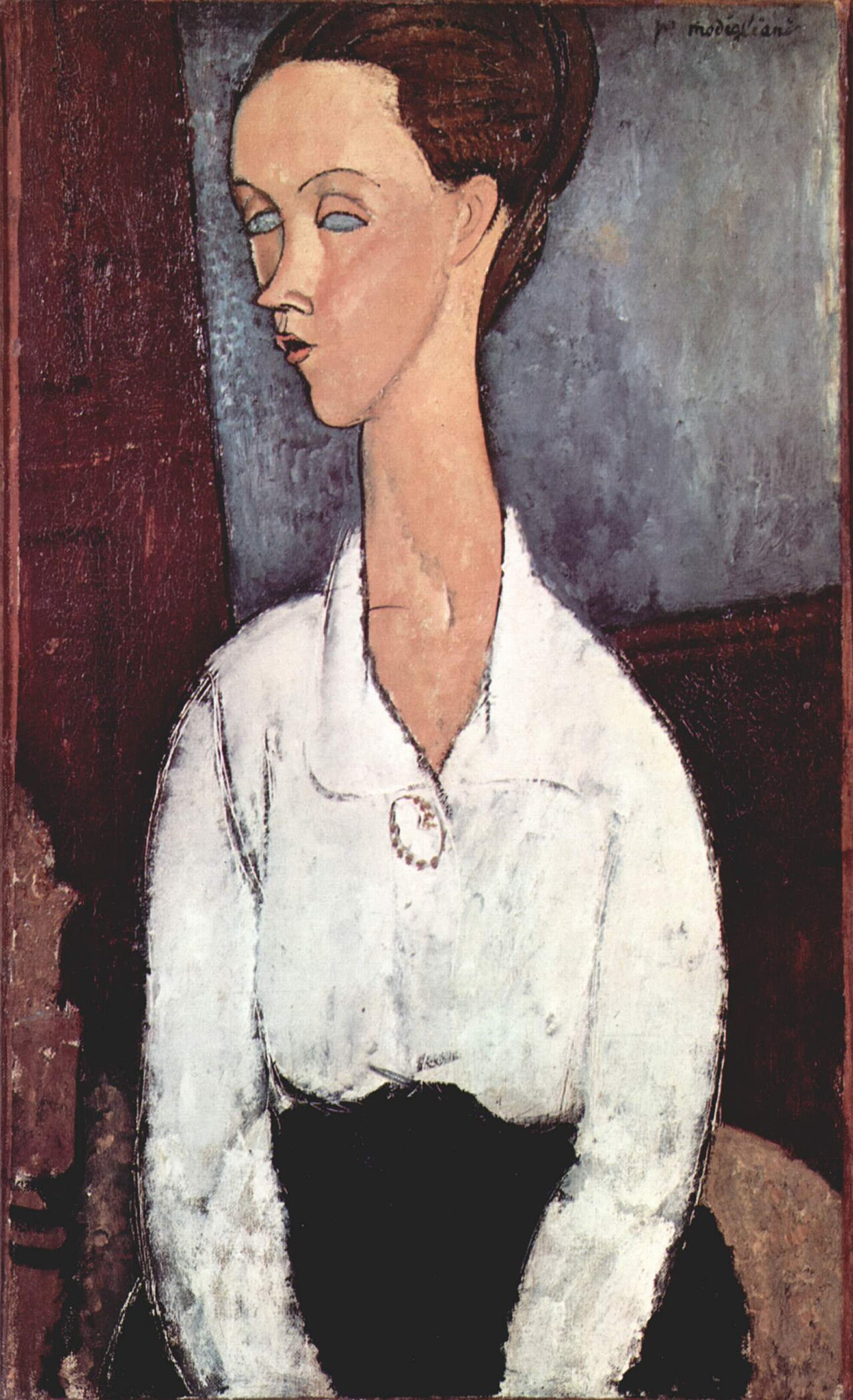
Portrait of Lunia Czechowska in a White Blouse is a canvas of 1917 held by the Pola Museum of Art in Hakone, Japan, under the number 002-0058. The sitter is turned almost into profile, in a white blouse with a small brooch at the throat, against a ground built of three vertical bands. With us it is made as a hand-painted copy, oil on canvas, to order, in eight sizes or in a size you give us; before dispatch we send you a photograph of the finished canvas.
| Title: | Portrait of Lunia Czechowska in a White Blouse |
| Other titles: | Portrait de Lunia Czechowska en chemisier blanc · Ritratto di Lunia Czechowska con una camicia bianca (the forms the catalogues use) |
| Painter: | Amedeo Modigliani (1884–1920) |
| Year of creation: | 1917 (signed at the upper right) |
| Original size (width × height): | 45 × 72.8 cm |
| Original technique: | oil on canvas |
| Painting style: | expressionism, École de Paris |
| Located: | Pola Museum of Art, Hakone (inv. 002-0058) |
| Our reproduction: | hand-painted copy, oil on canvas, eight sizes or a custom size |
Portrait of Lunia Czechowska in a White Blouse – Amedeo Modigliani
What is on the canvas?
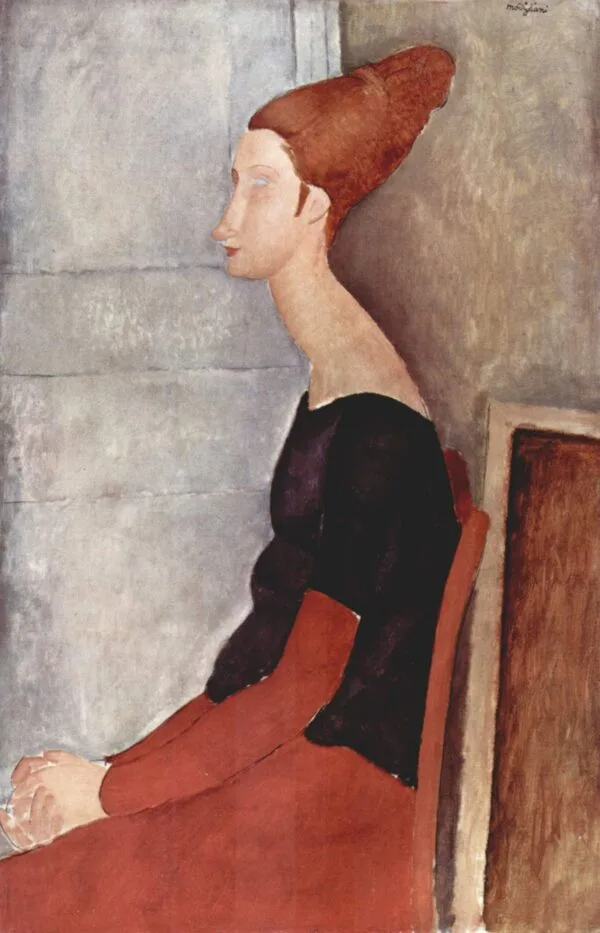
The sitter is shown to the hips and turned almost into profile to the left. Chestnut hair is parted at the centre and gathered low into a knot. The face is long and oval, built like a mask; the eyes are pale blue-grey almonds with no iris at all, so they look out without looking at anything — the device Modigliani is best known for, and the opposite of what he does on some of the late portraits. The nose is long and straight, the mouth small and reddish, and the neck is unusually long. She wears a white blouse with a soft collar and a small oval brooch at the throat; a dark skirt begins below it. The ground is not a room but three vertical bands: dark red-brown at the left edge, blue-grey behind the head, red-brown again at the right. The signature stands at the upper right.
Why is the blouse the whole picture?
Across the catalogues this work is known by what she is wearing — in German as the portrait with a white blouse, in Italian with a white shirt, in French with a white chemisier. The reason is visible at once: the blouse is the largest and lightest shape on the canvas and the only thing that catches the light. Everything else is held down — the muted red-brown ground, the dark skirt, the chestnut hair. Modigliani has built the whole composition around one bright field and around the long vertical of the neck that carries it. Take the blouse out and there is no picture left, which is presumably why no cataloguer ever tried to name it anything else. The circle he painted it in is the one we now call the École de Paris.
The record of the original, and what the museum does not say
The original is oil on canvas. The museum measures it 72.8 cm high and 45 cm wide; we give width first, so on our page it reads 45 × 72.8 cm. That height is worth a sentence, because we used to print 70 cm and it was wrong: the museum’s own figure is 72.8, and where the institution and an open database disagree about a measurement, the institution decides. On the accession number we are more careful than the usual formula allows. The museum’s page does not print 002-0058 as a label; it is the number in the museum’s own web address for the work, and Wikidata records it as the inventory number. We give it, and we say where it comes from. The museum publishes no ownership history for this canvas at all, so this page carries none — where the record is silent, so are we. The work also has its own Wikidata entry.
The motif among the painter’s works
Lunia Czechowska sat for Modigliani more than once, and the shelf carries another of her portraits, Portrait of Lunia Czechowska — a different canvas, not another version of this one. She was close to the dealer who kept the painter working, and both of that household are here too: Portrait of Léopold Zborowski and Madame Hanka Zborowska. Read together, the three are the same few rooms in Paris seen over three or four years. The whole selection is in the Amedeo Modigliani gallery, and we have written a longer article about the painter.
How is our hand-painted version made?
A painter paints it, with a brush, in oil on canvas, to your order. Every canvas painting takes some weeks, and each copy comes out slightly its own; that is the consequence of a person working rather than a machine. On this motif the whole job is the white. The blouse is not one flat white: it has to stay bright enough to carry the picture and still show its folds, and if it is painted too clean it turns into paper. The three bands of the ground must stay three distinct tones, because they are the only depth the canvas has. The eyes are left without an iris exactly as the original leaves them — that is the painter’s decision, not an omission, and copying it faithfully is what makes the face read as his. Before dispatch you receive a photograph of the finished canvas and approve it. It is never a print.
Which size for which wall?
For this motif we suggest 60 × 100 cm. The picture is upright and quiet, with no story in it, so it hangs well where a painting should settle a wall rather than command it — a bedroom, a hallway, a stairwell, or the space between two windows. Of the sizes we offer, 80 × 130 cm follows the proportions of the original most closely, and 40 × 65 cm has that same shape at the small end. Because the white blouse is the light of the picture, the subject reads best on a darker or coloured wall, where that bright field separates. A post-impressionist painting in a size that is not on the list is no trouble: we make it to order.
Frequently asked questions
Where is the original?
In the Pola Museum of Art in Hakone, Japan, under the number 002-0058.
Who was Lunia Czechowska?
A friend of the household of Modigliani’s dealer Léopold Zborowski, and one of the sitters he returned to. The shelf carries a second portrait of her.
Is Portrait de Lunia Czechowska en chemisier blanc the same work?
Yes. That is the French form of the same title; it is the same canvas.
How closely does it follow the original’s proportions?
The original measures 45 × 72.8 cm. The closest of our sizes is 40 x 65 cm, which departs from the original’s proportions by 0.44%.
- Subject: a woman to the hips turned almost into profile, white blouse with a small brooch, eyes without an iris, a ground of three vertical bands
- Original: 45 × 72.8 cm, oil on canvas, 1917, Pola Museum of Art, Hakone, inv. 002-0058
- Ours: hand-painted oil on canvas, eight sizes or a custom size, with a photograph to approve before dispatch
- Worth knowing: the museum’s page never prints the accession number — it is in the museum’s own web address, and we say so rather than presenting it as a label
The eyes on this canvas are painted without pupils. We counted all 76 Modigliani works on this shelf: 53 are like that, 17 are not – work by work.