







































Description
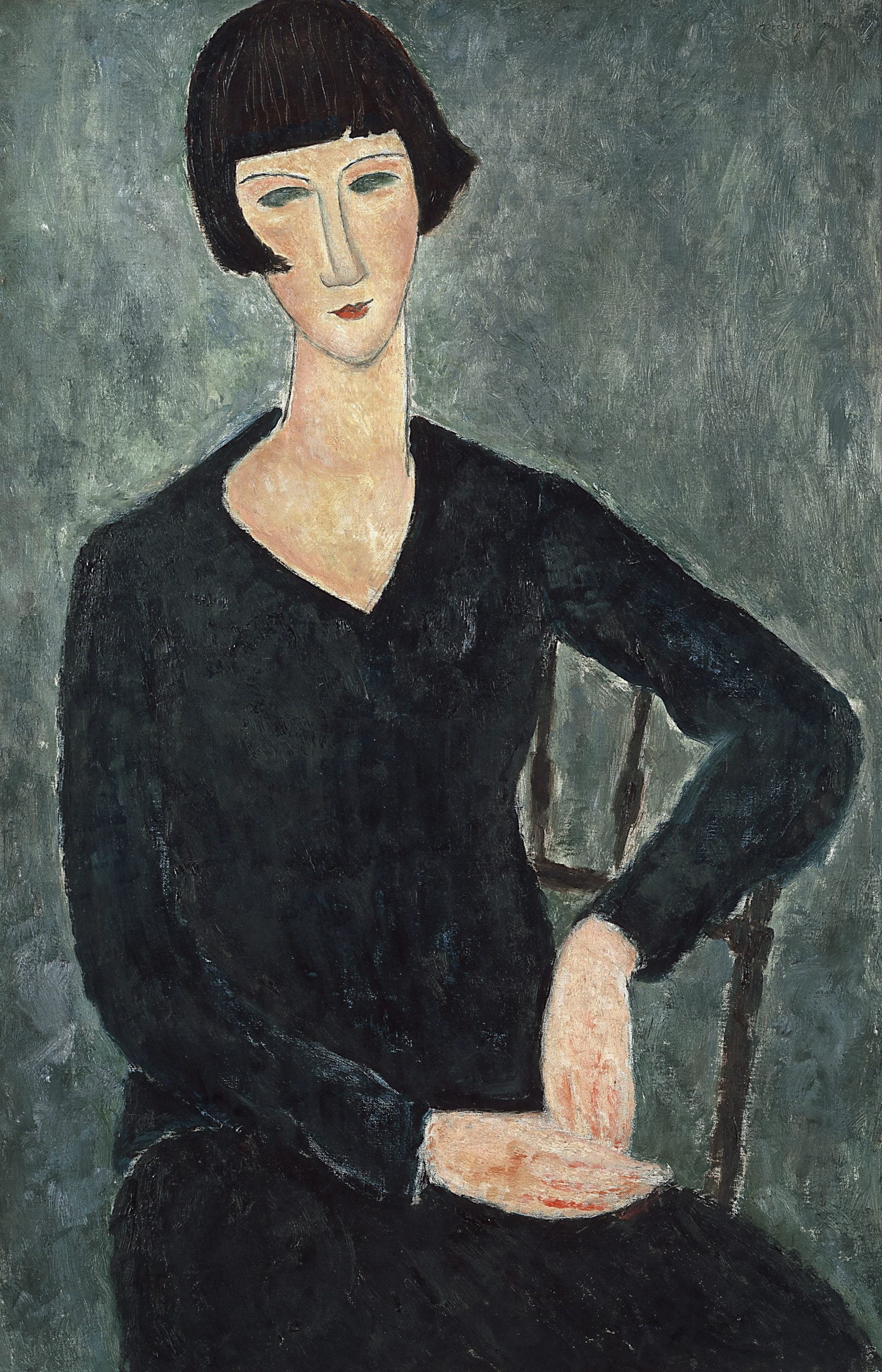
Seated Woman in a Blue Dress is an oil on canvas by Amedeo Modigliani which the museum dates to the span 1917–1919; the original measures 92 × 60 cm and belongs to the Moderna Museet in Stockholm under accession number NM 4897. Our canvas painting is a hand-painted copy of that work: an academy-trained painter makes it in oil on cotton canvas, in eight sizes from 40 × 60 cm to 120 × 180 cm or in the size you specify, and before dispatch we photograph it and send you the photograph for approval.
| Title: | Seated Woman in a Blue Dress |
| Other titles: | Young woman with fringe · The blue dress · Sittande kvinna i blå klänning |
| Painter: | Amedeo Modigliani (1884–1920) |
| Year: | 1917–1919 (the museum’s dating) |
| Original size (height × width): | 92 × 60 cm |
| Original technique: | Oil on canvas, signed upper right |
| Painting style: | Modern art, École de Paris |
| Where it is: | Moderna Museet, Stockholm – catalogue entry (acc. NM 4897), the gift of Oscar Stern in 1951 |
| Our reproduction: | hand-painted oil on canvas, eight sizes from 40 × 60 cm to 120 × 180 cm, custom size on request |
Seated Woman in a Blue Dress – Amedeo Modigliani
Who is the woman on the canvas?
We do not know. Two names appear beside this canvas in the catalogues, Fernande Barrey and Kiki de Montparnasse, but the same two names are attached to another, very similar portrait from the same years. A name that floats between two canvases identifies neither, so we do not write it down as a fact. What we do know is that alongside the known faces of the Paris art world Modigliani also painted people he met every day — neighbours, waitresses, girls from the quarter — and that between those anonymous portraits and the portraits of famous poets there is no difference of treatment in his painting: the same attention, the same elongated neck, the same seriousness.
What is on the canvas?
A woman sits on a wooden chair, turned slightly aside, looking down. The most recognisable thing is the hair: a dark, straight-cut bob with a thick straight fringe above the brows — which is exactly why the work also carries the catalogue title Young woman with fringe. The dress is very dark, blue-black, with a sharp V-neck, and takes up almost the whole lower half of the canvas. The right arm is bent, the hand resting on the hip with the elbow out; the left arm hangs down. Behind the elbow the back and one leg of the chair are visible, so the scene does stand in a room after all. The ground is a grey-green wall, painted in dense, restless strokes. The neck is elongated in his usual way, the face narrowed to an oval mask, the eyes pale blue-green and without pupils. Because the dress and the ground are so quiet, the face and the relation of dark cloth to pale skin carry all the attention — and that is exactly the hardest thing to get right here.
Why does the title name the dress and not the person?
Because that is how the work settled. When the sitter was not known by name, historians and dealers gave the picture a descriptive title, and it stuck. For this canvas the title is even disputed: the catalogues carry both “blue dress” and “black dress”, because the cloth is painted so dark that the colour cannot be settled at a glance. Only close up does the black show a blue-green base. It is a post-impressionist painting in the sense in which post-impressionism meant building the body out of planes rather than describing light. In Paris Modigliani belonged to that circle of immigrant painters we now call the École de Paris.
Where is the original today?
In the Moderna Museet in Stockholm, under accession number NM 4897. The route there is short and well recorded: the canvas was in the collection of Oscar Stern, who gave it to the museum in 1951. We give the measurements, technique and accession number from the catalogue entry, which carries them together; the structured record of the work also stands in a public database, which confirms the institution. The museum’s search page does not serve its records without JavaScript, so we did not copy the data from there.
Why does the museum not date the work to one year?
Because the exact year is not known. The museum gives the span 1917–1919, and so do we. Our page previously said 1918, which was more precise than the source allows, so we brought the entry into line with the museum’s dating. A span is not a gap in the record but the honest limit of what can be known: Modigliani almost never dated his canvases, and his portraits from these years stand so close together that they cannot be sorted into years by style. Anyone who quotes a single year has usually chosen it themselves.
How is our hand-painted version made?
The work is made by an academy-trained painter in oil on cotton canvas, stretched over a wooden frame. It is not a print: every stroke is laid by hand, and your canvas always differs a little from our reference. With this subject the dress is the hard part. Painted as a single flat black, the work stiffens and the face above it goes papery; built properly it is several dark layers over a blue-green base, so that the folds of the sleeve still show in it. With the ground it is the other way round: the grey-green wall is painted in visible, restless strokes which we do not smooth out. When the paint is dry we photograph the work and send the photograph for approval.
Which size for which wall?
For most homes the right choice is 60 × 92 cm — that size is the original’s, so you receive one-to-one proportions. The smallest, 40 × 60 cm, belongs in a hallway or on a narrow wall between two doors. The medium ones, 50 × 80, 70 × 110 and 80 × 120 cm, work above a sideboard or a sofa. The large ones, 90 × 140, 100 × 150 and 120 × 180 cm, want a free wall and at least three metres of distance; at those sizes the figure is larger than life. The format is upright and works where the wall is taller than wide. The work is quiet and restrained, with no forced effect, so it is easy to place in a room that already has a colour of its own; the dark dress sits well with warm wood tones and light walls.
Custom size, stretcher and frame
If your wall asks for a size that is not on the list, we will make it. Give us the height and width in centimetres; we check whether the proportion carries the original’s crop and tell you what changes at the edges — here it shows first at the right, where the chair is, and at the bottom, where the dress spreads; both hold the figure in place and cannot be cut away without cost. You can choose whether it arrives stretched on a wooden frame, ready to hang, or rolled in a tube, which is cheaper to ship. You pick the frame in our 3D application, which shows it realistically on the work, and on request we set the work into a photograph of your wall. If you are looking for a work we do not carry, see our made-to-order paintings.
Delivery and guarantee
We deliver to your address, the canvas held clear of the outer wall of the packaging. Lead time depends on size and the workshop’s load: we estimate it when you order and tell you if it changes. We guarantee workmanship and materials: if the work arrives damaged or does not match the photograph you approved, we repaint it at our own cost. Because you see it in a photograph before it ships, most questions are settled before it leaves.
Frequently asked questions
Where is the original?
In the Moderna Museet in Stockholm, accession number NM 4897.
When was the work made?
The museum dates it between 1917 and 1919. There is no more precise figure.
Is the dress blue or black?
It is painted so dark that both readings hold; the catalogues carry both titles. Close up the black has a blue-green base.
Do we know who the sitter was?
No. The names in circulation are attached to another portrait from the same years as well, so they identify no one.
Which size should I choose?
If you cannot decide, take 60 × 92 cm, the size of the original. For a narrow hallway wall 40 × 60 cm, for a large wall 120 × 180 cm.
Is the original for sale?
No. It belongs to a public museum collection, it is not on the market, and so we put no value on it.
How high should it hang?
With its centre about 145 cm above the floor. With an upright format it pays to hang it a little lower than feels right.
Which other Modigliani portraits of women do you have?
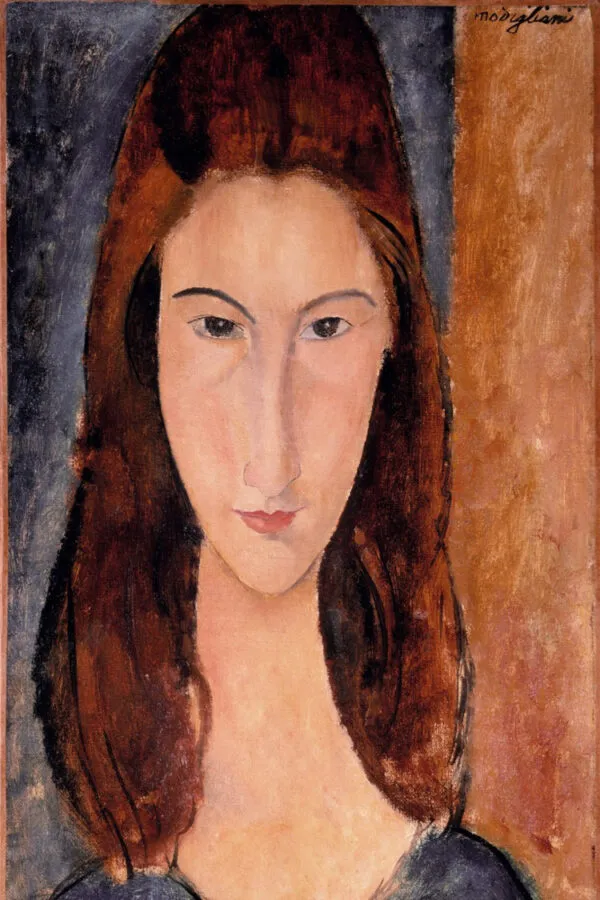
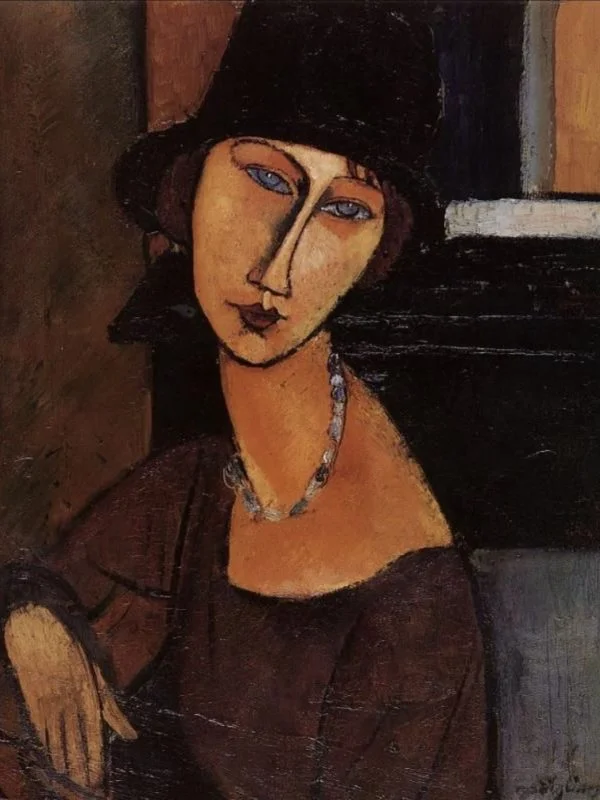
See Portrait of Jeanne Hébuterne in Black and Red Dress, Portrait of Lunia Czechowska, Portrait of a Polish Woman and Red-haired Young Woman in a Shirt. The full choice is in the Amedeo Modigliani gallery, and we have written a longer article about the painter.
How closely does it follow the original’s proportions?
The original measures 60 × 92 cm, and that is exactly the size we list: 60 x 92 cm. The proportions are the original’s, with no deviation.
- Subject: a young woman with a dark bob and thick fringe, in a very dark blue-black dress, seated on a wooden chair
- Original: 92 × 60 cm, oil on canvas, 1917–1919, Moderna Museet, Stockholm (acc. NM 4897)
- Our version: hand-painted oil on canvas, eight sizes from 40 × 60 to 120 × 180 cm; the 60 × 92 cm size is one-to-one with the original
- Worth knowing: Oscar Stern gave the work to the museum in 1951, and the exact year of painting is not known
The eyes on this canvas are painted without pupils. We counted all 76 Modigliani works on this shelf: 53 are like that, 17 are not – work by work.