


Description
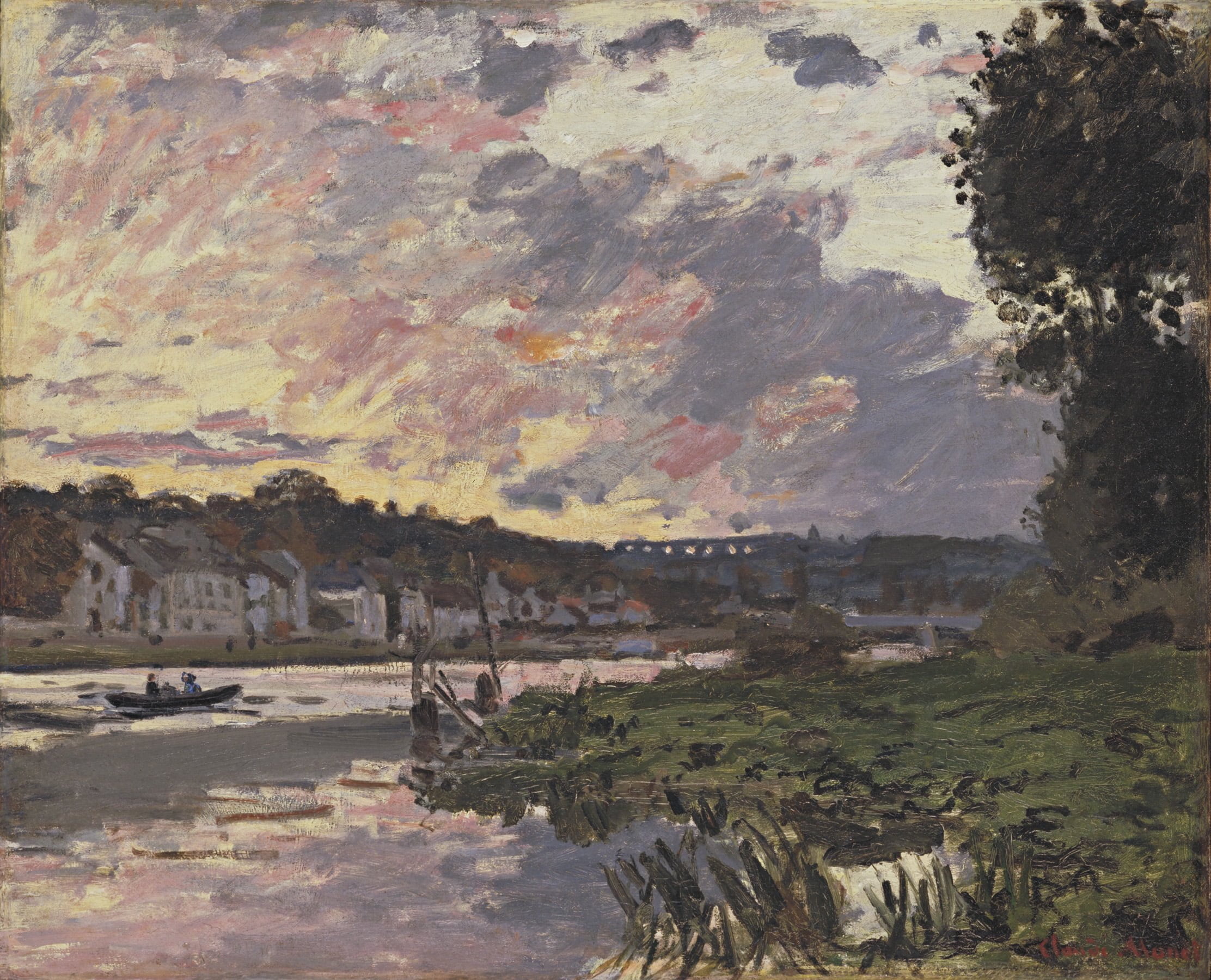
The Seine at Bougival is Monet’s 1869 work: a bend of the river under a pink and grey evening sky, a row of houses on the far bank, a moored boat in the grass by the water. The original is held by the Smith College Museum of Art in Northampton under accession number SC 1946.4. With us it is made as a hand-painted oil painting on canvas, at 73 x 60 cm or to your own measurements.
| Title: | The Seine at Bougival |
| Other titles: | La Seine à Bougival |
| Painter: | Claude Monet (1840–1926) |
| Year painted: | 1869 |
| Original size: | 73.5 cm x 60 cm |
| Original technique: | Oil on canvas |
| Painting style: | Impressionism |
| Located at: | Smith College Museum of Art, Northampton (accession no. SC 1946.4) |
| Our reproduction: | hand-painted oil on canvas, 73 x 60 cm, custom sizes on request |
The Seine at Bougival – Claude Monet
What is on the canvas?
The sky takes the upper half and is the liveliest part of the scene: grey cloud is shot through with salmon pink and lilac, laid on in short diagonal strokes. Below it the Seine lies calm and wide, giving the sky back in long horizontal passes. On the far bank stands a row of low white houses with brick roofs, and behind them a flat bridge runs off to the right. At the right edge a dark mass of trees rises, cut by the canvas edge, and it is what balances the whole. In the left foreground a small boat floats with two figures aboard, and nearer to us is a green grassy bank with reeds and a moored boat with a mast.
Where is this scene?
Bougival sits on the Seine west of Paris and was, in the late 1860s, a gathering point for painters who came out of the city to paint water. Monet worked there alongside Renoir; both were after the same thing, the reflection of sky on a moving surface. The view from this bank looks toward the settlement and the bridge, so not into empty countryside but into an inhabited stretch of river. The original measures 73.5 x 60 cm and is in the collection of the Smith College Museum of Art in Northampton, recorded there under accession number SC 1946.4. Bougival was also a popular Sunday destination for Parisians at the time, which explains the boats and the strollers along the water: the scene is not solitary but peopled. As an oil painting reproduction the motif is a rewarding one precisely because calm water and a moving sky meet in it.
Why is this painting important?
This is an early Monet, made before the first Impressionist exhibition, and that is exactly what makes it useful: the stroke is already quick and visible while the motif is still a classical river view. The sky is the principal character here, not a backdrop – Monet gives it half the canvas and most of the colour energy. The water is painted not as substance but as a mirror, an idea he would carry to its end in the water-lily series. As an impressionist painting it is one of those scenes where you can watch a painter’s attention move off the object and onto the light.
What does the painting mean?
It does not narrate an event; it holds the end of a day. In place of a story there are sky, water and two people in a boat who are not portrayed but belong to the landscape. The low bank in the foreground puts the viewer at the water, as though standing in the grass and looking across to the houses. It is the absence of a story that makes the scene quiet: nothing happens, and that is precisely the content. Made en plein air, on the spot and in one movement of mood, the work is closer to a note about light than to a description of a place.
The motif among Monet’s works
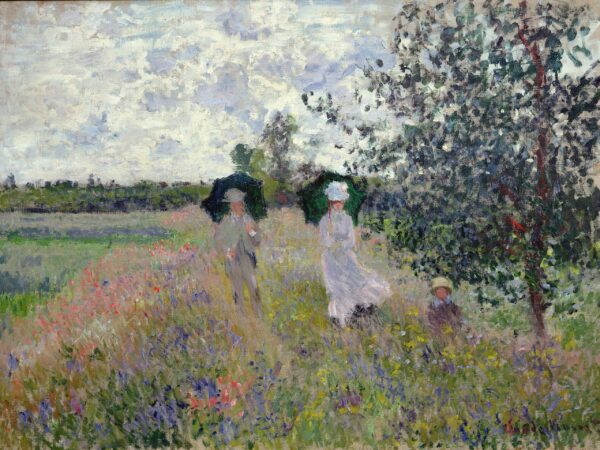
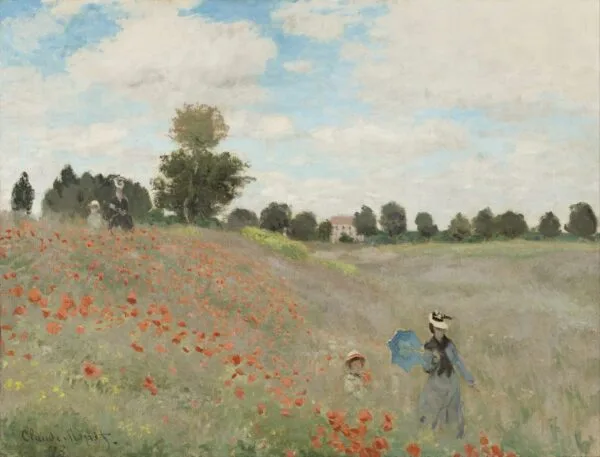
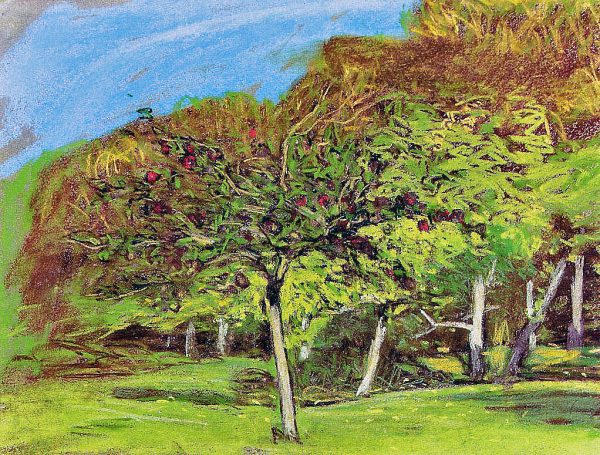
A river under a large sky recurs in Monet more than once. Related scenes are Poppies near Argenteuil, where the same stretch of river is taken over by red, and The Walk, Woman with a Parasol, where figures appear under a similar sky. When Monet looks at water from close up and drops the horizon, the result is a scene like Water Lilies I; in Corner of the Garden at Montgeron the planting closes the view altogether. The crowded bathing place on the Seine near Bougival, painted in the summer of 1869 with boats, strollers and swimmers, is Bathers at La Grenouillère.
How is our hand-painted reproduction made?
This is a canvas painting made with a brush and oil colour, not with a printer. The painter works from a high-resolution museum reference so the pinks and lilacs in the sky are right, and builds the surface the way the original does: short diagonal strokes in the cloud, long horizontal ones in the water, a denser layer in the foreground grass. That difference in direction and thickness is exactly what a print cannot give you, because there is nothing on it to cast a shadow. Because everything is done by hand, every hand-painted copy is its own and no two are ever quite alike.
Stretched on a stretcher, and framed if you chose that, in 15 to 45 days, once you approve the photograph of the finished work.
Which size for which wall?
If you are unsure which: 73 x 60 cm. We paint this Monet reproduction in a single offered size, 5 mm narrower than the original and the same height. The format is horizontal and at this size belongs above a chest of drawers, a desk, or on a narrow wall between doors; as a painting for living room walls it also sits well above a low sideboard. Since sky and water are light and free of hard contrast, the scene takes a north wall and soft light. If you need another size you do not pick it from a list – we paint it to your measurements, as set out below.
How high to hang the painting: the centre at eye level, roughly 145–150 cm from the floor; above a chest of drawers 15–25 cm above the top.
Custom size, stretcher and frame
Because a single size is offered, making the work to your measurements is the rule here rather than the exception; that is our painting made by order, in which we keep the proportions so bank and sky are never squeezed. Every copy is delivered stretched on a wooden stretcher and ready to hang. For the moulding, use our 3D application: it shows every one of our frame profiles on this subject, so you can compare gold, silver, black, white and natural wood before deciding – the application is for choosing the frame only. If you want to see how impressionist wall art will look on your own wall, that is our separate room-placement service.
Delivery and guarantee
Every copy is made to order in our studio in Slovenia, so allow 15 to 45 days depending on the size you choose. We ship it stretched and protected for transport, framed if you chose a frame, across the EU with no customs. Before dispatch you receive a photograph of the finished work to approve, and our returns policy applies to every order. The full range is in the Claude Monet gallery, and the painter’s life is set out in our Claude Monet article.
Frequently asked questions
Where is the original?
At the Smith College Museum of Art in Northampton, accession number SC 1946.4.
When was the work painted?
In 1869, in Monet’s early period on the Seine west of Paris.
Who are the figures in the boat?
No names are recorded, so we give none; in the scene they belong to the landscape and are not a portrait.
What is the painting about, in one sentence?
The end of a day on the river: sky, water and quiet, with no event.
- Subject: a bend of the Seine at Bougival under a pink and grey evening sky, houses and a bridge on the far bank
- Original: 73.5 x 60 cm, oil on canvas, Smith College Museum of Art, accession no. SC 1946.4
- Our version: hand-painted oil on canvas, offered size 73 x 60 cm, otherwise to your measurements
- Worth knowing: the sky takes half the canvas and most of the colour – the water only gives it back in long horizontal passes