





Description
| Title: | Corner of the Garden at Montgeron |
| Other titles: | Coin de jardin à Montgeron · Eine Ecke des Gartens in Montgeron |
| Painter: | Claude Monet (1840–1926) |
| Year painted: | 1877 |
| Original size: | 194 cm x 175 cm |
| Original technique: | Oil on canvas |
| Painting style: | Impressionism |
| Located at: | Hermitage Museum, St Petersburg (inv. ГЭ-9152) |
| Our reproduction: | Hand-painted oil on canvas, twelve sizes or made to measure |
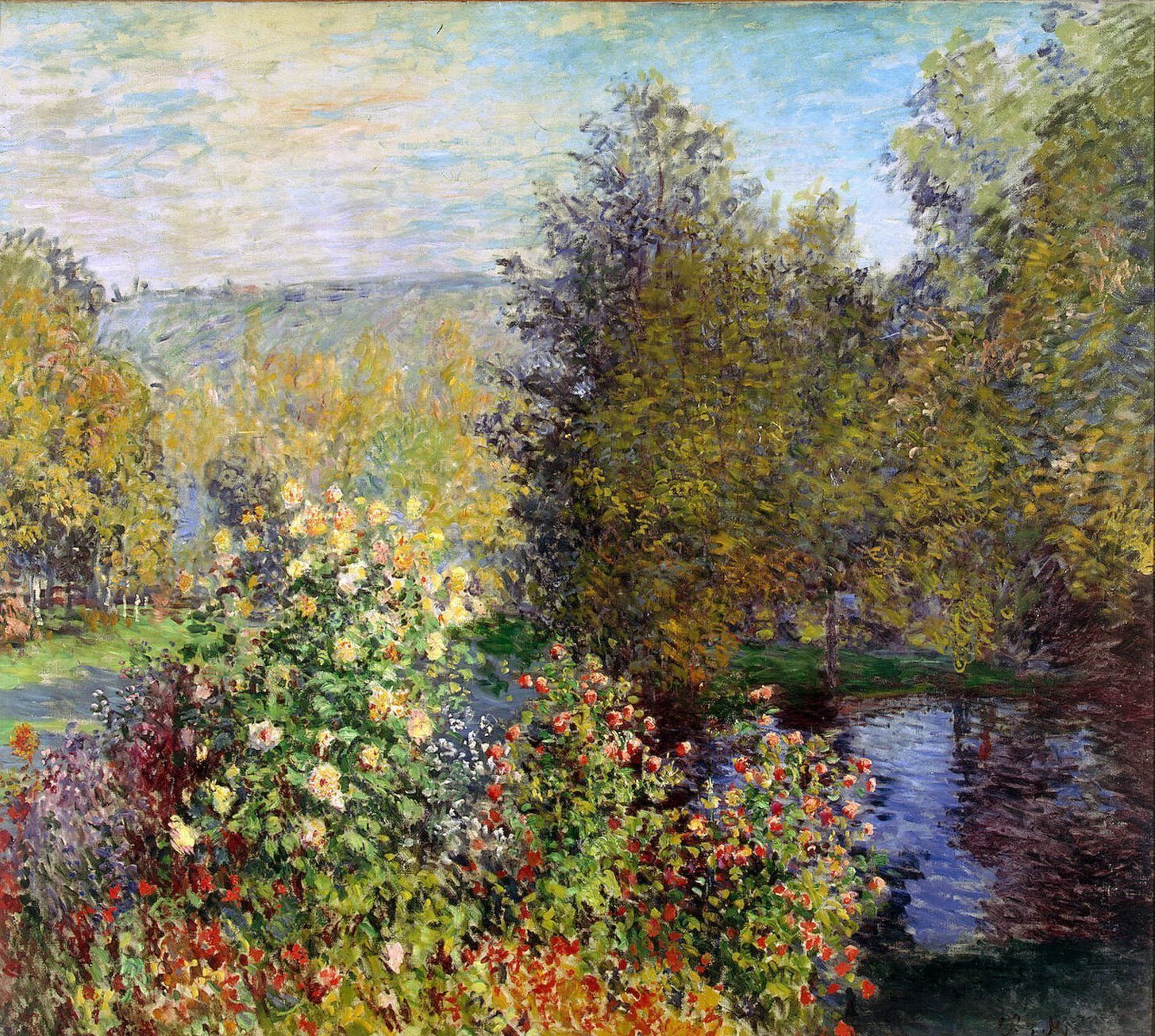
Corner of the Garden at Montgeron is Monet’s large garden composition of 1877: a bed of dahlias in red, white, cream and violet fills the lower half of the canvas, dark conifers and gold-yellow crowns rise behind it, and at the right edge the corner of a pond appears. The original hangs in the Hermitage Museum in St Petersburg. We make it as a hand-painted copy in oil on canvas, in twelve sizes or to your own measurement, with a photograph of the finished work sent for approval before dispatch.
Corner of the Garden at Montgeron – Claude Monet
What is shown?
The corner of a large private garden at the height of summer, seen from close up and low down, so that the flowers rise almost to the middle of the canvas. No house, no people, no path to walk in by — only the bed, the grass, the trees and a piece of water. Monet was not painting a view but the piece of garden directly in front of him, and that is exactly why the work behaves more like a window than a landscape.
What is on the canvas?
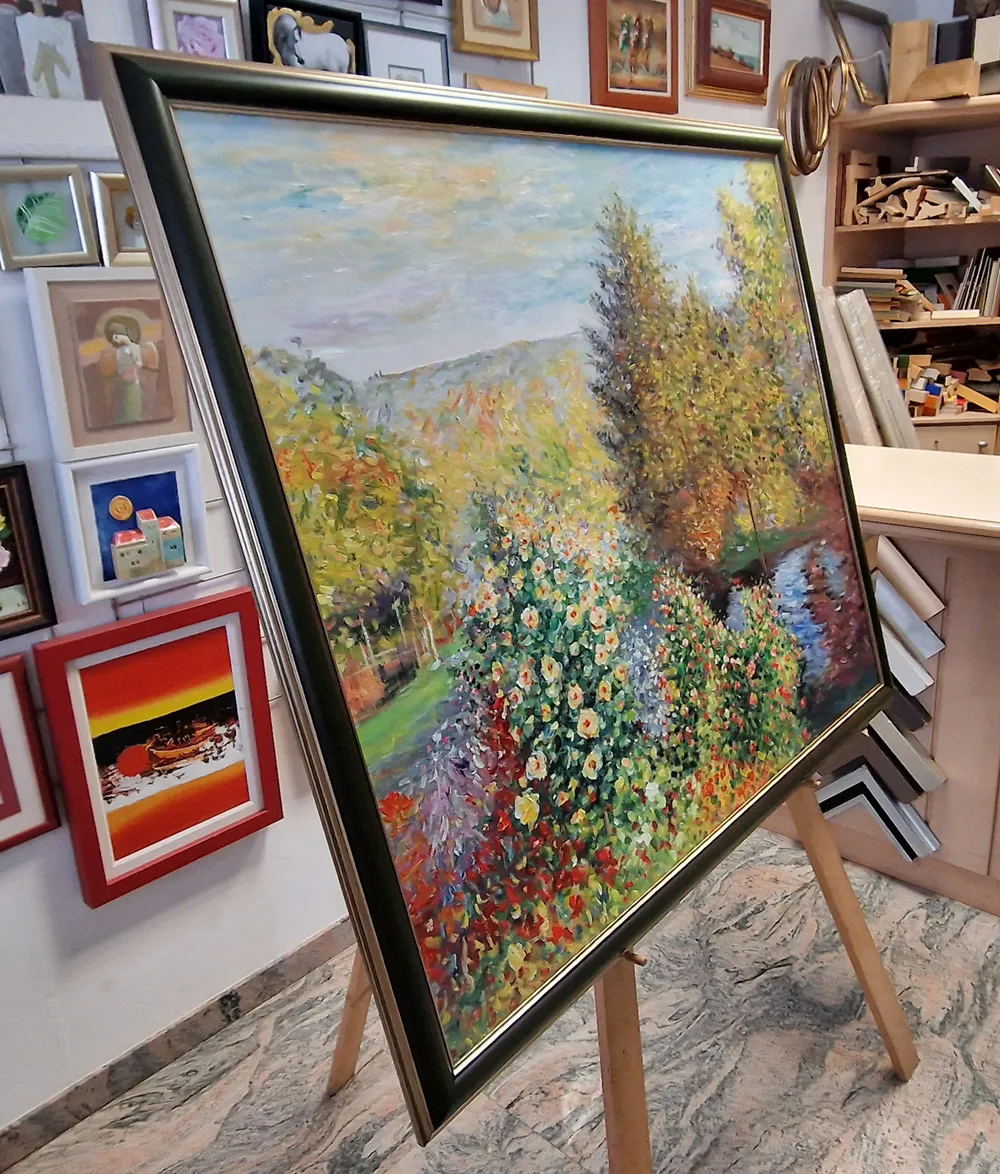
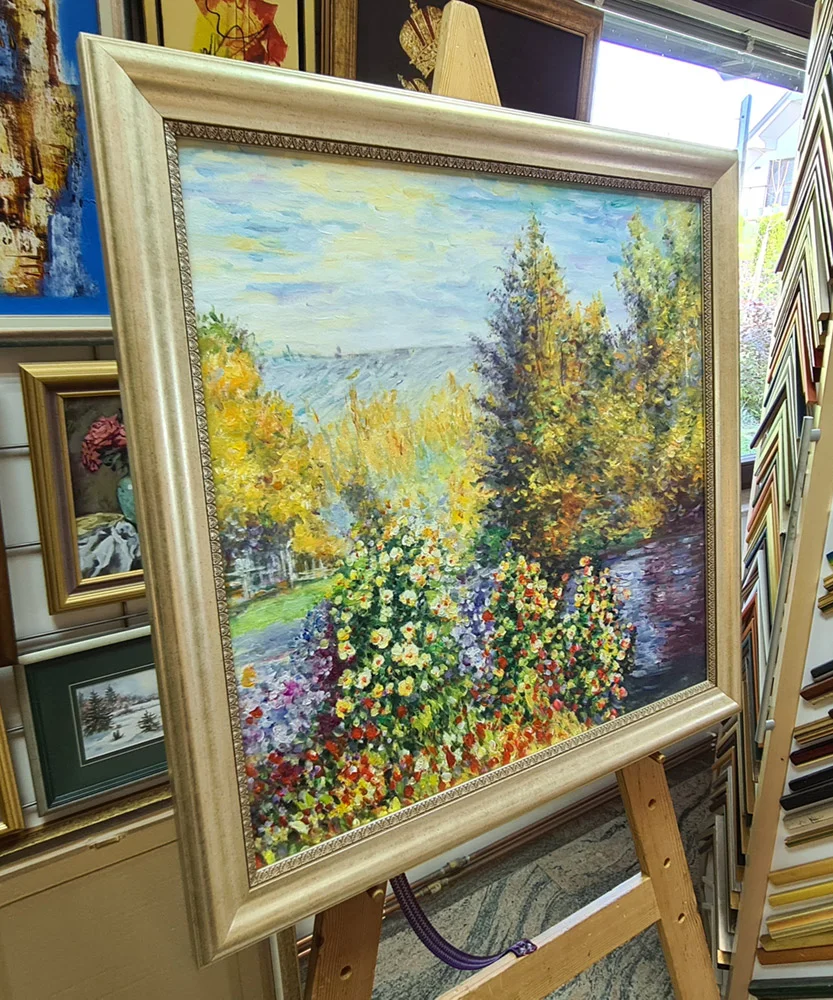
The lower half is a dense bed of dahlias: short, thick touches of red, white, cream, orange and violet lying side by side in a dark green mass of leaves, without a single drawn flower shape. To the left, behind the bed, a band of grass opens and a pale path curves out of the format. On the right stands a tall, dark blue-green conifer, and beside it a gold-yellow crown catching the sun. Right at the edge runs a dark, reddish violet band — the corner of the pond, the only water here. Above, a pale green-blue slope rises, and over it the sky, painted in long cream and yellow strokes. The canvas painting is almost square, which gives the flowers a weight an elongated format could not carry.
Why is the work this large?
Because it was not meant for an exhibition but for a wall. The collector Ernest Hoschedé invited Monet to the Château de Rottembourg at Montgeron and commissioned four large decorative panels for the round salon. This is one of them. That is why it measures nearly two metres across and is almost square: the format is not the painter’s choice but the wall’s measurement. The commission was short-lived — Hoschedé went bankrupt a year later and his collection went to auction — but the panels remained, and an oil painting reproduction of this scale is rare in Monet.
Why are dahlias in the foreground?
In the 1870s the dahlia was a fashionable garden plant, the pride of large houses, and Hoschedé’s garden had beds of them. For a painter they were ideal: they grow in dense bushes, the flowers are round and evenly sized, the colours pure and saturated. Monet did not draw them but built them out of points — from close up the bed is a disorder of coloured marks, and at two metres it resolves into flowers. An impressionist painting of this kind therefore behaves one way up close and another from the sofa, and both are correct.
Which of the Montgeron panels is this?
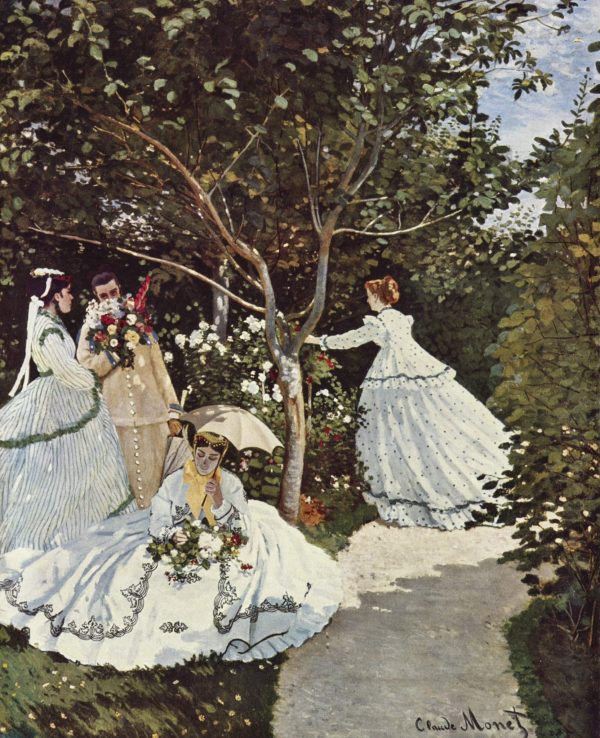
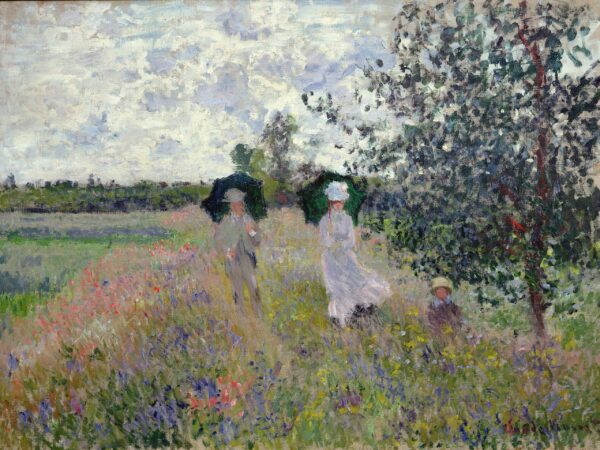
The four panels have gone their separate ways. This one and The Pond at Montgeron are in the Hermitage today, The Turkeys in the Musée d’Orsay is the third, and the fourth is in private hands. A smaller work from the same stay, The Rose Bushes in the Garden at Montgeron, is in the Museum Barberini. If you are looking for Monet’s gardens elsewhere, the figures among the flowers are Women in the Garden, the meadow beside the house is Meadow at Giverny, the poppy field is Poppy Field (Giverny) and the Dutch beds are Field of Tulips in Holland.
How is our hand-painted version made?
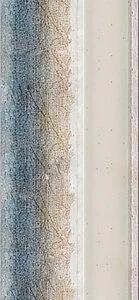
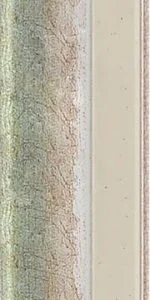
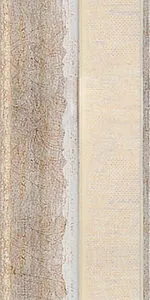
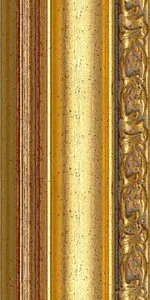
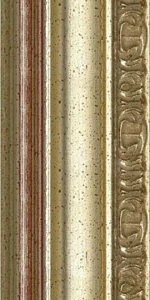
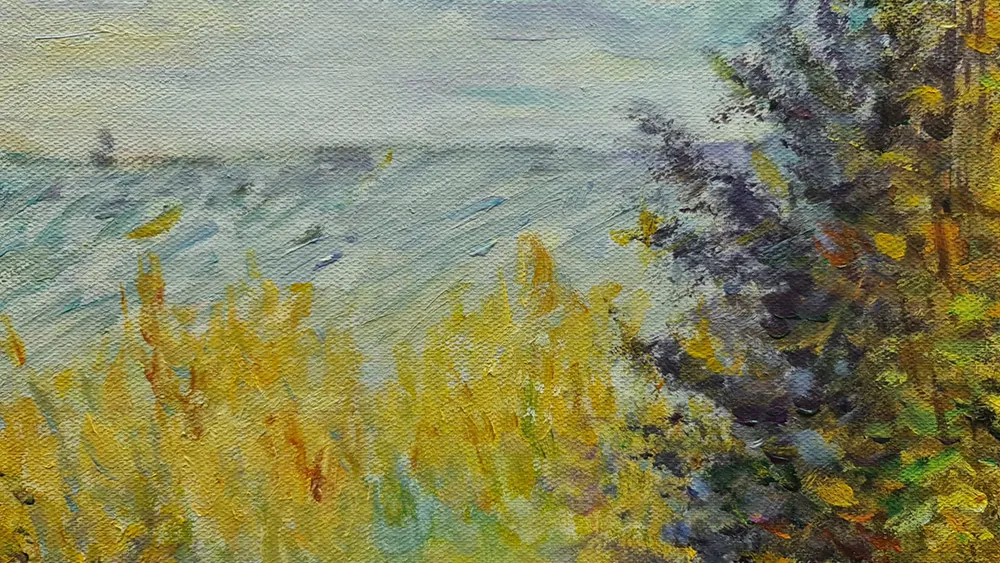
The painter works from the back forward: sky and slope first, then the trees, and only last the bed, which has to lie over everything else. The flowers go on one at a time, with the tip of the brush, and are not corrected — a retouched touch loses its edge and the bed turns to mush at once. In the first photograph the finished canvas stands in a dark green and gold frame, angled on the easel in our workshop. In the second photograph you see a second, separately painted version of the same subject in a pale champagne frame with a fine beaded edge — two orders, two canvases, and they are not the same. In the third photograph the surface is shot close up: the individual strokes are visible, and the weave of the canvas between them.
Which size for which wall?
Short answer: 120 x 120 cm for a living room, 80 x 80 cm for a smaller wall, 160 x 160 or 200 x 200 cm for a large open one. Because the original is almost square, the square sizes come closest to its ratio; they run from 50 x 50 to 200 x 200 cm, with 120 x 100 cm as well for a landscape wall. A painting for living room walls should take up roughly two thirds of the width of the sofa. The small sizes, 50 x 50 and 60 x 60 cm, are meant for a hallway or a shelf, where people stand close and see the separate touches. As impressionist wall art this subject wants a pale wall; against a dark one the flowers close up.
How high to hang the painting: put the centre of the canvas about 150 cm above the floor. Above a sofa, leave around twenty-five centimetres of air between the backrest and the bottom edge.
Made to measure, stretcher and frame
If none of the listed sizes suits, we paint to measure — send the width and the height and we will quote a price and a lead time. The original measures 194 x 175 cm, a ratio of about 1 : 1.11; if you want exactly that, say so. The canvas is stretched over a wooden stretcher and the edges are painted, so it does not look unfinished without a frame. The photographs show two different frames, dark green with gold and pale champagne; both come from our workshop, and you can choose from all of them.
Delivery and guarantee
We ship to the United Kingdom, Ireland and across the EU, wrapped in protective film and packed in a rigid box. For the largest sizes we will send the canvas rolled in a tube if you prefer. Before dispatch we send a photograph of the finished work; if something on it is wrong, it is corrected before the piece leaves the workshop. Every other Monet reproduction we paint is in the Claude Monet gallery, and we write about painting and about choosing a subject on the blog.
If the painting is a gift and you are unsure of the size, there is a wall art voucher: the recipient chooses the size and the subject.
Frequently asked questions
Where is the original?
In the Hermitage Museum in St Petersburg, under inventory number ГЭ-9152.
What year is it from?
From 1877, the year Monet was working on the Montgeron panels for Ernest Hoschedé.
Is “Coin de jardin à Montgeron” the same work?
Yes — that is the French name of the same painting; it is Eine Ecke des Gartens in Montgeron in German, Kot vrta v Montgeronu in Slovene, Kut vrta u Montgeronu in Croatian, Un angolo del giardino a Montgeron in Italian and A montgeron-i kert sarka in Hungarian.
Who commissioned the Montgeron paintings?
Ernest and Alice Hoschedé, in 1876: they asked Monet for four decorative views of the grounds of their Château de Rottembourg at Montgeron, and this corner of the garden with dahlias is one of them. Hoschedé went bankrupt the following year and never received the paintings.
- Painted by hand. Oil on canvas, no print and no machine application.
- Twelve sizes or made to measure. From 50 x 50 to 200 x 200 cm, otherwise to your own measurement.
- A photograph before dispatch. You see the finished work before it leaves the workshop.
- Figures from the museum. Year, size and inventory number are given as the Hermitage records them.