







































Description
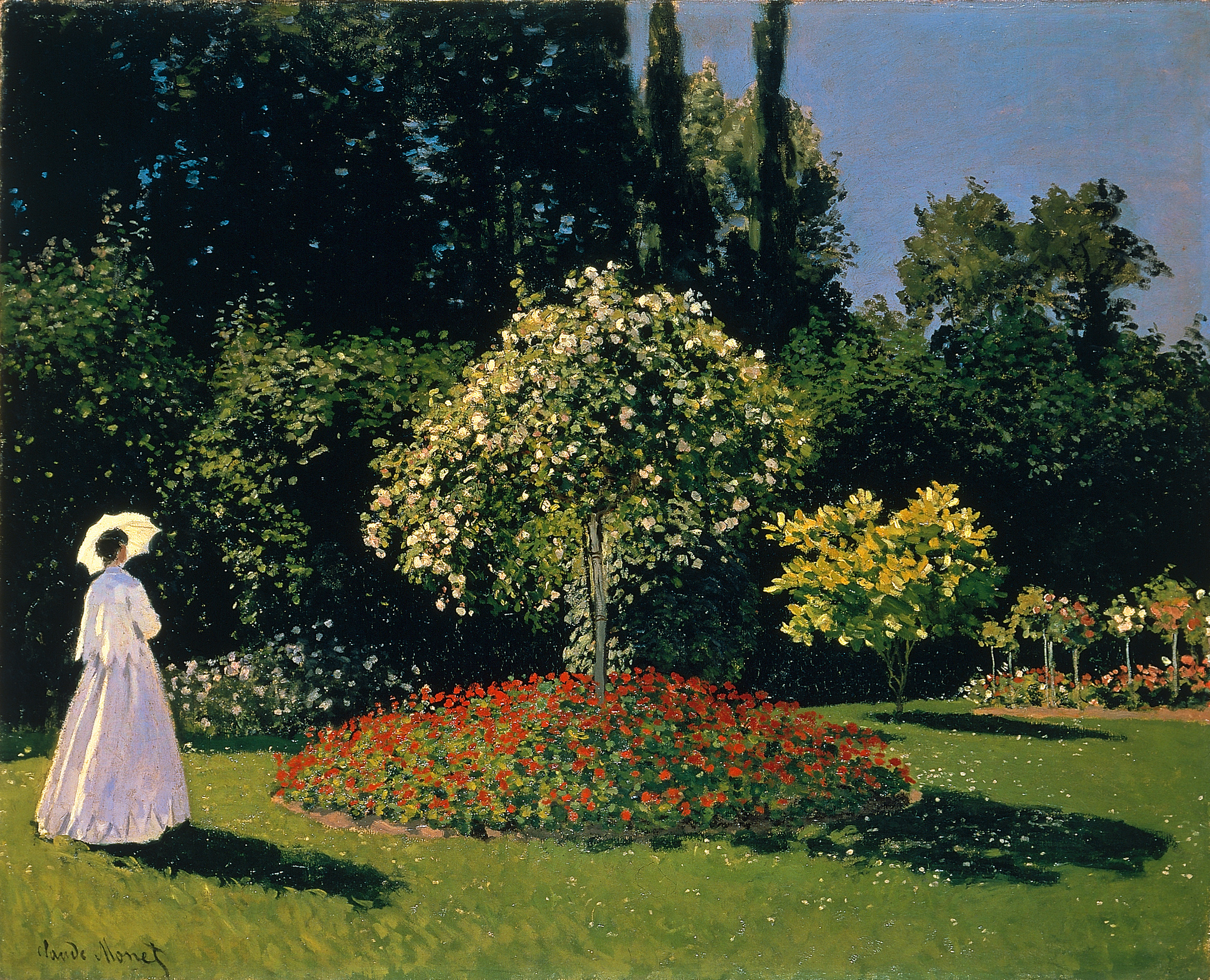
Woman in the Garden is Monet’s canvas of 1867: a woman in a white dress with a parasol standing on a sunny lawn beside a round bed of red flowers, with tall trees behind her and their shadows on the grass. The original belongs to the State Hermitage Museum in Saint Petersburg. We make it as a hand-painted reproduction in oil on canvas, in seven sizes or to your own measurement, with a photograph of the finished work sent for approval before dispatch.
| Title: | Woman in the Garden |
| Other titles: | Femme au jardin · Woman in the Garden at Sainte-Adresse |
| Painter: | Claude Monet (1840–1926) |
| Year painted: | 1867 |
| Original size: | 101 cm x 82 cm |
| Original technique: | Oil on canvas |
| Painting style: | Impressionism |
| Located at: | State Hermitage Museum, Saint Petersburg (inv. GE-6505) |
| Our reproduction: | Hand-painted oil on canvas, seven sizes or made to measure |
Woman in the Garden – Claude Monet
What is shown?
A summer garden in full sun. On the right, a woman in a long white dress stands on the lawn under a parasol, half turned away from us. In the middle of the grass lies a round bed of red flowers, the strongest colour on the canvas, and behind it rise tall dark trees with a strip of bright sky between them. Their shadows fall across the lawn in long blue-green bands, and the white of the dress is the brightest point in the whole scene.
Who is the woman?
She is usually identified as Jeanne-Marguerite Lecadre, a cousin of Monet, in the garden of the family house at Sainte-Adresse near Le Havre, where Monet spent the summer of 1867. She is small in the scene and her face is hardly shown: the painting is less a portrait than a study of a white dress in sunlight.
Why does this painting matter?
It belongs to the summer in which Monet worked out how to paint sunlight outdoors: light that bleaches the white, deepens the red and turns the shadows coloured. The same summer at Sainte-Adresse produced his terrace and beach scenes, and this garden is the quietest of them — one figure, one flowerbed and the light.
White in the sun
White is the hardest colour to paint in sunlight, because it is never only white. On the lit side the dress is warm and almost yellow; in the folds and under the parasol it turns blue and grey. Monet painted those differences instead of an outline, which is why the figure seems to stand in real light and not in front of a backdrop.
Sainte-Adresse and its gardens
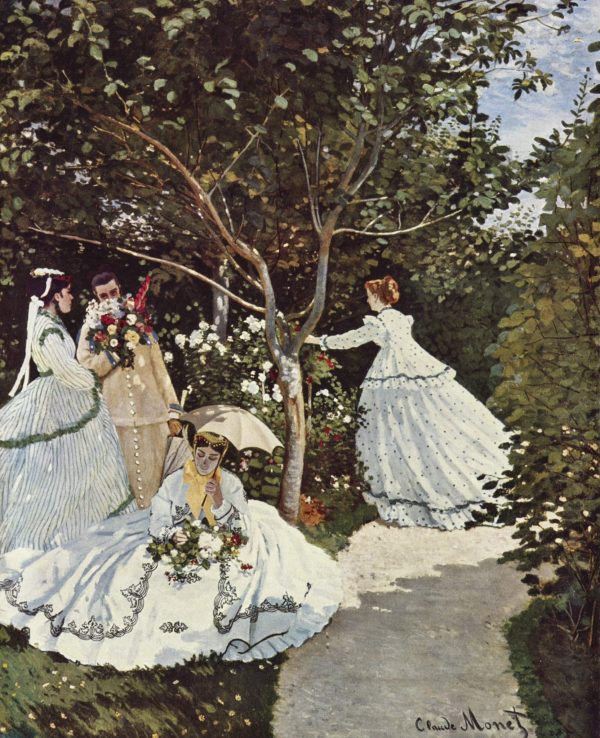
Monet painted the coast and gardens around Sainte-Adresse several times in the 1860s. The family terrace above the sea with its flags is Terrace at the Seaside, Sainte-Adresse; the shore with its fishing boats is The Beach at Sainte-Adresse; and four women in light summer dresses in a garden, painted a year earlier, is Women in the Garden.
How is our hand-painted version made?
The painter starts with the dark mass of the trees and the shadows on the lawn, because they set the light for everything else. Then the bright grass and the red flowerbed, each flower a separate touch. The woman comes last: the white dress is built from warm and cool whites side by side, and the parasol throws its own small shadow over her shoulders. Painted in one flat white, the figure would fall out of the light.
Every piece is a hand-painted copy in oil on canvas, made for your order. An impressionist painting lives on its visible brushwork, so we do not smooth it away: the strokes stand slightly above the surface and catch the light, which a printed oil painting reproduction cannot do.
Which size for which wall?
Short answer: 100 x 80 cm above a sofa or sideboard, 74 x 61 cm for a hallway or a smaller wall, and 150 x 120 cm for a large empty wall. A painting for the living room should take up about two thirds of the width of the furniture below it. All seven sizes, from 74 x 61 to 150 x 120 cm, follow the format of the original.
How high to hang the painting: put the centre of the canvas about 150 cm above the floor; above a sofa, leave 20 to 30 cm between the back and the lower edge.
Made to measure, stretcher and frame
If none of the sizes suits, we paint to measure — send the width and the height and we will quote a price and a lead time. The original measures 101 x 82 cm, a ratio of about 1.23 : 1. Every canvas painting we make is stretched over a wooden stretcher with painted edges, so it does not look unfinished without a frame. A light natural wood or a narrow white moulding keeps the summer brightness; a fine gold frame suits it too and picks up the sunlit grass.
Delivery and guarantee
We ship to the United Kingdom, Ireland and across the EU, wrapped in protective film and packed in a rigid box. Before dispatch we send you a photograph of the finished work; if something on it is not right, we correct it while the canvas is still in our workshop. Every other Monet reproduction we paint is in the Claude Monet gallery, and we write about the painter and about choosing a subject on our blog.
If the painting is a gift and you are unsure of the size, there is a wall art voucher: the recipient chooses the size and the subject.
Frequently asked questions
Where is the original?
In the State Hermitage Museum in Saint Petersburg, under inventory number GE-6505. The work is recorded in Wikidata, and the photograph we paint from is on Wikimedia Commons.
What year is it from?
From 1867. Monet painted it that summer in the family garden at Sainte-Adresse on the Normandy coast.
What does Woman in the Garden mean?
It tells no story. It is a study of sunlight: how it bleaches a white dress, sets a red flowerbed glowing and turns the shadows on the grass blue and green. The woman gives the light something to fall on.
Who is the woman in the painting?
Usually Jeanne-Marguerite Lecadre, a cousin of Monet, in the garden at Sainte-Adresse. She is seen from a distance and half turned away, so the painting is not a portrait in the usual sense.
- Painted by hand. Oil on canvas, no print and no machine application.
- Seven sizes or made to measure. From 74 x 61 to 150 x 120 cm, all in the format of the original.
- A photograph before dispatch. You see the finished work before it leaves the workshop.
- About the original. Year, size and inventory number as the State Hermitage Museum records them.