




Description
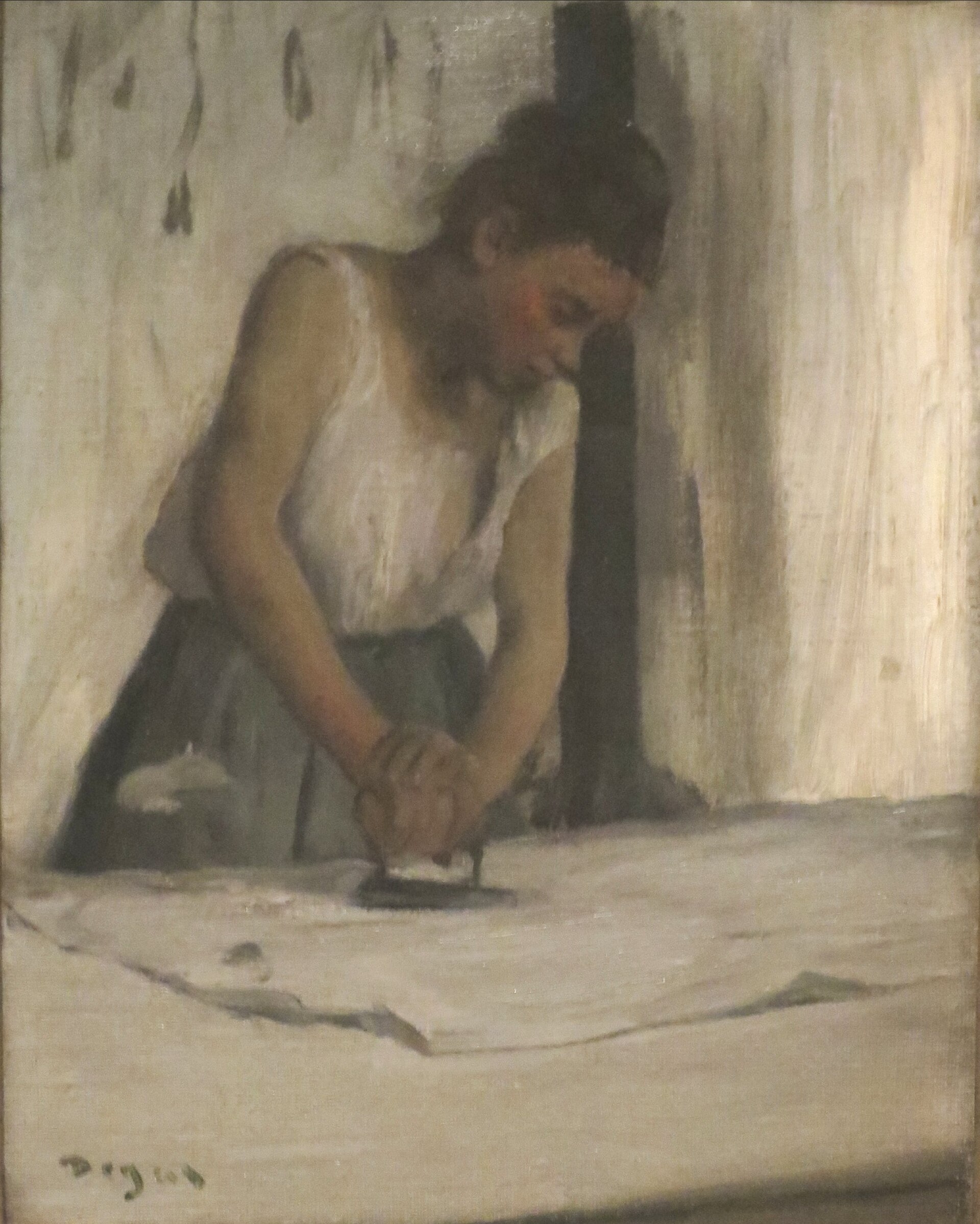
The Laundress shows a young woman pressing an iron down onto white linen with both hands. We see her close and slightly from the side, from the top edge of the table; her head is bowed, her face turned down, her hair loose at the back. She wears a white sleeveless shift and a dark green skirt. Behind her is a pale grey wall of vertical strokes, and at the right edge a dark standing band. Top left, dark shapes hang; lower left, the signature in dark green. The original is an oil work on canvas and is held by the Norton Simon Museum in Pasadena under inventory number M.1979.05.P. Ours is made by hand in eight sizes from 30 x 35 to 100 x 110 cm, or to your own measurement, and you receive a photograph of the finished work for approval before it ships.
| Title: | The Laundress |
| Other titles: | La blanchisseuse, Woman Ironing |
| Painter: | Edgar Degas (1834–1917) |
| Year: | 1873 |
| Size of the original: | 25 cm x 19 cm |
| Technique of the original: | oil, canvas |
| Style: | impressionism |
| Where it hangs: | Norton Simon Museum, Pasadena (inv. M.1979.05.P) |
| Our version: | hand-painted in oil on linen, 8 sizes from 30 x 35 cm to 100 x 110 cm, custom size on request |
The Laundress – Edgar Degas
Who is in the scene?
One woman at work; the record does not name her. She stands at the table, bent forward, pressing the iron down with both hands. Her arms are bare to the shoulder, the forearms strong, the hands closed over the handle. She wears a white sleeveless shift that has slipped from one shoulder, and a dark green skirt. Her hair is pinned up at the front and falls over her neck behind. Her face is turned down towards the linen and stays in shadow; the cheekbone is red from the heat or from the effort. There is nobody else in the scene.
What is on the canvas?
The scene stands upright and close. The lower third is taken by white linen on the table, painted in long soft strokes out of which only one folded edge rises. On it stands the dark iron, the one genuinely dark object in the foreground. Behind the woman is a wall, pale and grey-cream, with vertical strokes that suggest flaking plaster. Along the right edge runs a dark standing band, probably a door edge or a jamb. Top left hang three or four dark shapes, like washing on a line. Lower left, the signature in dark green. There is little colour: white, cream, grey, dark green, and one red on the cheek.
Why does this scene matter?
Because there is neither posing nor story. The woman does not look towards us and does nothing that looks like a scene; she simply presses the iron down. Degas painted labour as seriously as he painted ballet and opera, and this is among his sternest scenes: one person, one gesture, and a table that takes a third of the canvas. The second reason is the size. The original is small, far smaller than people expect of Degas, and that is exactly why it reads as something seen in passing rather than arranged.
What does the scene mean?
Work that nobody is watching. Impressionism in Degas was not landscape in the sun but a cut from modern city life, including the part of it that was not pretty; the Paris laundries were hot, damp and full of steam. An impressionist painting of this kind therefore stands closer to a report than to an idyll. As wall art it is restrained and quiet, with no strong colour; that is exactly why it holds a small room and works where the viewer stands close. Choose a large painting instead and the figure will read well beyond life size, which is a different picture from the one Degas made.
The subject among Degas’s works
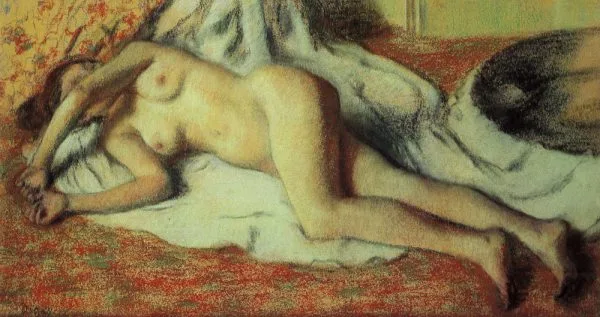
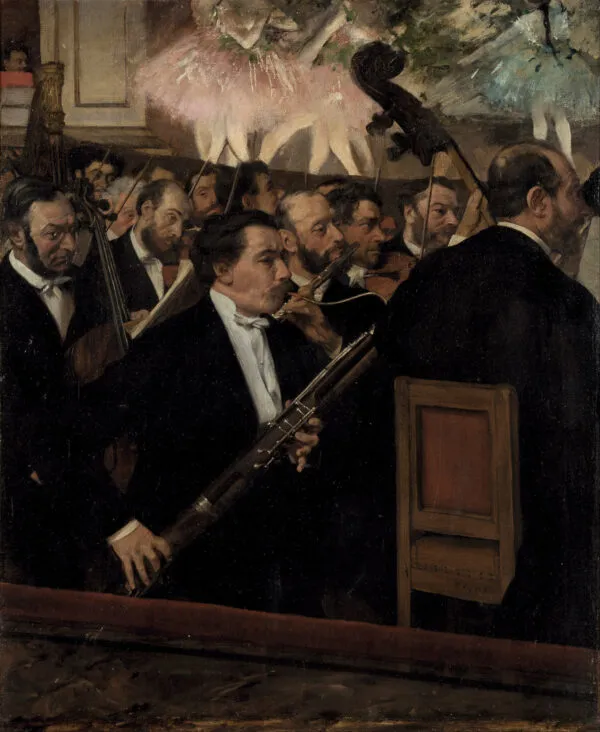
Laundresses run through two decades of Degas’s work. Woman Ironing shows the same task at a far larger scale, both hands on the iron seen from the side, The Convalescent is likewise a single female figure in held-back colour, and A Woman Seated beside a Vase of Flowers shows how Degas puts a person at the edge of a scene. Another laundress of later years is held by the Walker Art Gallery in Liverpool, and a related city trade is shown by The Millinery Shop at the Art Institute of Chicago.
How is our hand-painted version made?
With a brush and oil paint, not a printer. The original is oil on canvas, so the same technique as ours. The difficulty of this subject is not the drawing but how little colour it holds: the white shift, the white linen and the pale wall are three different whites and must stay three. So we paint the wall cooler and greyer, the linen warmer, and the shift lightest and with the fewest strokes. The dark band at the right edge and the dark iron are the only two true darks, and we leave them until last so they do not pull everything else down. The red on the cheek goes on at the very end and only once. Every reproduction is painted afresh, and no two are quite alike, because a hand does not repeat the same stroke twice; each hand-painted copy is therefore its own. For this work we have no photographs of our finished canvases, so none are shown here and none are described. You receive the photograph of your own canvas before it ships.
Which size for which wall?
If you do not know which: 50 x 55 cm. Here we should be honest about the proportions. The original measures only 25 x 19 cm, which makes it considerably smaller and noticeably narrower than anything we make; our smallest size, 30 x 35 cm, is closest to it both in size and in proportion, and still has more than twice its area. In proportion 30 x 35 and 60 x 70 cm are equally close, sharing the same ratio, so we name them together; all the rest are squarer than the original. The 30 x 35 and 43 x 47 cm keep the sense of a small, private scene. The 50 x 55 and 60 x 70 cm are the usual choice above a chest of drawers, and there the hands and the iron already read clearly. The 70 x 80 and 80 x 90 cm want a broader wall. At 90 x 100 and 100 x 110 cm the subject is strong, but reckon with a figure well above life size. Measure the size you choose on the wall first with a paper cut-out. No size is kept in stock as a finished piece: every copy is painted to order and stays a single piece.
Custom size, stretcher and frame
If none of the eight sizes fits, or if you want the proportion of the original, we paint to your measurement and keep the proportions of the scene as we do, so that the linen below keeps its third of the canvas and the dark band at the right edge stays as wide as it is in Degas; this is our work painted to order. Every canvas painting ships stretched on a wooden stretcher, ready to hang. For the frame, use our 3D app: it shows every moulding we carry on this subject, so you can compare gold, silver, black, white and natural wood — it is for choosing a frame and nothing else. If you want to see how the work looks on your own wall, we have a separate service for that, placement in the room.
Delivery and guarantee
Every piece is painted to order in our workshop in Slovenia, so allow 15-45 days depending on the size chosen; at the largest sizes the time is usually at the upper end. It travels stretched and protected for transport, framed if you chose a frame, to sixteen countries in the European Union, with no customs. Before it ships you receive a photograph of the finished work for approval, and our returns policy applies to every order. The painter’s full offer is in the Edgar Degas gallery, and his life is described in our article about Edgar Degas.
Frequently asked questions
What is happening in the scene?
A woman is ironing. With both hands she presses the iron onto white linen spread across the table.
Why is the face barely visible?
Because it is bent over the work. Degas did not turn it towards us and did not light it; it stays in shadow.
Why are both hands on the iron?
Because the irons of the period were not light, and you had to press with the whole weight of the upper body.
What is hanging at the top left?
Three or four dark shapes, to all appearances pieces of washing. Degas left them as strokes without detail.
Where is the original?
In the Norton Simon Museum in Pasadena, under inventory number M.1979.05.P.
How big is the original?
Only 25 x 19 cm. That is less than a sheet of A4 and considerably less than any of our sizes.
Why is your smallest size larger than the original?
Because the original is extraordinarily small. Our 30 x 35 cm is the closest to it, and still has more than twice the area.
Do your sizes follow the proportion of the original?
Not quite; the original is narrower than all of them. The closest are 30 x 35 and 60 x 70 cm.
Is this a print?
No. The work is made by hand in oil; the brushstrokes are visible and can be felt.
Can I have a size that is not on the list?
Yes, we paint to measurement and keep the proportions of the scene as we do.
Is it suitable as a gift?
Yes, especially for someone who likes quiet, restrained subjects. Because every piece is painted to order, allow for the making time; if you would rather leave the choice to the recipient, there is our voucher.
- Subject: a young woman ironing, both hands on the iron, her face bent over the work
- Original: Edgar Degas, oil painted on canvas, 25 x 19 cm, Norton Simon Museum, Pasadena (M.1979.05.P)
- Ours: painted by hand in oil, eight sizes from 30 x 35 to 100 x 110 cm, stretched and framed on request
- Note: the scene holds three different whites — the shift, the linen and the wall — and each has to stay its own