



Description
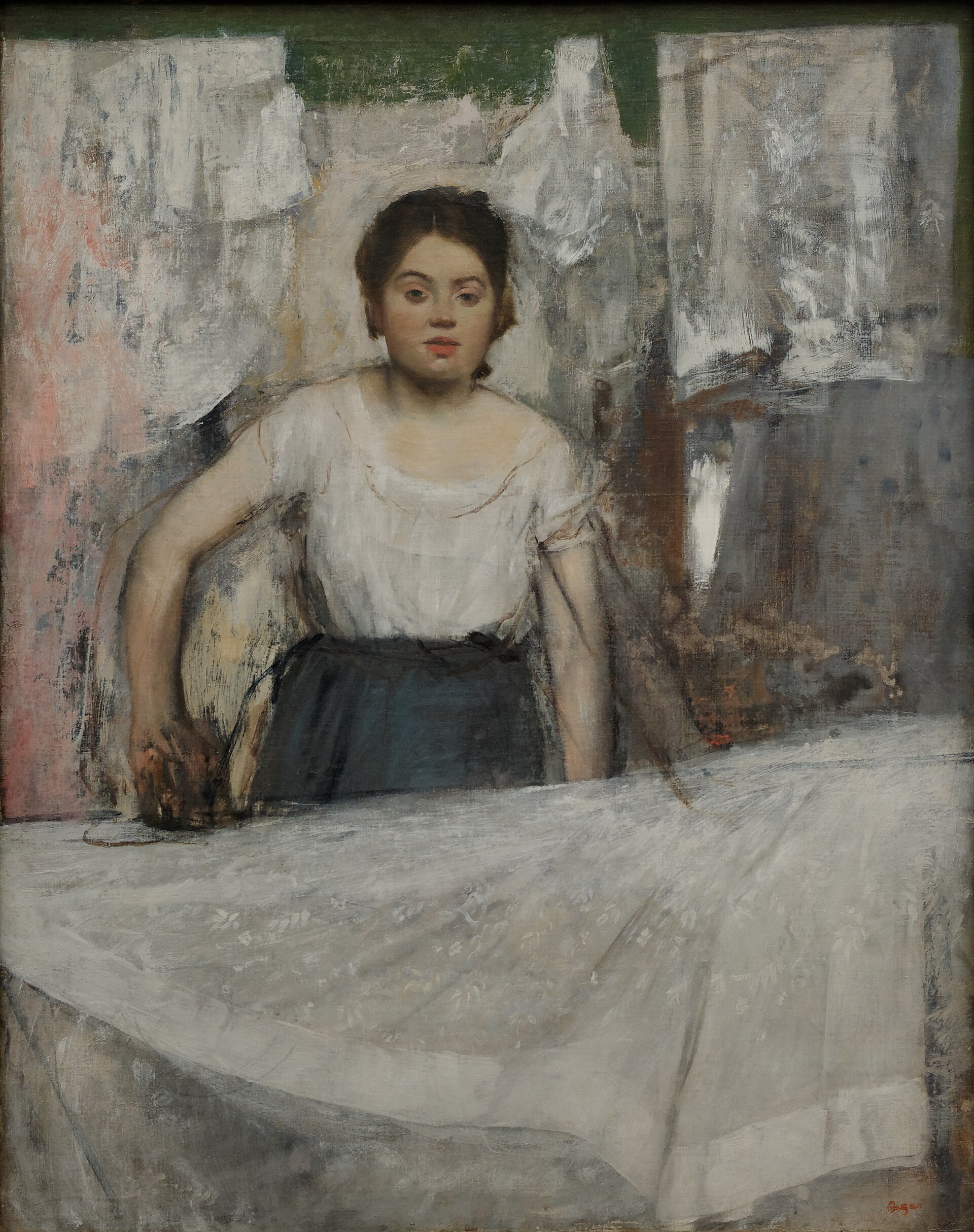
Woman Ironing shows a young woman standing behind a table covered with a large pale sheet. She wears a loose white blouse and a dark blue-grey apron; both arms reach forward, and with her right hand she presses the iron onto the cloth. She looks straight out at us, calm and tired. Behind her hangs laundry, at the very top a narrow green band appears, and at the upper left a pink patch. The original is an oil painting on canvas and is held by the Neue Pinakothek, Bayerische Staatsgemäldesammlungen in Munich under the inventory number 14310. We make it as a hand-painted work, in sizes from 30 x 35 to 100 x 110 cm or to your own measurements, and you receive a photograph of the finished work for approval before dispatch.
| Title: | Woman Ironing |
| Other titles: | La repasseuse, Die Büglerin |
| Painter: | Edgar Degas (1834–1917) |
| Year of execution: | circa 1869 |
| Original size: | 92.5 cm x 73.5 cm |
| Original technique: | Oil on canvas |
| Painting style: | Impressionism |
| Located at: | Neue Pinakothek, Bayerische Staatsgemäldesammlungen, Munich (inv. no. 14310) |
| Our reproduction: | hand-painted oil on linen canvas, 8 sizes from 30 x 35 cm to 100 x 110 cm, custom sizes on request |
Woman Ironing – Edgar Degas
Who is shown?
A single woman, who is not named. She is young and stands behind a table, seen from the waist up and from the front. She wears a loose white blouse with a round neckline and sleeves to the elbow, and over it a dark blue-grey apron tied at the waist. Both arms reach forward and down onto the cloth; her right hand holds the iron, her left rests further to the right on the fabric. Her dark hair is pinned up. She looks straight out at us — calm, unsmiling, like someone interrupted in the middle of work.
What is on the canvas?
Almost everything is white. The lower third is taken by a large pale sheet spread over the table; behind the woman hangs laundry that closes the background like a curtain. There are differences between the whites: the sheet is cool and greyish, the blouse warmer, the hanging laundry broken into lighter and darker planes. The only substantial dark mass in the whole scene is the apron. A narrow green band runs along the very top, there is a pink patch at the upper left, and brown and grey shapes at the right. At the lower right stands a red mark.
Why does this particular scene matter?
Because work that was then thought low is painted like a portrait. The laundress or the ironer was a genre figure in the painting of that time: someone you look at, not someone who looks at you. Here that is reversed. The woman stands at our eye level and looks straight out, the way the sitter of a commissioned portrait looks out. The second thing is the colour. Degas set himself the hardest task a painter has: a scene that is almost entirely white, and in it he had to paint four different things in white — the sheet, the blouse, the hanging laundry and the light in the room.
What does the scene mean?
Work without flattery and without accusation. Impressionism for Degas always meant exactness of observation, including when the subject is ordinary. An impressionist painting of this kind is therefore not a scene of pity but a scene of attention: what the hands are doing, how the body stands, how cloth behaves. As wall art it is unusually light and calm, and so it carries a smaller room well. A canvas painting for a kitchen, a dining room or a bright working corner suits this motif very well.
The motif among Degas’s works
Laundresses and ironers are Degas’s third great subject, beside the ballet and the races. The Laundress shows the same work with a different figure, Washerwomen puts two of them together, and The Ironer against the Light turns the same scene towards the window so that the figure becomes a silhouette. This work is catalogued in the Degas catalogue raisonné as MS 579, and how Degas saw a woman at work in a shop is shown by The Millinery Shop at the Art Institute of Chicago.
How is our hand-painted version made?
With a brush and oil colours, not a printer, and here the technique of the original is the same as ours: oil on canvas. Every one of our canvases is made layer after layer, and in this motif the whole difficulty is in the white. If every white surface is painted with the same colour, the scene goes as flat as paper; each has to take its own temperature — greys and ochre in the sheet, warmth in the blouse, coolness in the hanging laundry. The other demanding part is the face, which has to stay calm rather than friendly: a smile would turn the work into something else. We paint the apron last, because it is the only true dark and it sets the balance. Every reproduction is made afresh and no two copies are ever quite the same, because the hand does not repeat the same stroke twice; every hand-painted copy is therefore its own. For this work we have no photographs of our finished canvases, so we show and describe none here. The photograph of your canvas reaches you before dispatch.
Which size for which wall?
If you do not know which: 70 x 80 cm. The original measures 92.5 x 73.5 cm; our 80 x 90 cm size comes nearest to it in size, while in proportion the nearest are 30 x 35 and 60 x 70 cm, because our sizes run noticeably wider than the original. The 30 x 35 and 43 x 47 cm sizes are for a narrow space or the wall beside a door. The 50 x 55 and 60 x 70 cm sizes are for a smaller room or a kitchen, where the white holds up well. The 70 x 80 and 80 x 90 cm sizes are the most frequent choice above a chest of drawers or a table; at 80 x 90 cm we are close to the size of the original itself. The 90 x 100 cm size is for a larger wall, and at 100 x 110 cm we are at the sizes where a large painting really breathes and the figure is bigger than life. Measure your chosen size on the wall with a paper cut-out first; with an upright format the mistake is usually made in the height. None of the sizes is held in stock as a finished item: every copy is made to order and stays a single piece.
Custom size, stretcher bar and frame
If none of the eight sizes suits you, or if you want the original’s proportion, we paint to your measurements and keep the proportions of the scene, so that both hands stay on the canvas and the sheet below does not lose its width; that is our painting made to order. Every copy is delivered stretched on a wooden bar, ready to hang. For the frame, use our 3D application: on this motif it shows every moulding profile we carry, so you can compare gold, silver, black, white and natural wood – it is for choosing a frame and nothing else. If you want to see how the work looks on your own wall, that is our separate room-placement service.
Delivery and guarantee
Every copy is made to order in our studio in Slovenia, so allow 15 to 45 days depending on the size you choose; for the largest sizes the time is usually at the upper end. We send it stretched and protected for transport, framed if you chose a frame, to sixteen countries in the European Union, without customs duties. You receive a photograph of the finished work for approval before dispatch, and our returns policy applies to every order. The whole range is in the Edgar Degas gallery, and the painter’s life is described in our article about Edgar Degas.
Frequently asked questions
What is happening in the scene?
The woman is ironing. She stands behind a table with a sheet spread over it, pressing the iron with her right hand, and at that moment she looks over at us.
Who is the sitter?
She is not named. We know only what she is doing.
What is behind her?
Hanging laundry that closes the background. A narrow green band appears at the very top, a pink patch at the upper left, and brown and grey shapes at the right.
What is the red mark at the lower right?
It is not a signature but the estate stamp. The work stayed in Degas’s studio until the sale after his death, so it carries a stamp rather than a signature.
Where is the original located?
In the Neue Pinakothek, Bayerische Staatsgemäldesammlungen in Munich, under the inventory number 14310.
How large is the original?
92.5 by 73.5 cm. Our 80 x 90 cm size comes nearest to it in size.
Why is the year given as “circa”?
Because that is how the catalogue of works gives it: circa 1869. Where the year is not exactly settled, we do not settle it either.
Are your sizes in the same proportion as the original?
No – ours run noticeably wider. In proportion the nearest are 30 x 35 and 60 x 70 cm; if you want the original’s proportion, we paint it to your measurements.
Is this a print?
No. The work is painted by hand in oil colours; the brushstrokes are visible and can be felt.
Can I have a size that is not listed?
Yes, we paint to measure and keep the proportions of the scene while doing it.
Is it suitable as a gift?
Yes, especially for someone who likes quiet, light-filled scenes of everyday work. Because every copy is made to order, allow for the making time; if you would rather leave the choice to them, there is our gift voucher.
- Subject: a young woman behind a table spread with a sheet, the iron in her right hand, in a white blouse and dark apron, looking straight at the viewer
- Original: Edgar Degas, an oil painting on canvas, 92.5 x 73.5 cm, Neue Pinakothek in Munich (14310)
- Ours: hand-painted in oil, eight sizes from 30 x 35 to 100 x 110 cm, stretched and framed on request
- Worth knowing: the red mark at the lower right is not a signature but the estate stamp – the work stayed in Degas’s studio right up to the sale after his death