







































Description
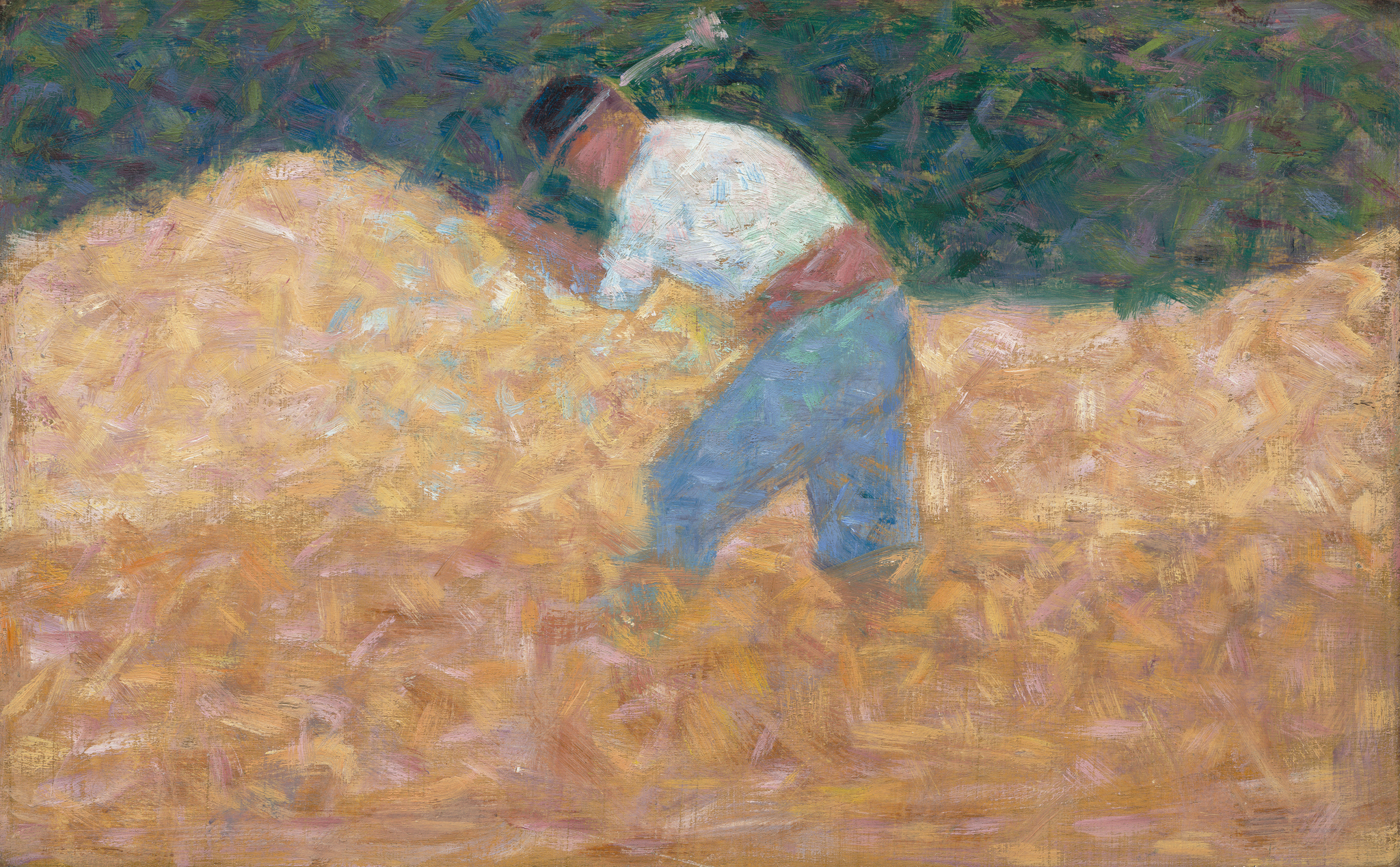
The Stone Breaker is a small oil painting on wood by Seurat, made c. 1882: a man in a white shirt and blue trousers bends over a large heap of pale stones and swings up a pickaxe, with a band of dark greenery behind him. The original, 24.1 x 14.6 cm, is held by the National Gallery of Art in Washington under number 2014.18.50. We make it as a canvas painting, hand-painted in oils, in eight sizes or to your own measurements, and before dispatch you receive a photograph of the finished work for approval.
| Title: | The Stone Breaker |
| Other titles: | The Stone Breaker – the title the museum itself uses; »Le Casseur de pierres« |
| Painter: | Georges Seurat (1859–1891) |
| Year painted: | c. 1882 |
| Original size: | 24.1 cm x 14.6 cm |
| Original technique: | oil on wood |
| Painting style: | Oil painting on wood – short, crossing, visible brushstrokes |
| Located at: | National Gallery of Art, Washington (inv. no. 2014.18.50) |
| Our reproduction: | hand-painted oil on canvas, 8 sizes from 25 x 16 cm to 150 x 100 cm, custom size on request |
The Stone Breaker – Georges Seurat
Who is in the painting?
A single man at hard labour, whom the museum record does not name. The museum lists the work as »The Stone Breaker«, and that is exactly what we see. He stands a little right of centre, bent deep forward, his head lowered towards the stones. He wears a white shirt, a reddish belt or sash and blue trousers. His head is dark; whether that is hair or a cap cannot be told on so small a painting. He holds a pickaxe in both hands and has just raised it: the handle and the head of the tool stand out near the top against the dark green background. His face is hidden by his bent posture and by shadow. There are no other people, no cart and no road. The record says nothing more about him, so we invent nothing.
What is on the panel?
A horizontal wooden panel, 24.1 cm wide and 14.6 cm high. The lower two thirds are filled by a large heap of stones in pale ochre, sandy and pinkish tones; it rises into a broad mound on the left and climbs again at the right edge, with the worker standing in the middle. The upper band is dark green, its short, slanting strokes suggesting dense bushes or foliage behind. There is no sky. Everything is painted in short, crossing strokes that lie over one another and run in all directions, so that the stones almost sparkle. The heap is not drawn stone by stone but built from a mass of small light and darker touches. There are no dots in the painting, only strokes. The record mentions no signature or stamp. The colours in our photograph are approximate, so we describe above all the subject and its arrangement.
Why does this painting matter?
Because on a very small piece of wood it shows how the French painter Georges Seurat looked at ordinary physical labour around 1882. Anyone looking for pointillism in his work will find something else here: instead of even dots, quick, crossed strokes that let white, blue, ochre and green touch one another. We do not attach labels such as neo-impressionism to this painting; we keep to what is visible on the panel and what the museum record states. Its smallness is the point: a whole movement, from raised pickaxe to bent back, is caught in a few centimetres, and every touch carries its share of the weight.
What does the scene mean?
Work, shown without a story and without embellishment. The man does not look at us, does not rest and does not pose; he is entirely in the moment before the blow. The heap is so large it almost surrounds the worker, giving the scene a sense of endurance: there is a great deal of work, and one man. We add no symbols, nor do we claim to know what the painter meant by it. At home the painting brings the warmth of pale, sandy tones, and the worker with his pickaxe gives it a quiet strength familiar to anyone who has ever dug, carried or broken stone.
What happened to the original?
The museum publishes the panel’s history. It stayed with the painter until his death; in the posthumous inventory of his studio it is listed as number 4. Then, until 1956, it belonged to Jacques and Pierre Puybonnieux in Paris, sons of Marie Puybonnieux, Seurat’s cousin, who according to the museum probably inherited the painting from Seurat’s mother. The brothers probably also lent it to the exhibition Seurat et ses amis in 1933. Next comes the dealer Wildenstein in Paris, with no year given. After that it belonged to Paul Mellon of Upperville, Virginia, who bequeathed it to the National Gallery of Art in 1999, with a life interest for his wife Rachel Lambert Mellon (1910–2014). All details are taken from the museum record.
What place does it have among Seurat’s works?
It is one of the small scenes of labour on wood in our gallery. Closest to it is Peasant with a Hoe: it is held by the same National Gallery of Art in Washington, was likewise made c. 1882 and has the same size, 24.1 x 14.6 cm. Our range also includes Farm Women at Work and The Gardener. For a pair on the wall, hang Peasant with a Hoe beside The Stone Breaker in the same size, since the two originals share one format.
How is our hand-painted version made?
With a brush and oil paint, never by machine. Our painter works from a high-resolution photograph of the original and keeps what makes the panel alive: the short, crossing strokes in the heap of stones, the white of the shirt standing out from the sandy tones, and the dark green band at the top. A pointillist technique would be the wrong choice here, because it would turn the quick, crossed strokes into a different, more orderly work. Because everything is done by hand, no two canvases are ever quite alike, and every hand-painted copy remains one of a kind. We do not yet have photographs of our own of a finished canvas of this subject; when we paint it for the first time, we will photograph it and publish the photographs here.
Which size for which wall?
If you are not sure which to choose, take 60 x 40 cm. Our smallest size, 25 x 16 cm, is the closest in our range to the original: against the panel’s 24.1 x 14.6 cm it is 0.9 cm wider and 1.4 cm taller. The format is horizontal, so it sits well above a narrow chest of drawers, above a bed or in a group of smaller works. 50 x 30 and 60 x 40 cm are the most common choices for a hallway or bedroom; 70 x 45 and 80 x 50 cm hold their own above a desk; 90 x 60 cm is the size for a living room, while 120 x 75 and 150 x 100 cm turn the small panel into a large, bright painting in which the strokes come out even more strongly. Every oil painting reproduction of this subject is made to order.
Custom size, stretcher bar and frame
If none of the eight sizes suits your wall, we paint to your measurements and keep the proportions of the original, so that the worker, the heap of stones and the green band stay in balance; that is our custom size painting service. You can order the painting in three forms: as a rolled canvas without a stretcher, stretched on a wooden stretcher bar and ready to hang, or framed; you choose the form when you order. You choose a frame in our 3D app, which shows gold, silver, black, white and wooden profiles on this subject; it is meant only for choosing the frame. To see it on your own wall, use our separate room-visualisation service.
Delivery and guarantee
Every canvas is painted to order in our studio in Slovenia, so allow 15 to 45 days depending on the size. We send it in the form you chose when ordering — rolled, stretched or framed — protected for transport, within Slovenia and across the EU with no customs duty. Before dispatch you receive a photograph of the finished work for approval, and our returns policy applies to every order. You will find all of Seurat’s subjects in the Georges Seurat gallery, and our article about Georges Seurat also describes what a good fine art reproduction of a famous painting looks like.
Frequently asked questions
Where is the original?
In the National Gallery of Art in Washington, in the museum’s public collection under number 2014.18.50; »Collection of Mr. and Mrs. Paul Mellon« is the museum’s credit line for the work.
Who is the man in the painting?
An unnamed worker breaking stones; the museum record does not name him. In the painting he wears a white shirt, a reddish belt and blue trousers.
What is he holding?
A pickaxe, raised for the blow; the handle and head of the tool are visible near the top, against the dark green background.
Why does the date say c. 1882?
Because the museum gives c. 1882 rather than an exact year. We record it the same way.
Are there dots in the painting?
No. The heap of stones and the greenery are painted with short, crossing strokes, not dots, and that is how we paint them too.
Is this a print?
No. We paint ours by hand, oil on canvas; the brushstrokes are visible and can be felt.
Why is your painting not on wood?
The original is painted on wood; we paint on canvas, so the painting is lighter and equally durable in every size. You choose whether it comes as a rolled canvas without a stretcher, stretched over a stretcher bar and ready to hang, or framed.
Which size should I choose?
For a hallway or bedroom, 60 x 40 cm; for the size closest to the original, 25 x 16 cm. The detailed guide is above.
Can I have a size that is not on the list?
Yes. We paint to measure and keep the side ratio of the original.
Is the original for sale?
No. The panel is in the museum’s public collection in Washington and is not for sale; we can paint its subject for you by hand on canvas.
Is it a good gift?
Yes, especially for someone who respects manual work or works with stone themselves. If you would rather leave the choice to the recipient, there is our gift voucher.
- Subject: a bent worker with a pickaxe over a large heap of stones, dark greenery behind – c. 1882
- Original: 24.1 x 14.6 cm, oil paint on wood, National Gallery of Art, Washington (inv. no. 2014.18.50)
- Ours: hand-painted in oils on canvas, eight sizes from 25 x 16 to 150 x 100 cm, as a rolled canvas, stretched or framed — your choice
- Worth knowing: the heap of stones fills two thirds of the painting and is made entirely of short, crossed strokes