
















Description
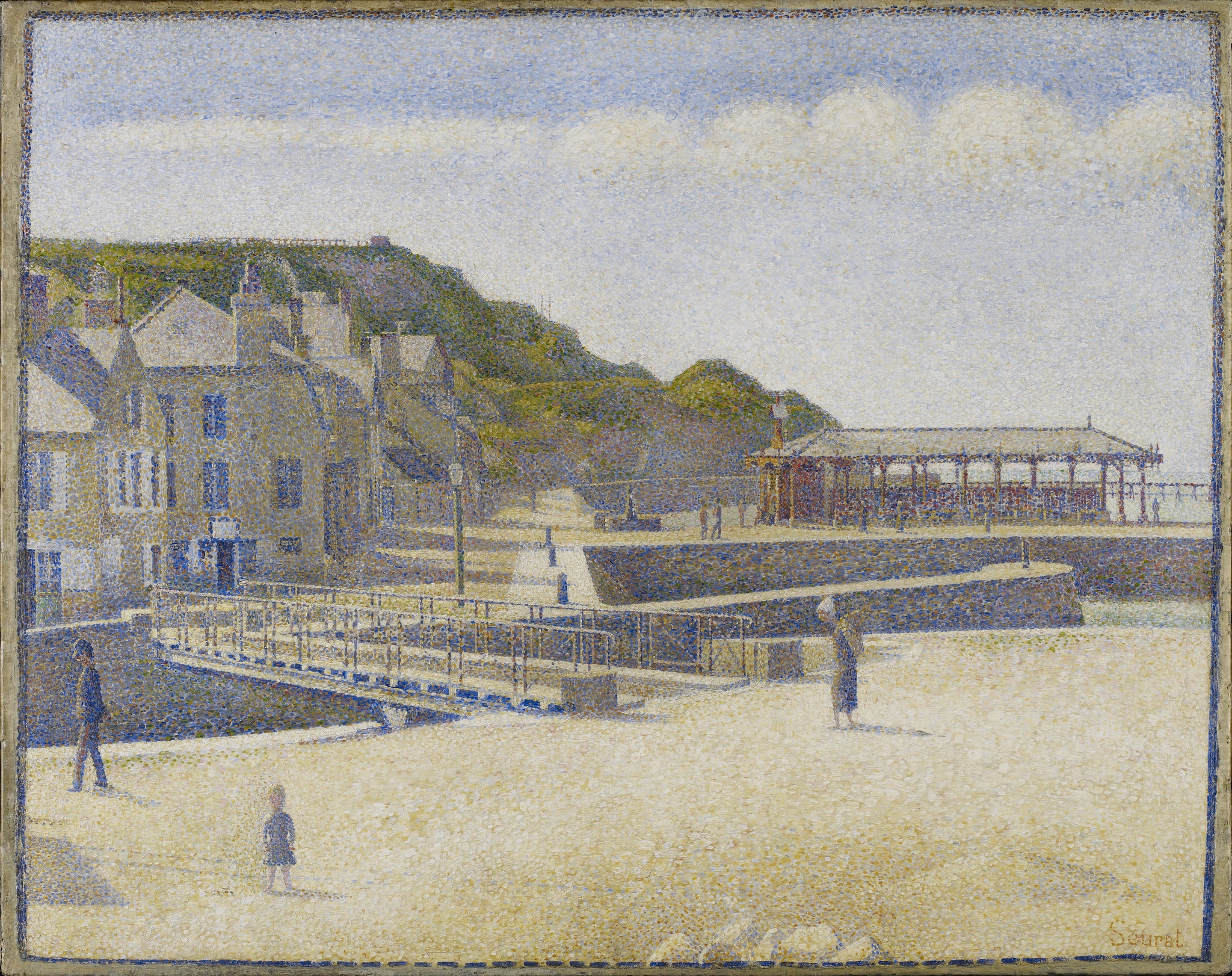
Port-en-Bessin (Minneapolis) is a painting by Seurat from 1888: a harbour with a pale jetty, a row of stone houses beneath a green hill on the left, a roofed pavilion on the right, a small footbridge with a railing in the foreground and a few people out on the jetty. The original, oil on canvas, 83.2 x 66 cm, is held by the Minneapolis Institute of Art under number 55.38. We make it as a fine art reproduction, hand-painted in oils on canvas, in eight sizes or to your own measurements, and before dispatch you receive a photograph of the finished work to approve.
| Title: | Port-en-Bessin (Minneapolis) |
| Other titles: | Port-en-Bessin |
| Painter: | Georges Seurat (1859–1891) |
| Year painted: | 1888 |
| Original size: | 83.2 cm x 66 cm |
| Original technique: | Oil on canvas |
| Painting style: | Pointillism – painting with dots |
| Located at: | Minneapolis Institute of Art, Minneapolis (inv. no. 55.38) |
| Our reproduction: | hand-painted in oils on canvas, 8 sizes from 46 x 38 cm to 150 x 120 cm, custom sizes on request |
Port-en-Bessin (Minneapolis) – Georges Seurat
Who is in the painting?
A handful of small, quiet figures on a wide, bright jetty. At front left a man in a dark suit is walking, and below him, right by the bottom edge, stands a small child in blue. To the right of the footbridge stands a woman in a long skirt, and further back, under and beside the pavilion, a few more tiny figures are suggested with just a few dots of colour. Nobody is doing anything in particular. The people here belong to the place just as the lamp, the railing and the houses do, and none of them is the hero of the picture.
What is on the canvas?
A horizontal canvas whose lower half is filled almost entirely by a pale, sandy-yellow jetty. On the left stands a row of tall stone houses with steep roofs, chimneys and many windows, and behind them rises a hill covered in greenery that slopes away to the right. On the right is a long, low pavilion with reddish posts and a pale roof, with the jetty wall running in front of it. In the left foreground a footbridge with a thin railing leads into the scene, and a lamp stands behind it. The sky is pale blue, crossed by a line of small white clouds. Everything is painted in tiny dots of pure colour, and around the edge runs a dark dotted border that Seurat painted himself and that forms part of the canvas. At bottom right is the signature, in orange: Seurat.
Why does this painting matter?
Because a single canvas shows Seurat’s method in full. Pointillism is carried through rigorously here: every surface, from the sand on the jetty to the walls of the houses, is built up from tiny dots that only merge in the viewer’s eye. This way of painting is known as neo-impressionism. What also sets this canvas apart is the painted dotted border, which closes off the scene like a frame but is an integral part of the work rather than a wooden one. For anyone who loves the coast and its buildings, it is a calm, clear harbour scene.
What does the painting mean?
The museum record offers no interpretation of the scene, so we do not read more into it than the eye can see. We see a harbour at a still moment: no ships in the foreground, no bustle, only a few people moving slowly across the great bright jetty. The houses, the pavilion and the footbridge are arranged in clear, almost geometric shapes, and the sky above them is light and airy. On this canvas the French painter tells no story; instead he captures the light and order of a place. In a home this stillness is restful, and the pale sand, blue sky and green hill sit well in light, simply furnished rooms.
What happened to the original?
The museum publishes a chain of owners; we summarise it stage by stage, with all its reservations. It begins with the Paris gallery Barbazanges, listed with a question mark, so the museum does not confirm it as an owner. The painting then belonged to Salomon van Deventer of Wassenaar and The Hague from 1913 to 1937, and by 1934–1935 at the latest he shared it with Étienne Bignou of Paris. In 1937 it was with the dealers Paul Rosenberg & Co. in New York, who sold it to the London firm Reid and Lefevre; that firm sold it on in the same year (the record reads “sold to Beatty”). From 1937 until her death in 1952 it belonged to Mrs Alfred Chester Beatty (Edith Dunn), after which it passed by inheritance to Sir Alfred Chester Beatty of Dublin, who owned it from 1952 to 1955 and sold it to Rosenberg. In 1955 it was once again with Paul Rosenberg and Co. in New York, and on 7 December it was sold from there to the museum. The museum’s credit line is The William Hood Dunwoody Fund. Every stage above comes from the museum record.
What place does this painting have among Seurat’s works?
The museum dates the painting to 1888, and it shows Port-en-Bessin. From the same town we also offer the canvas Port-en-Bessin, Entrance to the Harbor, held by the Museum of Modern Art in New York, and the coastal view Seascape at Port-en-Bessin, Normandy. Another recent addition to our range is the canvas Port-en-Bessin, the Outer Harbor at Low Tide. If you would like several views of the same place on one wall, these canvases can hang together.
How is our hand-painted version made?
With a brush and oil paint, never with a printer. Our painter works from a reference image of the original and sets down the dots one after another, so that, just as with Seurat, the colours mix only in the eye. The pointillist technique calls for patience: the sand on the jetty, the house walls and the sky are made up of thousands of tiny touches. We also include Seurat’s painted dotted border around the edge of the canvas, since it belongs to the original work, together with the signature at bottom right. Because everything is done by hand, no two canvases are ever quite alike, and every hand-painted copy remains one of a kind. We do not yet have our own photographs of a finished canvas of this subject; we will photograph it the first time we paint it and publish the photos here.
Which size suits which wall?
If you are not sure which to choose, take 80 x 65 cm. It is our size closest to the original, which measures 83.2 x 66 cm: ours is 3.2 cm narrower and 1 cm shorter. The format is horizontal, so it fits above a sofa, a chest of drawers or a bed. 46 x 38 and 50 x 40 cm suit smaller walls, hallways and a study; 60 x 50 and 70 x 60 cm fill a medium-sized wall on their own; 80 x 65 and 90 x 75 cm are sizes for a living room; and 120 x 100 and 150 x 120 cm are meant for large, empty walls, where the bright jetty opens up almost like a window. Every canvas painting of this subject is made to order.
Custom size, stretcher bar and frame
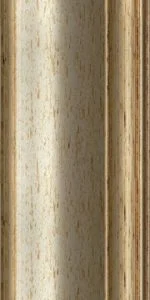
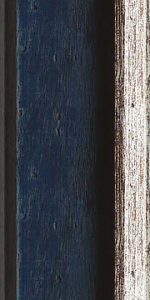
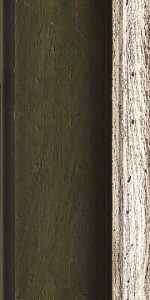
If none of the eight sizes suits your wall, we paint to your measurements and keep the proportions of the original, so the houses, pavilion and jetty stay in balance; that is our custom size painting service. You can order the painting in three forms: as a rolled canvas without a stretcher, stretched on a wooden stretcher bar and ready to hang, or framed; you choose the form when you order. You choose the frame in our 3D app, which shows gold, silver, black, white and wooden profiles on this subject; the app is for choosing the frame only. To see the painting on your own wall, we offer a separate room-visualisation service.
Delivery and guarantee
We paint every canvas to order in our studio in Slovenia, so allow 15 to 45 days, depending on size. We ship it in the form you chose when ordering — rolled, stretched or framed — protected for transport, within Slovenia and across the EU without customs duty. Before dispatch you receive a photograph of the finished work to approve, and every order is covered by our returns policy. You will find all of Seurat’s subjects in the Georges Seurat gallery, and our article about Georges Seurat explains when a reproduction of a famous painting is genuinely good.
Frequently asked questions
Where is the original?
At the Minneapolis Institute of Art, under number 55.38. The museum bought it on 7 December from Paul Rosenberg and Co. of New York.
Are there people in the painting?
Yes, a few small figures: a man on the left, a child at the bottom, a woman to the right of the footbridge and a few people by the pavilion.
Is the dotted frame part of the painting?
Yes. Seurat painted the dark dotted edge onto the canvas himself, so we paint it as well.
Is this a print?
No. The work is painted by hand, in oils on canvas; you can see and feel the dots and brushstrokes.
Which size should I choose?
For the size closest to the original, 80 x 65 cm. The detailed guide is above.
Can I have a size that is not on the list?
Yes, we paint to measure and keep the side ratio of the original.
Is the painting signed?
Yes. At bottom right, in orange, is the signature: Seurat.
What does the painting say in one sentence?
That a quiet day in a small harbour, with houses, a jetty and a few people, can be painted out of nothing but light and tiny dots.
Is the original for sale?
No. The canvas belongs to a museum collection and is not for sale, but our hand-painted version can hang in your home.
How high should I hang it?
With its centre at eye level, about 145–150 cm from the floor; hang the smaller sizes lower, closer to where you sit.
Is it suitable as a gift?
Yes, especially for someone who loves the sea and the coast. If you would rather leave the choice to the person receiving it, there is our gift voucher.
- Subject: the harbour of Port-en-Bessin with houses, a pavilion, a footbridge and a few people on the jetty – 1888
- Original: 83.2 x 66 cm, oil paint on canvas, Minneapolis Institute of Art (inv. no. 55.38)
- Ours: hand-painted oil painting reproduction, eight sizes from 46 x 38 to 150 x 120 cm, as a rolled canvas, stretched on a stretcher bar or framed — your choice
- Worth knowing: Seurat painted the dark dotted border around the edge himself, and it is part of the canvas