



Description
| Title: | Portrait of the Second Wife of the Artist |
| Other titles: | Portrait of the second wife of the artist (catalogue) |
| Painter: | Henri Rousseau |
| Year painted: | not reliably dated |
| Original size: | 23 cm x 19 cm (height x width, as published) |
| Original technique: | oil on canvas |
| Painting style: | naive art (primitivism) |
| Held at: | Musée Picasso, Paris, France (as published) |
| Our reproduction: | hand-painted oil on canvas, ten sizes or a size made to order |
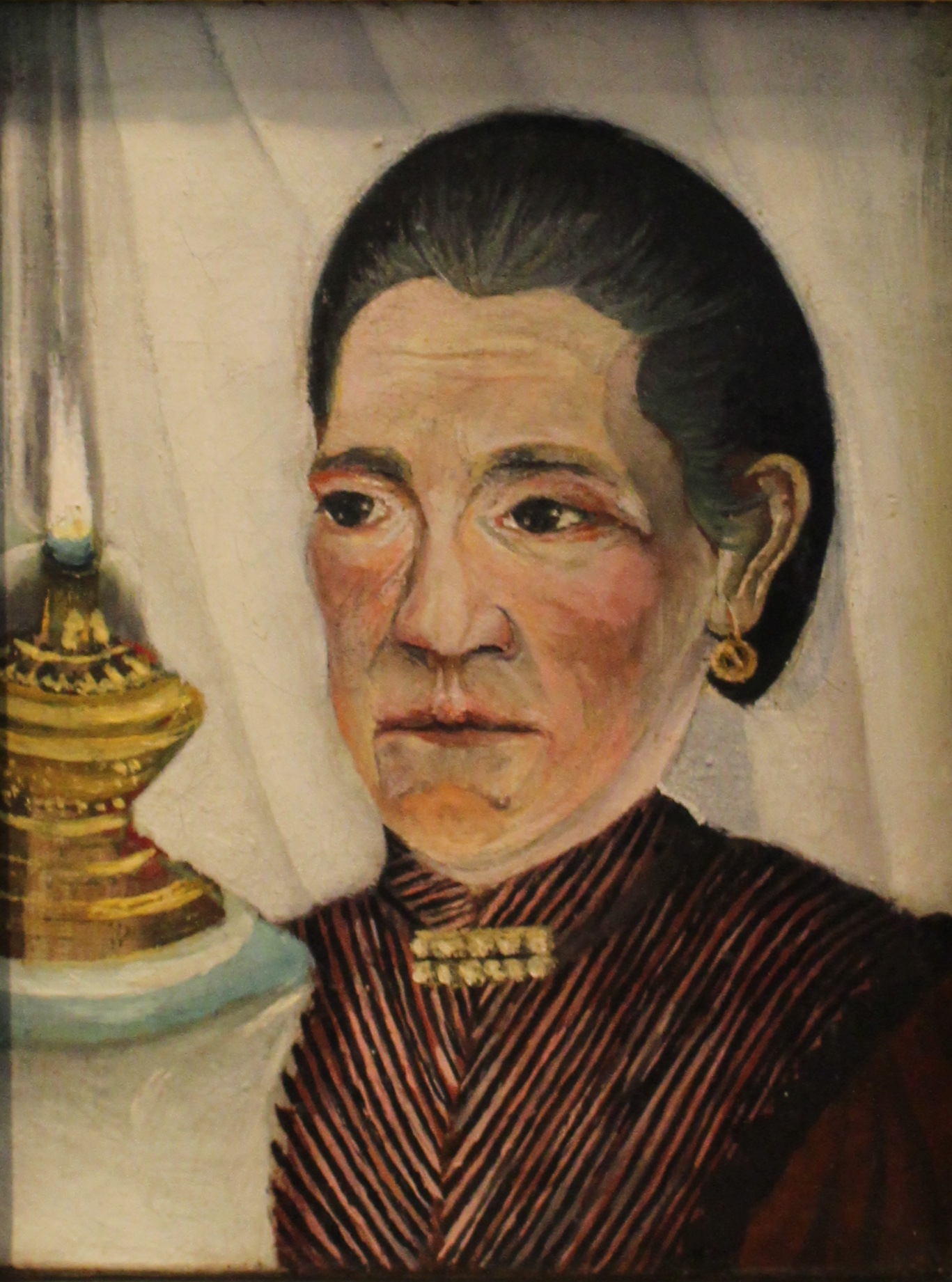
Portrait of the Second Wife of the Artist is a painting by Henri Rousseau, oil on canvas, not reliably dated; according to the published data it is held by the Musée Picasso in Paris. What you see: a woman with dark hair drawn back, in a black-and-red striped bodice, before a pale curtain, with a lit oil lamp with a gilded reservoir at her left. We paint it by hand in oils, in ten sizes or to measure, and send you a photograph of the finished painting before dispatch.
Portrait of the Second Wife of the Artist
What is on the canvas?
The background is a pale grey curtain in soft vertical folds. The woman, with a serious face, looks slightly past us; her dark hair is drawn smoothly back, she wears a gold earring, and her bodice is closely striped in black and red, fastened under the throat with a gold brooch. At the left stands a lit oil lamp: a gilded reservoir with a ringed surface on a pale blue foot, and above it a tall glass chimney with a small flame. There is nothing else in the picture. Another family portrait by the same painter is Portrait of the Father of the Artist.
Why does this portrait have a partner?
This painting does not stand alone: it is the companion to Portrait of the Artist with a Lamp. The two are the same size, the same pale curtain hangs behind both, and the same oil lamp burns beside both, only mirrored: in the woman’s portrait it stands at the left, in the man’s at the right. Hung side by side, the two lamps turn towards each other and the faces look outward. The title speaks of the painter’s second wife; we give no name and no dates, because the source we could read gives none.
Which size suits which wall?
The published dimensions of the original are 23 cm high and 19 cm wide, about the size of a postcard; the smallest size, 55 x 66 cm, is nearest to its proportion. Ten sizes are available: 55 x 66, 60 x 70, 63 x 79, 71 x 90, 76 x 95, 81 x 100, 89 x 105, 91 x 115, 99 x 125 and 110 x 130 cm. Because the painting is one of a pair, we suggest ordering both in the same size and hanging them side by side; the smaller sizes suit a bedroom or a hallway, and above a sofa a pair from 71 x 90 cm upward. Above a sofa the painting usually takes about two thirds of the width of the furniture; above a bed it should stay narrower than the headboard. Custom sizes are ordered through the made-to-order painting page, where you enter the width and height; we suggest keeping the proportion of the original and changing only the scale. Another portrait by the same painter is The Child with the Doll.
How is the painting made, and does it come framed?
Your canvas is begun only after you order it, and is painted by hand in oils in our workshop in Slovenia, at the size you choose. The painter lays in the curtain first, then the oil lamp with its glass chimney, then the striped bodice, and the face last. We do not print, and no machine application is used, so no two versions are exactly alike. The canvas is stretched on a wooden frame and arrives ready to hang; a picture frame is not included in the price and is chosen separately. Before packing we photograph the finished painting and send you the photograph for approval; only then does it travel. The painter and his wife on their wedding day appear in The Past and the Present. The whole collection is in the Henri Rousseau gallery.
How is it delivered, and what do we guarantee?
We deliver to Slovenia, Croatia, Italy, Austria, Hungary and Germany. Depending on its size, the canvas travels rolled in a rigid tube or stretched on its frame, always in protective wrapping and as a tracked parcel. The making time depends on the size and is confirmed when you order. We guarantee that every painting is painted by hand and that you see a photograph of the finished work before dispatch; if anything in it is not as you wish, we correct it before it leaves the workshop.
Frequently asked questions
Where is the original kept?
According to the published data, at the Musée Picasso in Paris; we could not read the museum’s own page, so we do not link it.
When was it painted?
The painting is not reliably dated, so we give no year.
Is a frame included?
No. The canvas is stretched on a wooden frame and ready to hang without a picture frame; a frame can be chosen separately.
Is this a print?
No. It is painted by hand in oils, and the layers of paint can be seen and felt.
Is the painting suitable as a gift?
Yes, especially as a pair with the painter’s portrait: hung together, the two lamps face each other. If you would rather the recipient chose, there is a gift voucher.
- Subject: a woman in a striped bodice before a pale curtain, a lit oil lamp at the left; partner to the painter’s portrait with a lamp.
- Original: oil on canvas, 23 x 19 cm (as published), Musée Picasso, Paris; not reliably dated.
- Our version: hand-painted oil, ten sizes from 55 x 66 to 110 x 130 cm or to measure, unframed, photograph before dispatch.
- Of note: the museum’s own page could not be read from here, so this page names the museum as published and carries no link.