



Description
| Title: | The Child with the Doll |
| Other titles: | L’Enfant à la poupée (the museum’s title) |
| Painter: | Henri Rousseau |
| Year painted: | about 1892 |
| Original size: | 67 cm x 52 cm (height x width) |
| Original technique: | oil on canvas |
| Painting style: | naive art (primitivism) |
| Held at: | Musée de l’Orangerie, Paris, France (inv. RF 1963 29) |
| Our reproduction: | hand-painted oil on canvas, ten sizes or a size made to order |
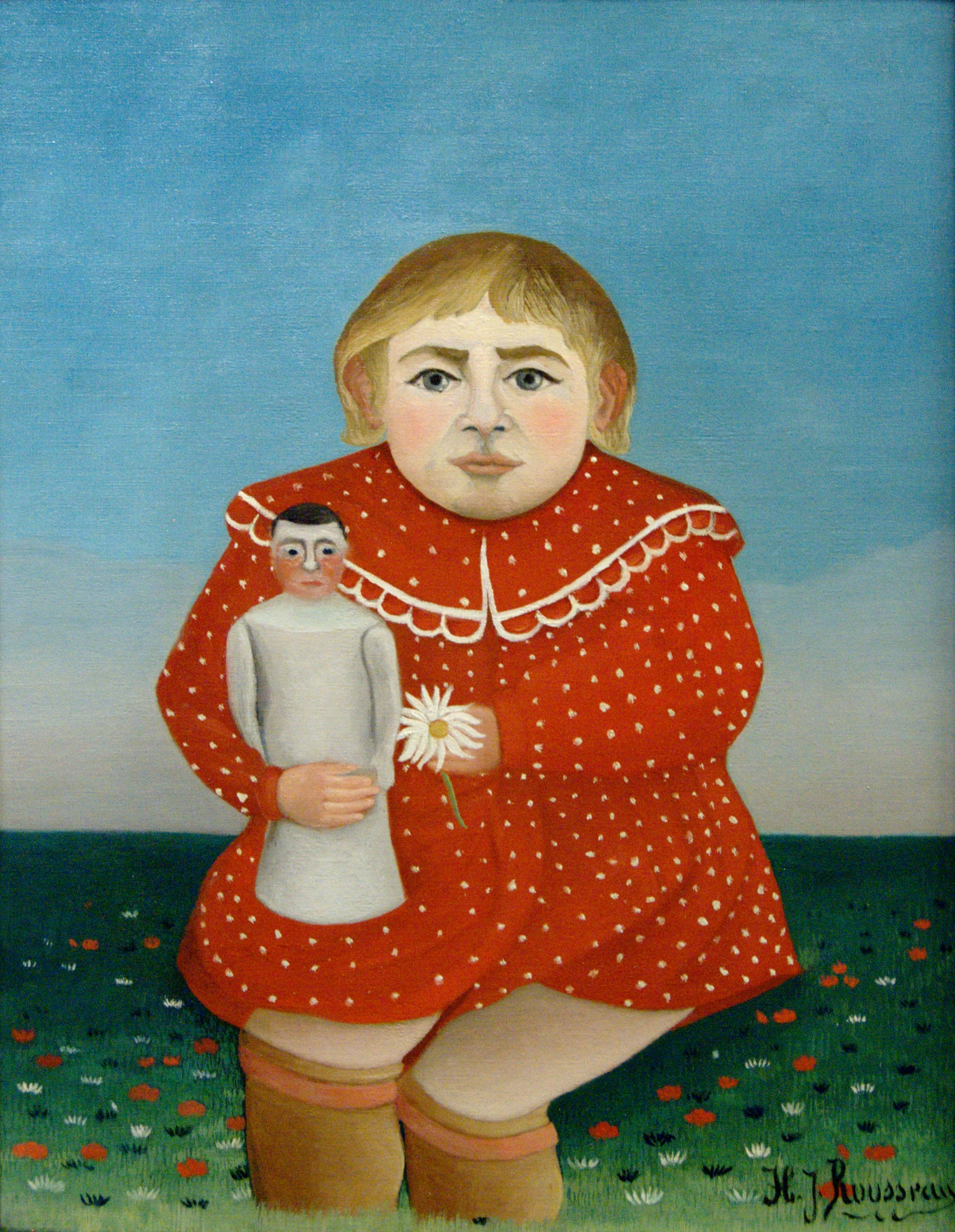
The Child with the Doll is a painting by Henri Rousseau, oil on canvas, dated by the Musée de l’Orangerie to about 1892. The original is 67 cm high and 52 cm wide and is held by the Musée de l’Orangerie in Paris under inventory number RF 1963 29. What you see: a child with fair, bobbed hair in a red dress with white dots, holding a doll in a white dress in one arm and a daisy in the other hand, in a flowering meadow under a blue sky.
The Child with the Doll
What is on the canvas?
The canvas is upright, and the child fills almost all of it. She looks straight at us, with a round face, fair hair cut in a bob and a steady, unsmiling gaze. Her red dress is scattered with white dots and has a broad white collar with a scalloped edge. In her right arm she holds a doll with dark hair in a long white dress; in her left hand, a single daisy. Her legs, in brown stockings, disappear into the grass at knee height. Behind her a green meadow scattered with small red and white flowers runs to a straight horizon, and above it a blue sky grows paler towards the ground. The signature, H. J. Rousseau, is in black at the lower right.
Why does the child look so strange?
The museum answers this directly. It calls her a disquieting, almost hypnotic figure who looks you straight in the eye, with features that have nothing childlike about them and a body that seems gigantic and out of proportion: the legs, vanishing oddly into the grass, are enormous next to the arms, especially the right arm, which holds a popular cardboard doll. The body is shown in the Egyptian manner, the upper half facing us and the legs in profile, with almost no modelling, and the white dots on the red dress make the figure so flat that she seems pasted onto the background. The landscape, the same text says, is reduced to the bare minimum: an almost even blue sky and a flowered meadow that recalls medieval tapestries, with only the darker grass and the smaller daisies in the distance to give some depth. Another child, a baby on a pink cloth, sits in the grass in The Family.
What did Rousseau’s contemporaries see in it?
According to the museum, Rousseau here rediscovers the look of the French and Italian “primitives” at a time fascinated by every kind of primitivism, and it was this side of his art that fascinated his contemporaries. The painter André Lhote wrote that in the Middle Ages he would have delighted the crowd, and the art critic Arsène Alexandre called him the Paolo Uccello of our century. The record also lists where it was shown: first at the Salon des Indépendants in Paris in 1892, and, among later exhibitions, Cubism and Abstract Art at the Museum of Modern Art in New York in 1936. Other portraits we offer include Portrait of the Father of the Artist and The Past and the Present.
How large is the original, and what does that mean on a wall?
The original is 67 cm high and 52 cm wide, smaller than every size we offer. Ten sizes are available: 55 x 70, 58 x 75, 63 x 79, 71 x 90, 74 x 96, 81 x 100, 85 x 110, 89 x 116, 95 x 128 and 107 x 135 cm. The smallest, 55 x 70 cm, is 3 cm wider and 3 cm taller than the original, which brings it close to the real size; 58 x 75 and 85 x 110 cm keep its proportion most closely. Because the child fills the canvas, the painting holds its own at small sizes, and at the large ones she becomes almost life-sized: at 107 x 135 cm she stands well over a metre tall on the wall. Custom sizes are ordered through the made-to-order painting page.
How is a hand-painted reproduction made?
Your canvas painting is made by hand in oils when you order it, in the size you choose. Following a high-resolution image of the original, the painter keeps the surfaces as flat as Rousseau painted them, with almost no modelling, and sets the white dots of the dress one by one so that the child stays pinned to the background as she is in the original. Every hand-painted canvas comes out a little different from the next, which is what separates it from a print. It comes stretched on a wooden frame, ready to hang. More of Rousseau’s figures, among them The Football Players, are in the Henri Rousseau gallery.
Frequently asked questions
Where is the original kept?
At the Musée de l’Orangerie in Paris, inventory number RF 1963 29. When we read the museum’s page, it said the work was not currently on display in the galleries, so check with the museum before a visit.
Who owned the painting before the museum?
The museum lists Wilhelm Uhde in Paris; his sale at the Hôtel Drouot on 30 May 1921, held under wartime sequestration, lot 57; J. Quinn of New York; Paul Guillaume; and Madame Jean Walter, from whom it was bought in 1963 with the help of the Société des Amis du Louvre. It went to the Louvre and came to the Orangerie in 1977.
When was it painted?
The museum dates it to about 1892, and the record lists it at the Salon des Indépendants in Paris in the same year.
Is this a print?
No. It is painted by hand in oils, and the layers of paint can be seen and felt.
Is the painting suitable as a gift?
Yes, for anyone who likes a portrait with character: the child’s steady, stern gaze is the heart of the painting. If you would rather the recipient chose, there is a gift voucher.
- Subject: a child in a red dress with white dots holds a doll and a daisy in a flowering meadow under a blue sky.
- Original: oil on canvas, 67 x 52 cm (height x width), Musée de l’Orangerie, Paris, inv. RF 1963 29; about 1892.
- Our version: hand-painted oil, ten sizes from 55 x 70 to 107 x 135 cm, or a size made to order.
- Of note: the critic Arsène Alexandre called Rousseau the Paolo Uccello of our century, as the museum’s text recalls.