


Description
| Title: | Portrait of the Artist with a Lamp |
| Other titles: | Portrait de l’artiste à la lampe (the record’s title) |
| Painter: | Henri Rousseau (1844–1910) |
| Year painted: | Not reliably dated |
| Original size: | 23 cm x 19 cm (height x width) |
| Original technique: | oil on canvas |
| Painting style: | naive art (primitivism), Post-Impressionist period |
| Held at: | Musée Picasso, Paris, France (inv. RF1973-88) |
| Our reproduction: | hand-painted oil on canvas, ten sizes or a size made to order |
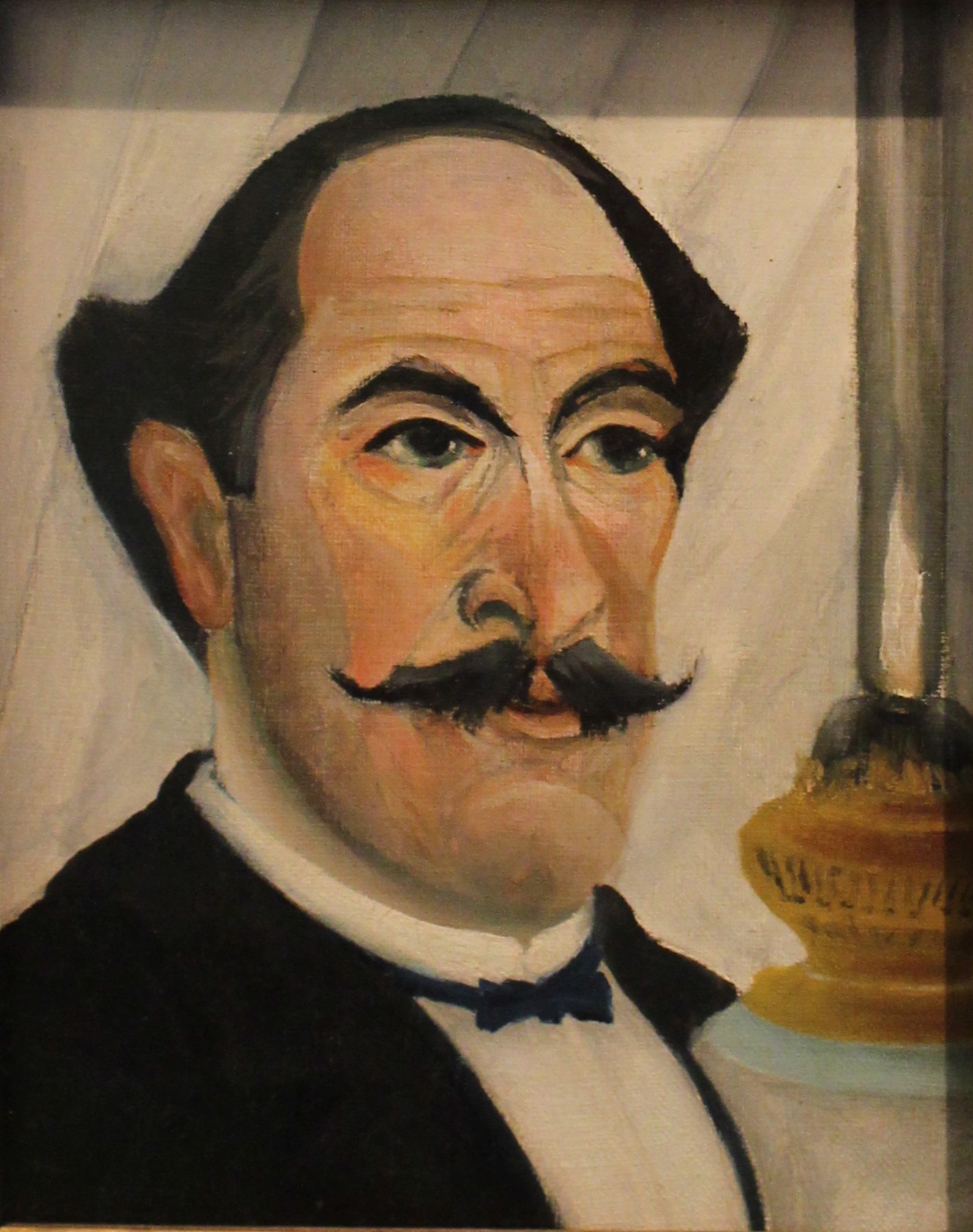
Portrait of the Artist with a Lamp is a painting by Henri Rousseau, oil on canvas; the work is not reliably dated. The original measures 23 cm high and 19 cm wide and is held by the Musée Picasso in Paris under inventory number RF1973-88. What you see: a man with a high forehead and a large moustache in a black jacket before a pale curtain, with a lit oil lamp and its glass chimney at the right.
Portrait of the Artist with a Lamp
What is on the canvas?
The background is a pale grey-white curtain in soft vertical folds. At the right stands a lit oil lamp: a gilded reservoir with a ringed surface on a pale blue-green foot, above it a dark toothed collar, and a tall clear glass chimney enclosing a pale upright flame. The left two thirds are filled by the head and shoulders of a man of middle to later years, turned slightly, his eyes on the viewer. He has a high bald forehead, dark hair combed thickly at the sides and back over the ears, heavy brows, blue-grey eyes under heavy lids, a strong nose, full cheeks and chin, and a large dark moustache with the ends turned up. He wears a black jacket, a white standing collar and a dark blue bow tie. There is nothing else in the picture.
Why does this canvas have a partner?
This work does not stand alone: it is the companion to Portrait of the Second Wife of the Artist. Both are from the same collection, both measure 23 cm x 19 cm, both have the same pale curtain behind them and the same lit oil lamp, with one difference that shows only when they are set side by side: the lamp is mirrored. In the woman’s portrait it stands at the left, here it stands at the right, so that hung as a pair the two lamps turn inward. That is not our supposition but what a comparison of the two images shows.
What does the title say, and what does it not?
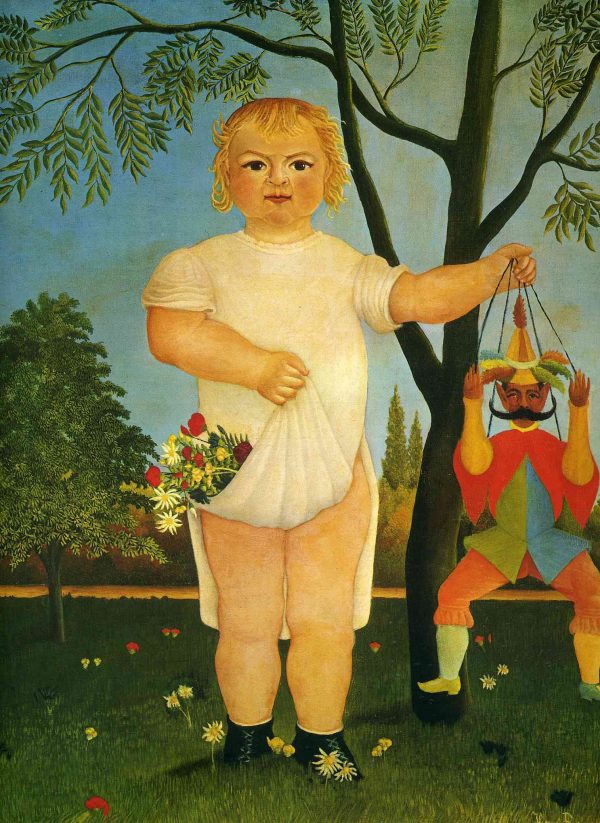
The title in the record speaks of the artist, and the attribution field names Henri Rousseau. We repeat the title as written and go no further: we do not claim the man shown is the painter, give no dates for him, or place the work in his life. The inference may be obvious, but it is the record’s to make, not ours. We likewise do not date the work, because the record gives no year. Two other family portraits by the same hand in this group are Portrait of the Father of the Artist and The Child with the Doll.
How large is the original, and what does that mean on a wall?
The original measures 23 cm x 19 cm, about the size of a postcard. Because it is one of a pair, the sensible choice is the same size for both, hung side by side; the lamps then form the centre and the faces look outward. At our smallest sizes the toothed collar and the points of the moustache already read more clearly than on the original, and at half a metre wide every strand of hair is legible. The size closest to the original’s proportions is 55 x 66 cm. We do not copy canvases at their original measurement; you choose the size to suit the wall, and custom sizes are ordered through the made-to-order painting page. For the opposite case, a wide bright scene, see View of the Bridge at Sèvres.
How is a hand-painted reproduction made?
Every artwork is painted by hand in oils, to order, in the size you choose. The painter works from a high-resolution image of the original, layer by layer, so that the lamp’s glass chimney, the toothed collar beneath it and the points of the moustache stay legible at the smaller sizes. Because it is handwork, two canvases of the same size always differ a little; that is not a fault but the difference between a painting and a print. The canvas is stretched on a wooden stretcher and prepared for hanging. The full collection of canvases by this painter is in the Henri Rousseau gallery.
Frequently asked questions
Where is the original kept?
At the Musée Picasso in Paris, under inventory number RF1973-88. We give no link to the museum record here, because it could not be opened and checked from this end.
What year was the work painted?
We do not say. The record does not date the work to a single year, so we neither state a year nor estimate one.
How large is the original?
23 cm high and 19 cm wide, oil on canvas, so roughly the size of a postcard.
Is this a print?
No. Every canvas is painted by hand, in oils, to order. The body of the paint is visible and can be felt, which a print cannot imitate.
Is the painting suitable as a gift?
Yes, particularly as a pair with the woman’s portrait, since hung together the two lamps turn to face each other. If you would rather leave the choice to them, there is a gift voucher.
- Subject: a man with a high forehead and a large moustache in a black jacket before a pale curtain, with a lit oil lamp and its glass chimney at the right.
- Original: oil on canvas, 23 x 19 cm (height x width), Musée Picasso, Paris, inv. RF1973-88; the year is not reliably dated.
- Our version: hand-painted oil, ten sizes from 55 x 66 to 110 x 130 cm, or a size made to order.
- Of note: the canvas is not a single work but one of a pair, and the lamp is mirrored between them, so that hung together the two lamps turn inward.