







































Description
| Title: | The Past and the Present |
| Other titles: | The Past and the Present, or Philosophical Thought; Le passé et le présent, ou Pensée philosophique (the museum’s titles) |
| Painter: | Henri Rousseau |
| Year painted: | 1899 |
| Original size: | 85.2 cm x 46.8 cm (height x width) |
| Original technique: | oil on canvas |
| Painting style: | naive art (primitivism) |
| Held at: | Barnes Foundation, Philadelphia, USA (inv. BF582) |
| Our reproduction: | hand-painted oil on canvas, nine sizes or a size made to order |
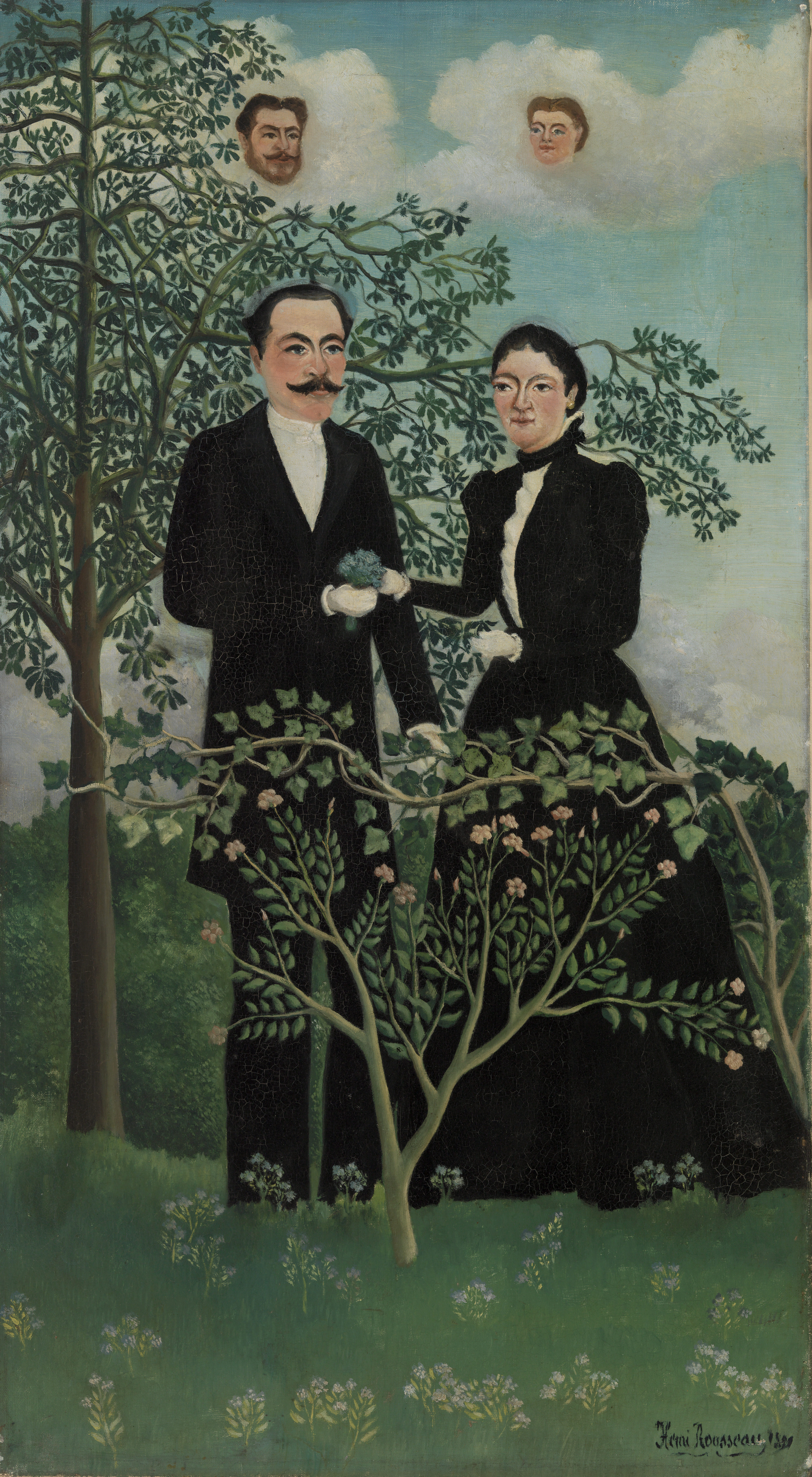
The Past and the Present is a painting by Henri Rousseau, oil on canvas, 1899, held by the Barnes Foundation in Philadelphia under inventory number BF582 and the full title The Past and the Present, or Philosophical Thought. The original is 85.2 cm high and 46.8 cm wide. What you see: a man and a woman in black standing behind a blossoming sapling in the grass, and above them, among white clouds, two heads without bodies.
The Past and the Present
What is on the canvas?
The canvas is narrow and tall, almost twice as high as it is wide. At the left stands a man in a black coat and white shirt, with a heavy black moustache, holding a small bluish posy in white-gloved hands. Beside him on the right stands a woman in a black dress with puffed sleeves and white lace at the throat, her hair drawn smoothly back, reaching towards the posy with a gloved hand. Both look straight out at us. In front of them grows a slender sapling with pink blossom, and a long leafy branch runs across them at the waist, so that the leaves partly screen them; they stand in grass scattered with small white and pale mauve flowers. At the left edge a tall, thin tree with hand-shaped leaves rises and spreads its crown over the upper part of the picture. In the sky, among white clouds, float two heads: at the left a man’s with dark hair and a beard, at the right a woman’s with light brown hair. The signature and date, Henri Rousseau 1899, are at the lower right.
Who are the bride and groom, and whose are the heads in the sky?
The museum’s record says it plainly. The two standing figures are the painter himself and his wife on their wedding day, and the little heads floating above them are meant as a loving homage to their deceased spouses. That is why the full title the museum gives speaks of the past and the present, and of philosophical thought. The record does not name the wife, and neither do we. Another wedding Rousseau painted is The Wedding Party, and another portrait from the painter’s family is Portrait of the Second Wife of the Artist.
What is a portrait-landscape?
The museum writes that Rousseau painted many portraits and often posed his sitters outdoors, surrounded by plants and flowers, both real and imagined. For pictures of this kind he coined the term portrait-landscape. Here it means that the plants are not a backdrop: the sapling, the branch and the flowering grass stand in the same plane as the couple and partly hide them. Another family portrait by the painter, set against the sky, is Portrait of the Father of the Artist.
How large is the original, and what does that mean on a wall?
The original is 85.2 cm high and 46.8 cm wide. Nine sizes are available: 46 x 84, 50 x 90, 60 x 110, 70 x 130, 80 x 140, 90 x 160, 120 x 210, 130 x 240 and 160 x 300 cm, all in the same narrow proportion. The one nearest the original is the smallest, 46 x 84 cm; the larger sizes bring the couple close to life size, so the narrow canvas sits well on a wall between two windows or beside a door. Custom sizes are ordered through the made-to-order painting page. A portrait-landscape from the same year, in the same collection, is Portrait of a Woman in a Landscape.
How is a hand-painted reproduction made?
We paint your canvas painting by hand in oils after you order it, at the size you choose. From a high-resolution image of the original, the painter lays in the sky with its clouds and the tree at the left first, then the two black costumes, and last the sapling, leaf by leaf, and the small flowers in the grass, so that they stay sharp against the dark ground. A hand-painted canvas always differs slightly from the next, and that difference is exactly what a print cannot give you. It is stretched on a wooden frame, ready to hang. The whole collection is in the Henri Rousseau gallery.
Frequently asked questions
Where is the original kept?
At the Barnes Foundation in Philadelphia, inventory number BF582.
When was it painted?
In 1899, the date the museum gives; the year also stands beside the signature at the lower right.
Where has the painting been exhibited?
The museum’s record lists the Salon des Indépendants in Paris in 1907, Rousseau’s retrospective at the same Salon in 1911, and an exhibition at Paul Rosenberg’s in Paris in 1923.
Is this a print?
No. It is painted by hand in oils, and the layers of paint can be seen and felt.
Is the painting suitable as a gift?
Yes, especially for a wedding or an anniversary: it is a couple’s wedding portrait. If you would rather the recipient chose, there is a gift voucher.
- Subject: the painter and his wife on their wedding day behind a blossoming sapling, two heads in the clouds above them.
- Original: oil on canvas, 85.2 x 46.8 cm (height x width), Barnes Foundation, Philadelphia, inv. BF582; 1899.
- Our version: hand-painted oil, nine sizes from 46 x 84 to 160 x 300 cm, or a size made to order.
- Of note: according to the museum’s record, the heads in the sky are a homage to the couple’s deceased spouses.