







































Description
| Title: | The Avenue in the Park at Saint-Cloud |
| Other titles: | The Avenue in Saint-Cloud Park (the museum’s title) |
| Painter: | Henri Rousseau |
| Year painted: | about 1908 |
| Original size: | 46.2 cm x 37.6 cm (height x width) |
| Original technique: | oil on canvas |
| Painting style: | naive art (primitivism) |
| Held at: | Städel Museum, Frankfurt am Main, Germany (inv. SG 404) |
| Our reproduction: | hand-painted oil on canvas, eight sizes or a size made to order |
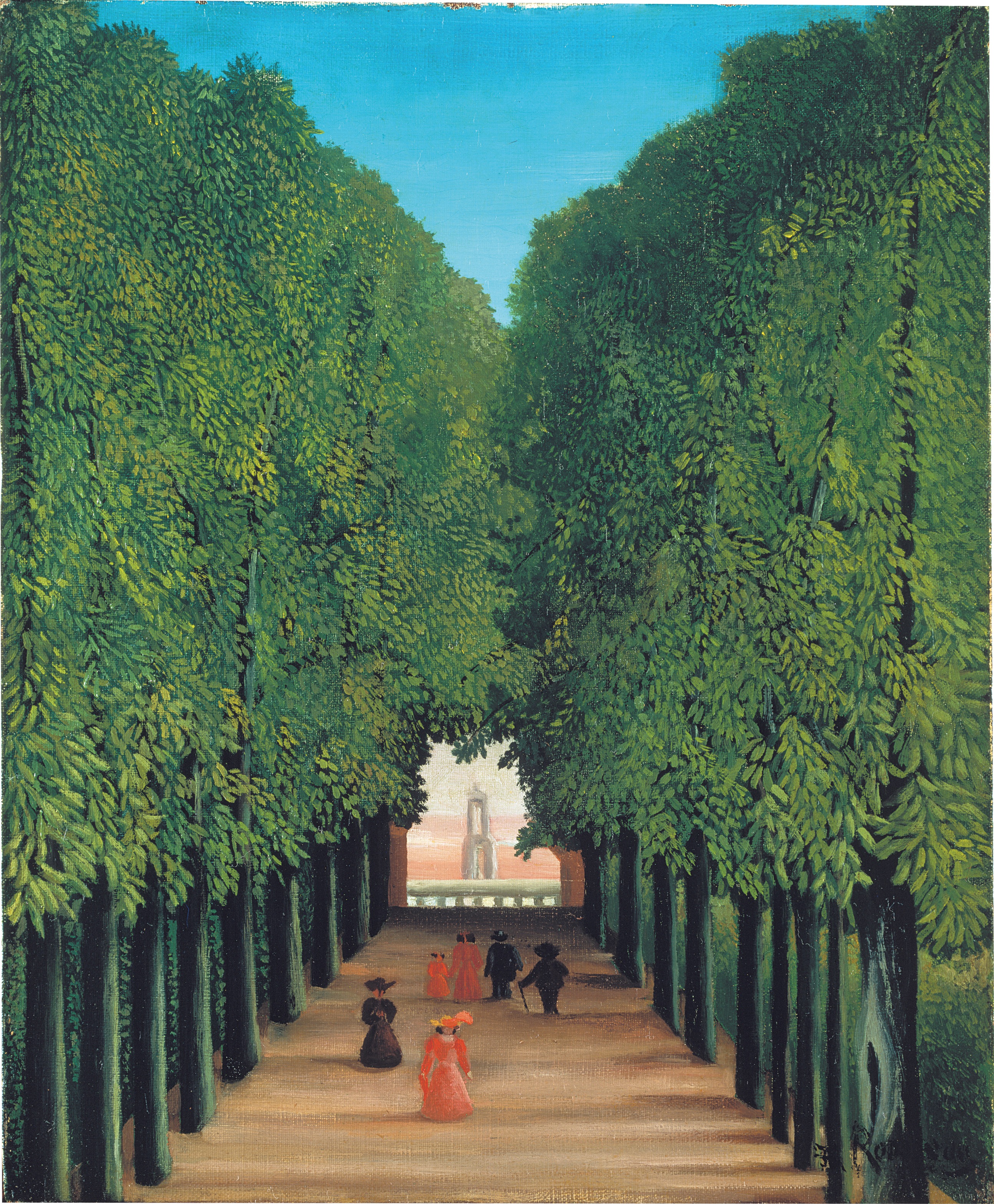
The Avenue in the Park at Saint-Cloud is a painting by Henri Rousseau, oil on canvas, dated about 1908 by the Städel Museum in Frankfurt am Main, which holds it under inventory number SG 404. The original is 46.2 cm high and 37.6 cm wide. What you see: two rows of tall trees converging towards the centre and almost closing off the sky, and on the sandy path between them tiny strollers walking towards a pale structure at the end of the avenue.
The Avenue in the Park at Saint-Cloud
What is on the canvas?
The canvas is upright. From left and right two rows of tall trees with straight, dark, evenly spaced trunks converge towards the centre, and their dense green crowns almost close over the path, leaving only a wedge of bright blue sky. Below, a pinkish sandy path runs straight into the depth. At its end a pale structure opens out: an upright pale form in the middle of a low balustrade, reddish walls to either side and a pink sky behind. Tiny people walk along the path: nearest a woman in a long coral-red dress and a hat with a red feather, beside her at the left a woman in dark clothes, further on a woman and a girl in red holding hands, and two men in dark clothes and hats, one with a cane. The signature, H. Rousseau, is at the lower right.
Why are the people so small?
The museum singles this out as the heart of the painting: tiny people walk along an avenue of uniformly lined-up trees, and every detail, whether in the foreground or the background, is treated with equal importance, in a certain naive manner. That is why the leaves are marked with small strokes even in the most distant crowns. The museum adds that, for this fusion of dream world and reality, Rousseau is considered one of the pioneers of Surrealism. Tall trees above tiny strollers also appear in Jardin du Luxembourg.
How did the painting reach the museum?
The museum’s record names the collection of Pauline Kowarzik (1852–1929) in Frankfurt, who became the first woman appointed, in an advisory capacity, to the acquisition committee of the city gallery. When inflation brought her into financial difficulty in 1926, she sold her private collection to the Städel for a monthly life annuity; that is how this painting came to the city gallery in 1926. Another tree-lined path with small figures is The Banks of the Bièvre near Bicêtre.
How large is the original, and what does that mean on a wall?
The original is 46.2 cm high and 37.6 cm wide. Eight sizes are available: 57 x 70, 69 x 85, 81 x 100, 90 x 110, 100 x 120, 130 x 160, 146 x 180 and 160 x 200 cm. Even the smallest is larger than the original, and 57 x 70 cm keeps its proportion almost exactly. The strollers are only a few centimetres tall on the original, so it takes the larger sizes to show them from across the room, and at those sizes the upright avenue works like a view through a window into the park. Custom sizes are ordered through the made-to-order painting page. A park in Paris with strollers is View of Montsouris Park, the Kiosk.
How is a hand-painted reproduction made?
We paint your canvas painting by hand in oils after you order it, at the size you choose. From a high-resolution image of the original, the painter lays in the sky and the structure at the end of the avenue first, then the trunks, then the crowns, one leaf at a time, and paints the tiny figures last. A hand-painted canvas always differs slightly from the next, and that difference is exactly what a print cannot give you. It is stretched on a wooden frame, ready to hang. The hills of Saint-Cloud are also named in the Pushkin Museum’s title for View of the Bridge at Sèvres, and the whole collection is in the Henri Rousseau gallery.
Frequently asked questions
Where is the original kept?
At the Städel Museum in Frankfurt am Main, inventory number SG 404.
When was it painted?
About 1908, the dating the museum gives; the canvas carries only the signature H. Rousseau, with no date.
What stands at the end of the avenue?
A pale upright form in the middle of a low balustrade, with reddish walls to either side. The museum’s record does not name it, and neither do we.
Is this a print?
No. It is painted by hand in oils, and the layers of paint can be seen and felt.
Is the painting suitable as a gift?
Yes, especially for someone who loves walks and parks: the scene is calm and green. If you would rather the recipient chose, there is a gift voucher.
- Subject: two rows of tall trees over a sandy path with tiny strollers, a pale structure behind a balustrade at the end.
- Original: oil on canvas, 46.2 x 37.6 cm (height x width), Städel Museum, Frankfurt am Main, inv. SG 404; about 1908.
- Our version: hand-painted oil, eight sizes from 57 x 70 to 160 x 200 cm, or a size made to order.
- Of note: according to the museum, every detail, in the foreground or the background, is treated with equal importance.