



Description
| Title: | The Family |
| Other titles: | La famille (French title in the museum’s record) |
| Painter: | Henri Rousseau |
| Year painted: | about 1892–1900 |
| Original size: | 46 cm x 55 cm (height x width) |
| Original technique: | oil on canvas |
| Painting style: | naive art (primitivism) |
| Held at: | Barnes Foundation, Philadelphia, USA (inv. BF581) |
| Our reproduction: | hand-painted oil on canvas, eight sizes or a size made to order |
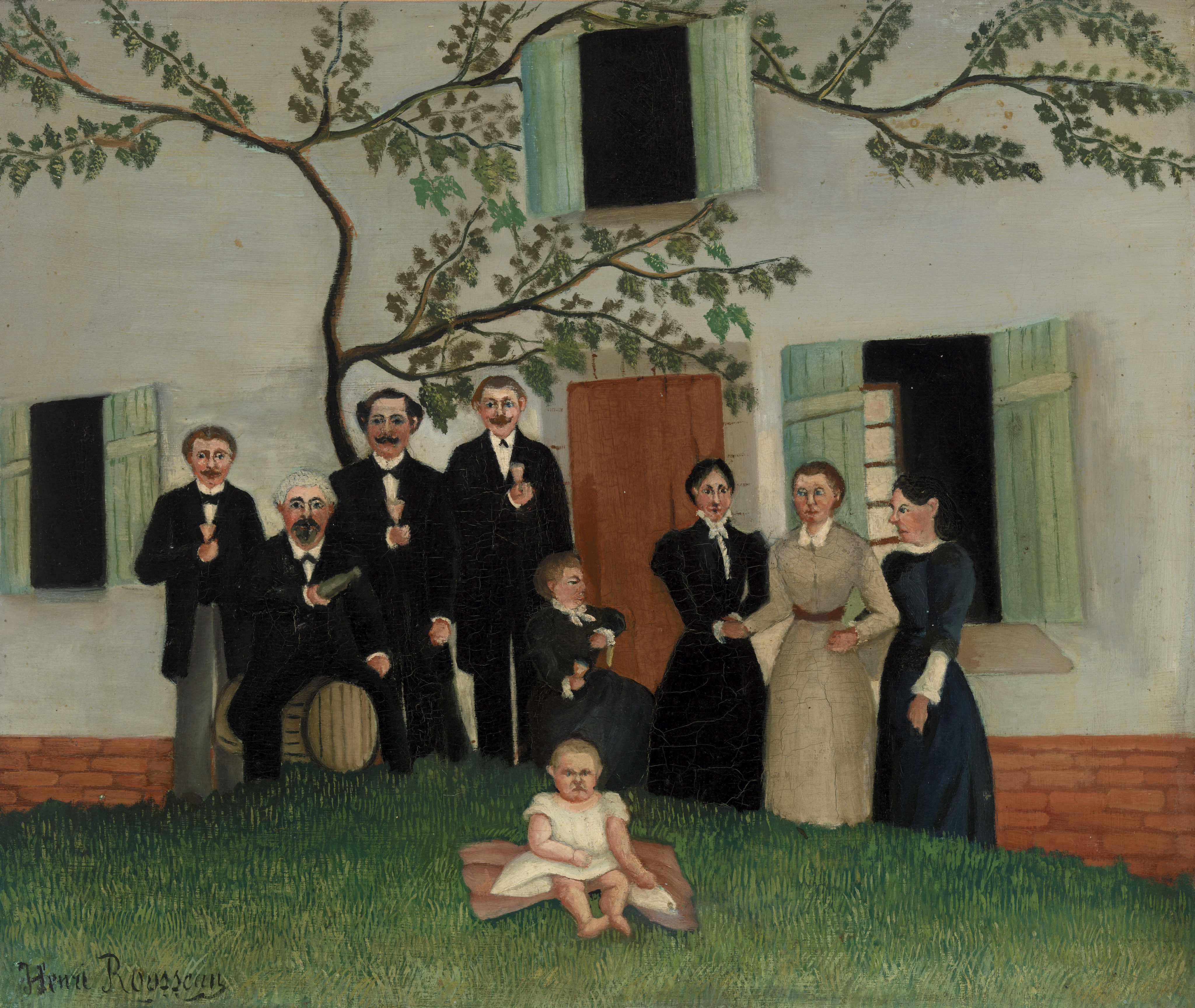
The Family is a painting by Henri Rousseau, oil on canvas, dated by the Barnes Foundation to about 1892–1900. The original is 46 cm high and 55 cm wide and is held by the Barnes Foundation in Philadelphia under inventory number BF581. What you see: a family lined up outdoors in front of a whitewashed house, the men holding small cups beside a wine barrel, three women on the right, and a baby in white sitting on a pink cloth in the grass.
The Family
What is on the canvas?
The whole family stands against the side wall of a whitewashed building, as if lined up for a photograph. A band of red brick runs along the foot of the wall; above are three windows with pale green shutters, two of them opening onto darkness, and a reddish-brown door in the middle. A vine climbs the wall from the left and spreads its branches, hung with small bunches of grapes, across the upper half. On the left three men in dark suits raise small cone-shaped cups, while a fourth, white-haired, sits beside a wooden barrel holding a dark bottle. Between the two groups sits a figure in black, and on the right stand three women: in black, in cream with a brown belt, and in dark blue. In front, on bright green grass, a baby in a white dress sits on a pink cloth, the only figure outside the row. The signature, Henri Rousseau, is at the lower left.
What is the family celebrating?
The museum’s description reads the wine barrel, the bottle and the small cups as signs of a celebration and names three possibilities: a birth, a baptism or the wine harvest. It does not choose, and neither do we. The baby on the pink cloth would fit the first two and the grapes on the vine the third; the painting itself states none of them. The museum describes the plant on the wall as a treelike grapevine. Another posed group among the works we offer is The Wedding Party.
What did younger painters see in work like this?
According to the museum, the straightforward yet mysterious way the scene is painted is a hallmark of Rousseau’s style, and something that deeply inspired up-and-coming Parisian artists such as Pablo Picasso. Here that means faces set side by side without a trace of movement, a family arranged as flatly as the wall behind it, and no explanation of the occasion. The record also lists an exhibition: in June 1923 the painting was shown in Paris at P. Rosenberg, in an exhibition devoted to Henri Rousseau, as number 15. Among the other paintings of people we offer are The Child with the Doll and The Past and the Present.
How large is the original, and what does that mean on a wall?
The original is 46 cm high and 55 cm wide, smaller than every size we offer. Eight sizes are available: 70 x 58, 85 x 71, 100 x 80, 110 x 90, 120 x 100, 160 x 133, 180 x 149 and 200 x 160 cm. The smallest, 70 x 58 cm, is 15 cm wider and 12 cm taller than the original; 85 x 71 cm keeps its proportion most closely. With nine figures in a single row, each face is small, so the family reads best from 100 x 80 cm upwards, where the expressions can be told apart. A wide, calm format like this suits a dining room or a hallway. Custom sizes are ordered through the made-to-order painting page.
How is a hand-painted reproduction made?
Each order is painted by hand in oils, in the size you pick. With nine faces in one row, the painter works through them one at a time from a high-resolution image of the original, so that each keeps its own expression and the row does not turn into a pattern; only then is the dark mass of the clothing brought together. Because every canvas painting is handmade, no two are identical, and that is what separates it from a print. It comes stretched on a wooden frame, ready to hang. More of Rousseau’s paintings of people, among them The Football Players, are in the Henri Rousseau gallery.
Frequently asked questions
Where is the original kept?
At the Barnes Foundation in Philadelphia, inventory number BF581. Whether it is on view on a given day is best checked with the museum.
Who are the people in the painting?
The museum names none of them, and neither do we. We describe only what can be seen: four men, a seated figure in black, three women and a baby.
When was it painted?
The Barnes Foundation dates it to about 1892–1900, a range rather than one year, and we keep it as a range.
Is this a print?
No. It is painted by hand in oils, and the brushstrokes can be seen and felt on the surface.
Is the painting suitable as a gift?
Yes, especially for a family occasion such as a birth or a christening, since the scene itself may be one. If you would rather let the recipient choose, there is a gift voucher.
- Subject: a family in a row before a whitewashed house, men with cups by a wine barrel, three women and a baby on a pink cloth.
- Original: oil on canvas, 46 x 55 cm (height x width), Barnes Foundation, Philadelphia, inv. BF581; about 1892–1900.
- Our version: hand-painted oil, eight sizes from 70 x 58 to 200 x 160 cm, or a size made to order.
- Of note: the museum reads the barrel, bottle and cups as a celebration, a birth, a baptism or the wine harvest, and does not decide which.