


Description
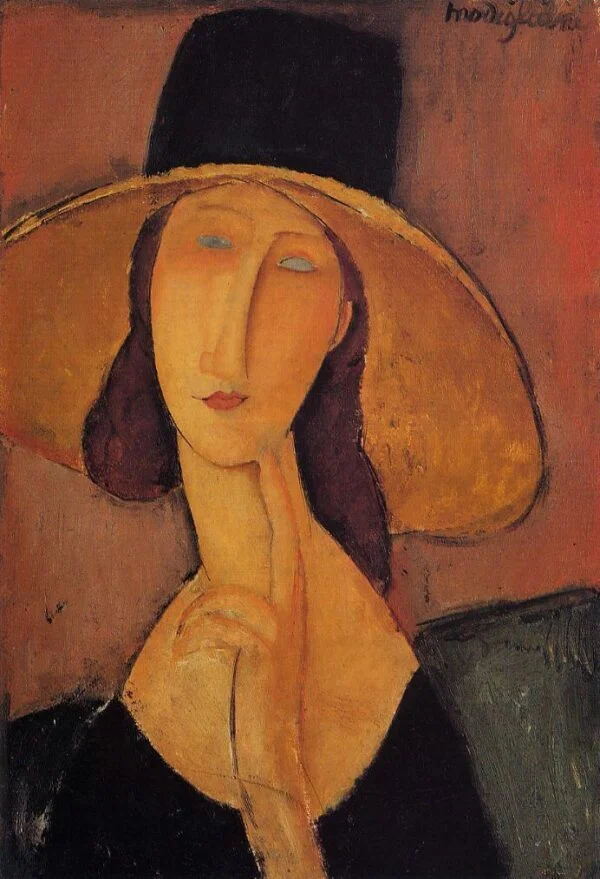
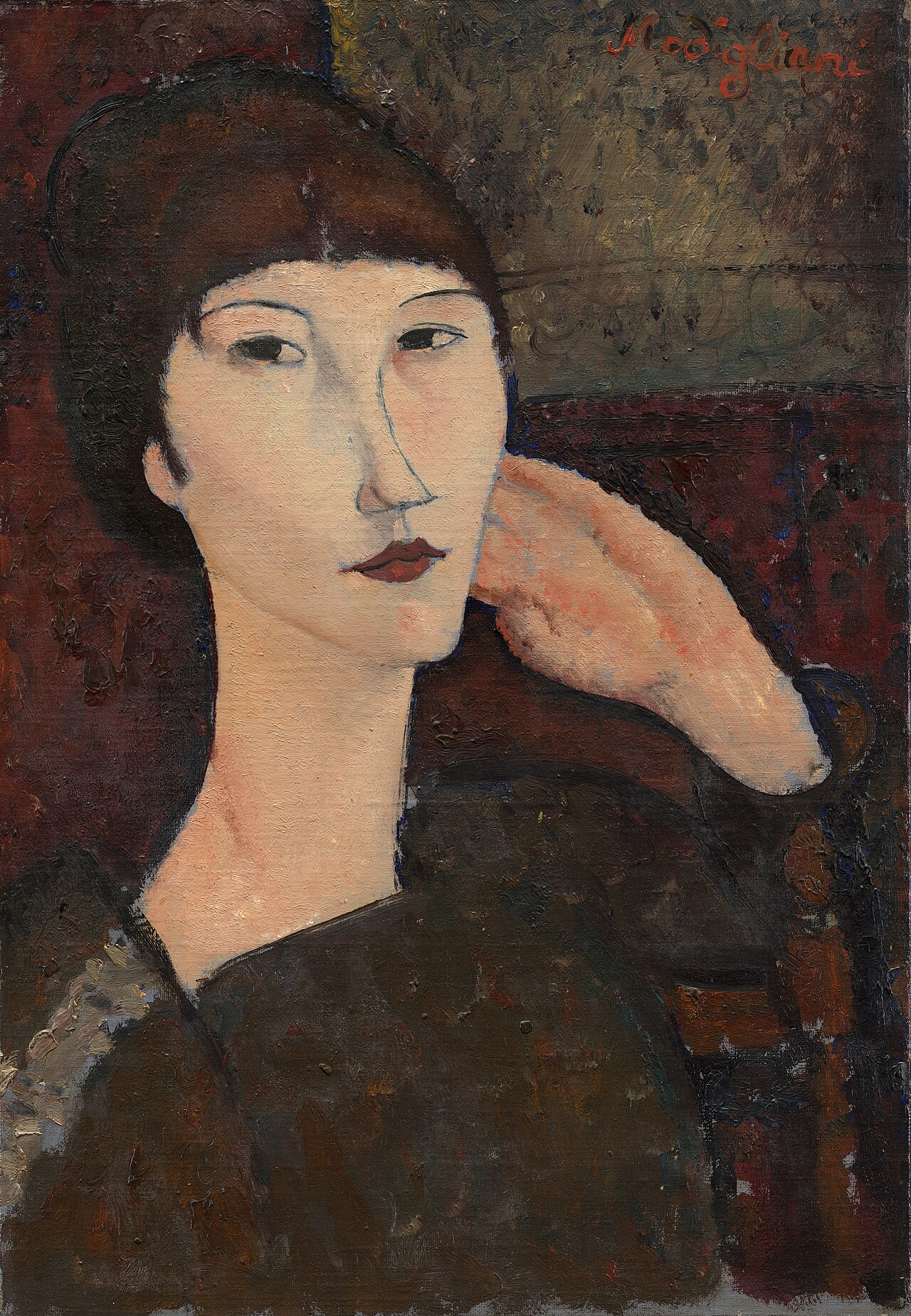
Adrienne (Woman with Bangs) is a canvas of 1917 in the National Gallery of Art in Washington, under the number 1963.10.171. A pale, smooth face with a heavy fringe turns to our right while the eyes come back to us, and one hand is raised so the fingers rest along the cheek. With us it is made as a hand-painted copy, oil on canvas, to order, in eight sizes or in a size you give us; before dispatch we send you a photograph of the finished canvas.
| Title: | Adrienne (Woman with Bangs) |
| Other titles: | Adrienne alone, the short form used by the French and German records |
| Painter: | Amedeo Modigliani (1884–1920) |
| Year of creation: | 1917 — the museum’s year |
| Original size (width × height): | 38.1 × 55.3 cm, the painting; the museum also gives the frame, 54.6 × 71.4 × 6.3 cm |
| Original technique: | oil on linen — the museum’s own wording |
| Painting style: | expressionism, École de Paris |
| Located: | National Gallery of Art, Washington (inv. 1963.10.171, Chester Dale Collection) |
| Our reproduction: | hand-painted copy, oil on canvas, eight sizes or a custom size |
Adrienne (Woman with Bangs) – Amedeo Modigliani
What is on the canvas?
The sitter is shown from the chest up, seated, her body angled to our right. Her far arm is raised so that the fingers of that hand rest along her cheek and the wrist lies on the back of the chair — the one gesture in an otherwise still picture. Dark auburn hair is cut in a heavy fringe straight across the forehead and swept up and back at the sides. The face is very pale and smoothly painted, a long oval with thin arched brows; the eyes are dark almonds that look back towards us from the corners while the head turns away; the nose is one long sloping line, the mouth small and burgundy. The features are drawn with fine dark grey lines rather than modelled. She wears a rust-brown garment with a square neckline, and a lighter strip of grey and blue runs along her near shoulder. Behind her is a wine-red wall, indistinctly patterned, with an olive-tan rectangle in the upper right corner. Everything but the face is worked in mottled, broken colour, which is what makes the face read as smooth. The signature stands at the upper right in bright red, and the museum records it there in its own inscription line.
Why are there two sets of measurements?
Because the museum publishes both and labels them, which is the helpful way to do it. Its record gives the overall size, 55.3 cm high by 38.1 cm wide, and separately the framed size, 71.4 by 54.6 by 6.3 cm. The first is the painting; the second is the painting in its frame, and the depth is the give-away, since no stretched canvas is six centimetres thick. We print the painting: 38.1 × 55.3 cm, width first. It is worth pointing at because not every record is so clear — Lolotte is catalogued with three figures and no label, and there the difference has to be worked out rather than read. Here the museum has done the work for us. As a check of our own, the published photograph of this canvas has a shape of 0.692 against 0.689 from the museum’s figures, a difference of four tenths of one per cent.
The record of the original
The original is oil on linen, which is the museum’s own wording and a little more precise than oil on canvas. The number is 1963.10.171, the year is 1917, and the credit line is the Chester Dale Collection — the same American collector whose gift put The Italian Woman into the Metropolitan Museum, so two works on this shelf passed through the same hands before they reached two different museums. The museum marks its photograph of this canvas as being in the public domain. Its own website does not answer automated readers from our server, so the link above is registered against an archived copy of that same museum page, which carries the title, the medium, both sets of measurements, the credit line, the accession number and the inscription. The work also has its own Wikidata entry. The whole selection is in the Amedeo Modigliani gallery, and we have written a longer article about the painter.
Where has the picture been?
The museum publishes a chain and, better, publishes its own doubts about it. It begins: possibly Paul Guillaume, who died in 1934 — and the museum footnotes why it says possibly, namely that a photograph of this painting sits in an album of copy-prints that belonged to Guillaume, on the evidence of a letter of 1998 in its curatorial files. He is on this shelf himself, as Paul Guillaume. Then the picture was bought in 1927 by the Paris dealer Etienne Bignou, and the museum quotes the Chester Dale papers for the detail that Bignou bought it from an artist in Montparnasse, a friend of Modigliani. It adds that Bignou’s own photograph albums, consulted at the Musée d’Orsay, contained nothing further — a negative result, published. Bignou sold it to Chester Dale on 18 April 1928, and Dale left it to the museum in 1963. A first owner marked possibly, a second with a footnote, and a search that found nothing said out loud: that is what a good provenance looks like. Guillaume, Bignou, Dale: that is the trade route by which the École de Paris left Montparnasse and reached American collections.
How is our hand-painted version made?
A painter paints it, with a brush, in oil on canvas, to your order. Every canvas painting takes some weeks, and each copy comes out slightly its own; that is the consequence of a person working rather than a machine. This motif turns on a contrast of surfaces rather than of colours. The face and the hand are laid on smooth and almost without visible brushwork; everything around them — the wall, the chair, the dress — is broken, mottled and worked. If the copyist paints the whole picture at one texture the face stops coming forward and the likeness goes flat. The second thing is the drawing of the features, which is done in thin grey line over the pale ground and must be put down lightly and left; gone over twice it turns heavy and the sitter ages ten years. The signature is bright red and small, and it belongs to the picture. Before dispatch you receive a photograph of the finished canvas and approve it. It is never a print.
Which size for which wall?
For this motif we suggest 60 × 90 cm, and there is an unusual option here: our smallest size, 38 × 55 cm, is the size of the original itself. It is also the closest on proportion, 0.3 per cent from the original’s shape, with 90 × 130 cm just behind at 0.5 per cent; the next after those is 70 × 100 cm at 1.6 per cent. So you can have this one at life size, hung where a small picture works — beside a door, in a hallway, on a narrow strip of wall — or enlarged to 90 × 130 cm where the face carries a room. The palette is wine-red, rust and pale skin, which sits well on white and on warm grey, and disappears into a red wall. A post-impressionist painting in a size that is not on the list is no trouble: we make it to order.
Frequently asked questions
Where is the original?
In the National Gallery of Art, Washington, accession number 1963.10.171, from the Chester Dale Collection.
How large is the original?
38.1 × 55.3 cm. The museum also publishes the framed size, 54.6 × 71.4 × 6.3 cm, and labels it as the frame.
Can I order it at the original size?
Yes. Our smallest size, 38 × 55 cm, is within a couple of millimetres of the canvas as the museum measures it.
How closely does it follow the original’s proportions?
The original measures 38.1 × 55.3 cm, and that is exactly the size we list: 38 x 55 cm. The proportions are the original’s, with no deviation.
- Subject: a seated woman from the chest up, heavy fringe, one hand raised to the cheek, a wine-red patterned wall behind
- Original: 38.1 × 55.3 cm, oil on linen, 1917, National Gallery of Art, Washington, inv. 1963.10.171
- Ours: hand-painted oil on canvas, eight sizes or a custom size, with a photograph to approve before dispatch
- Worth knowing: the museum publishes its provenance with its own hedges — a first owner marked possibly, and a search of another dealer’s albums that turned up nothing, said out loud
The eyes on this canvas do have pupils. Of the 76 Modigliani works on this shelf 17 are like that, and 53 have no pupils – work by work.