



Description
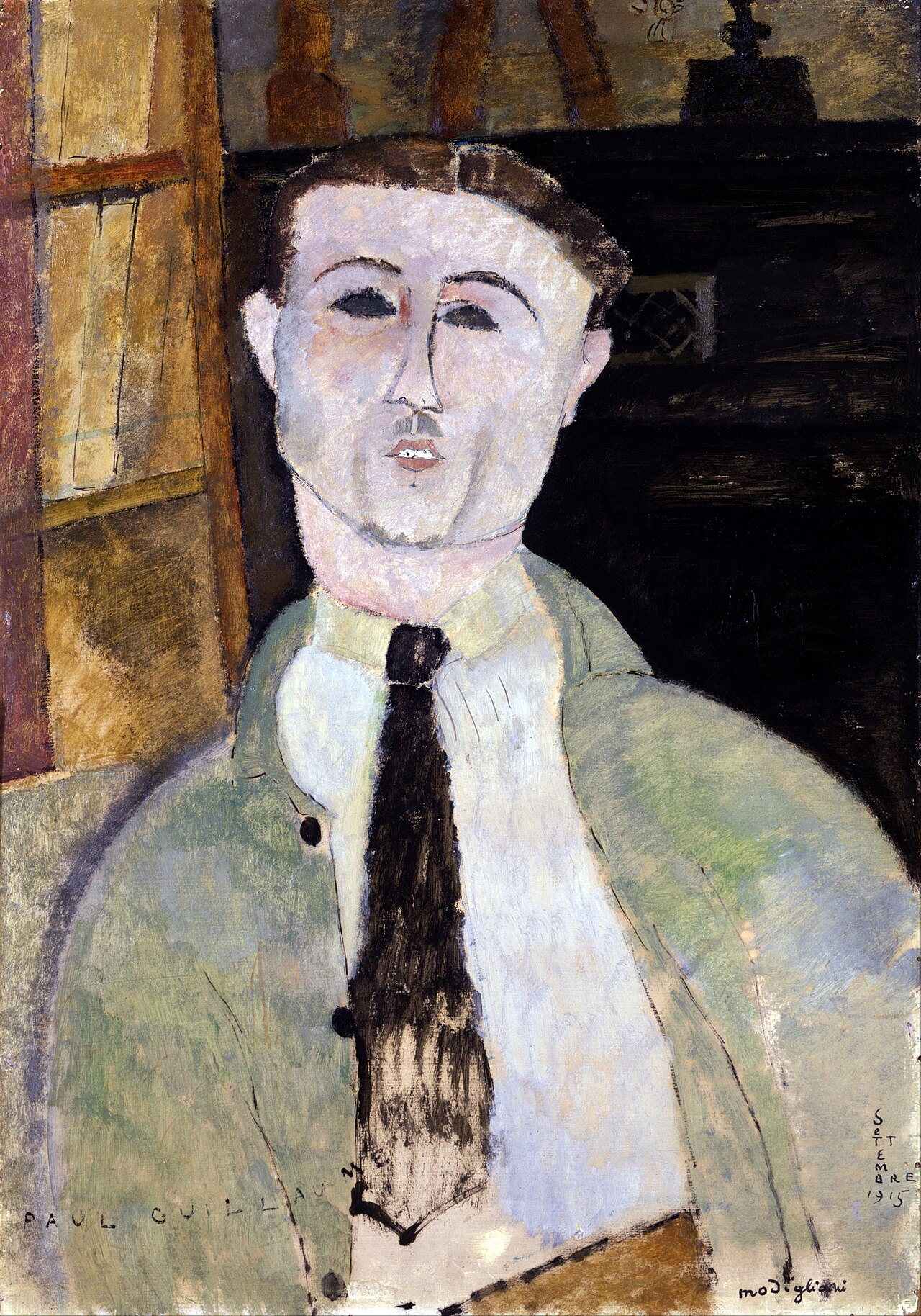
Paul Guillaume is a portrait of September 1915 in the Toledo Museum of Art, under the number 1951.382. A young man in a pale grey-green jacket and a broad black tie sits frontally in a room with a bookcase behind him, and his name, the month and the painter’s signature are all written into the picture. With us it is made as a hand-painted copy, oil on canvas, to order, in eight sizes or in a size you give us; before dispatch we send you a photograph of the finished canvas.
| Title: | Paul Guillaume |
| Other titles: | Portrait de Paul Guillaume, the French form; the picture itself carries PAUL GUILLAU… |
| Painter: | Amedeo Modigliani (1884–1920) |
| Year of creation: | September 1915 — the museum’s dating, and the painter wrote SETTEMBRE 1915 on the picture |
| Original size (width × height): | 52.1 × 74.9 cm, the painting; the museum also gives the frame, 82.6 × 106.7 × 5.1 cm |
| Original technique: | oil on wood panel — the museum’s own wording; Wikidata says cardboard instead |
| Painting style: | expressionism, École de Paris |
| Located: | Toledo Museum of Art (inv. 1951.382, purchased with funds given by Mrs C. Lockhart McKelvy) |
| Our reproduction: | hand-painted copy, oil on canvas, eight sizes or a custom size |
Paul Guillaume – Amedeo Modigliani
What is on the picture?
A young man is shown half-length, seated and frontal, filling the panel. He wears a pale grey-green jacket over a white shirt with a wide soft collar, and a broad black tie hangs down the centre. The face is very pale and mask-like, drawn long: a single line for the nose, a small pursed mouth, a narrow clipped moustache, a pointed chin. The eyes are flat dark almonds with no pupils and no irises under strong dark brows — the museum reads that as the stylisation of a mask, and notes that the sitter collected African masks. Dark brown hair is swept back from a high forehead. Behind him the room is split: at the left a tall ochre bookcase of horizontals and verticals, at the right a near-black mass with a small lattice panel and, above it, a dark object with a pale finial. Three things are written on the picture: his name in capitals at the lower left, cut across by the tie so that it reads PAUL GUILLAU; the month and year stacked vertically at the right edge, in Italian; and the signature in script at the lower right.
Why is the month painted on it?
Because Modigliani dated this one to the month, in his own language, up the right-hand edge: SETTEMBRE 1915. That is why our year row can say September rather than just a year — the museum dates it to that month too, and the picture agrees with the museum. It is also why the name is worth looking at: written across the bottom in capitals and then interrupted by the tie, so that what survives is PAUL GUILLAU. He did this repeatedly. Lola de Valence has its title painted into the ground and cut by the head, and the Jerusalem portrait of his dealer has the sitter’s name scratched across the top and cut by the hair. Three pictures, three interrupted names, and no sign that any of them troubled him.
The record of the original, and one disagreement
The museum gives the painting as 74.9 cm high and 52.1 cm wide, and separately gives the frame as 106.7 by 82.6 by 5.1 cm; we print the painting, width first, so on our page it reads 52.1 × 74.9 cm. On the support there is a plain disagreement worth naming: the museum records oil on wood panel, and the work’s Wikidata entry records cardboard. We follow the museum, which has the object; Wikidata is named rather than quietly dropped. The credit line is a purchase made with funds given by Mrs C. Lockhart McKelvy, and the museum’s record notes the picture is out on loan. The museum’s own site does not answer automated readers from our server, so the link above is registered against an archived copy of that same page, which carries the artist, the date, both measurements, the medium, the credit line and the object number. The whole selection is in the Amedeo Modigliani gallery, and we have written a longer article about the painter.
The sitter, and why he keeps appearing here
Paul Guillaume was a Paris dealer who handled African art and the contemporary avant-garde, Picasso and Matisse among them, and who became one of Modigliani’s first supporters and then his dealer. The museum records that Modigliani painted him four times in oil, with several drawings besides, and that he was twenty-three when he sat for this one, in his own library. He is the reason a good deal of the École de Paris found buyers at all, and his name has turned up three times on this shelf already in other people’s provenance: the Barnes bought Beatrice (Portrait of Béatrice Hastings) from him, and the National Gallery of Art records him, with a careful possibly, as the first owner of Adrienne (Woman with Bangs). Here he is the subject rather than the seller.
How is our hand-painted version made?
A painter paints it, with a brush, in oil on canvas, to your order. Every canvas painting takes some weeks, and each copy comes out slightly its own; that is the consequence of a person working rather than a machine. The whole picture turns on the pale, almost chalky face and the flat black of the tie and the eyes; between them everything else is muted grey-green, ochre and brown. The face must be kept matt and light-filled, built up rather than glazed, or it stops being a mask and becomes a portrait like any other. The eyes have no pupils and must not acquire any — that is the single most common way this motif is spoiled. The lettering is part of the picture and is painted with the same brush, including the interruption where the tie crosses the name. The original is on a wood panel and ours is on canvas, which we say rather than let anyone expect board. Before dispatch you receive a photograph of the finished canvas and approve it. It is never a print.
Which size for which wall?
For this motif we suggest 80 × 115 cm, and it is the rare case where the arithmetic and the recommendation agree exactly: 80 × 115 cm is 0.008 per cent from the shape of the original, which is as close as a listed size can be to a measured object. Behind it come 52 × 75 cm at 0.3 per cent — which is also, near enough, the size of the original itself — then 90 × 130 cm at 0.5 and 70 × 100 cm at 0.6. So you can have it at life size or at wall size without losing the proportion either way. The palette is quiet and cool, so it holds a white or grey wall and warms up next to wood. A post-impressionist painting in a size that is not on the list is no trouble: we make it to order.
Frequently asked questions
Where is the original?
In the Toledo Museum of Art, object number 1951.382, bought with funds given by Mrs C. Lockhart McKelvy. The museum’s record notes it is on loan.
Why do the eyes have no pupils?
Because Modigliani painted them that way. The museum reads it as the stylisation of a mask, and points out that the sitter collected African masks.
What is written on it?
The sitter’s name at the lower left, cut short by the tie; the month and year up the right edge, in Italian; and the signature at the lower right.
How closely does it follow the original’s proportions?
The original measures 52.1 × 74.9 cm, and that is exactly the size we list: 52 x 75 cm. The proportions are the original’s, with no deviation.
- Subject: a young dealer half-length in a pale grey-green jacket and black tie, pupil-less eyes, a bookcase behind him, his name and the month painted on the picture
- Original: 52.1 × 74.9 cm, oil on wood panel, September 1915, Toledo Museum of Art, inv. 1951.382
- Ours: hand-painted oil on canvas, eight sizes or a custom size, with a photograph to approve before dispatch
- Worth knowing: the picture dates itself to the month, and the museum and Wikidata disagree about the support — panel against cardboard — so we print the museum’s and name the other
The eyes on this canvas are painted without pupils. We counted all 76 Modigliani works on this shelf: 53 are like that, 17 are not – work by work.