






Description
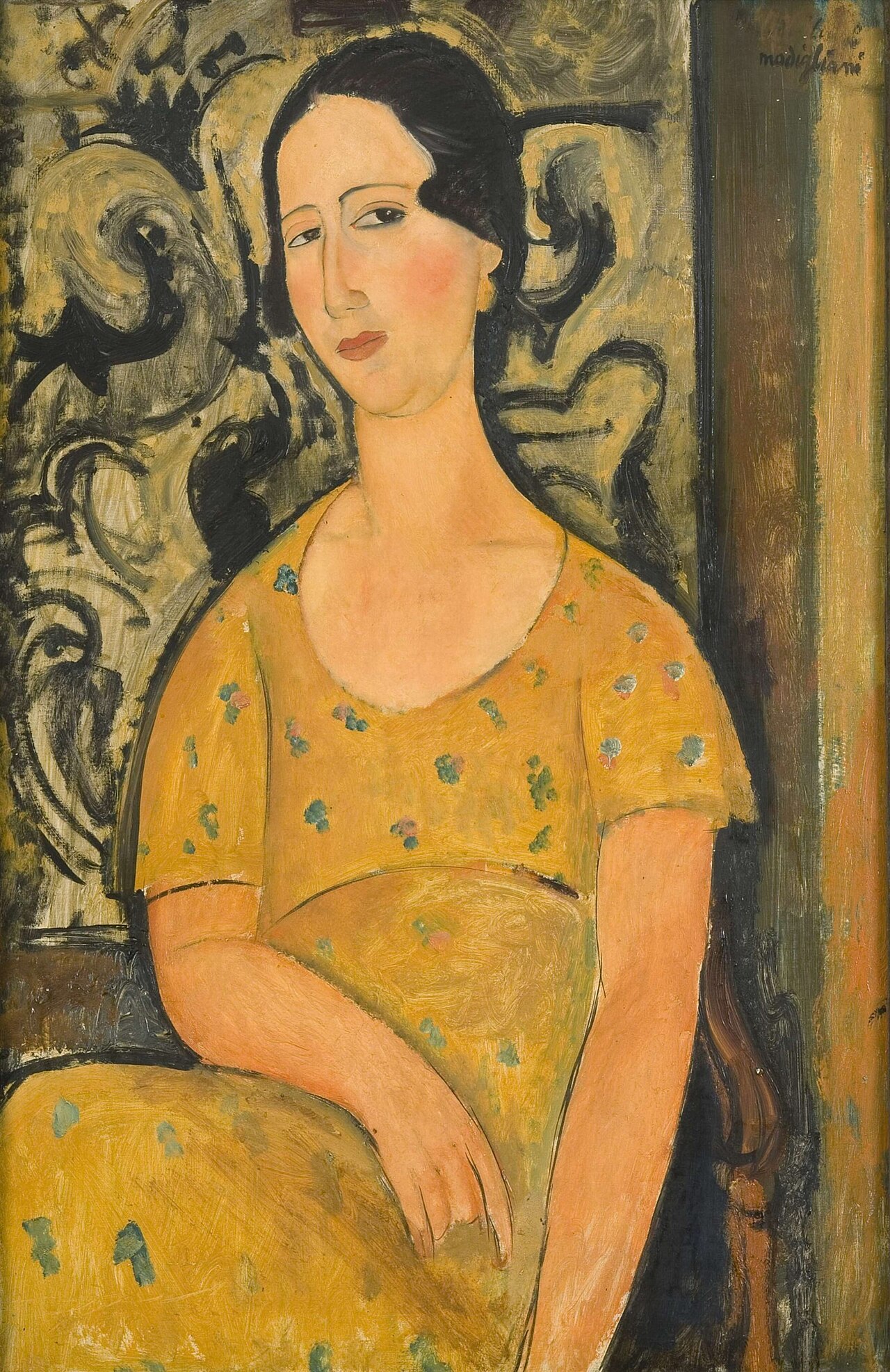
Young Woman in a Yellow Dress is a canvas of 1918 in the Cerruti Collection at the Castello di Rivoli near Turin. A young woman sits in a yellow dress scattered with small flowers, against a panel of pale ochre and black scrollwork, and her pupils sit at the outer edges of her eyes. With us it is made as a hand-painted copy, oil on canvas, to order, in eight sizes or in a size you give us; before dispatch we send you a photograph of the finished canvas.
| Title: | Young Woman in a Yellow Dress |
| Other titles: | Jeune femme à la robe jaune (Renée Modot), the museum’s own French form with the sitter named |
| Painter: | Amedeo Modigliani (1884–1920) |
| Year of creation: | 1918 — the museum’s year; it places the painting in Nice, probably in the summer |
| Original size (width × height): | 60 × 92 cm |
| Original technique: | oil on canvas |
| Painting style: | expressionism, École de Paris |
| Located: | Cerruti Collection, Castello di Rivoli (inv. 0149, catalogue no. A142, acquired 1987) |
| Our reproduction: | hand-painted copy, oil on canvas, eight sizes or a custom size |
Young Woman in a Yellow Dress – Amedeo Modigliani
What is on the canvas?
A young woman sits to three-quarter length, her body turned a little to our right and her head upright. The face is a long cream-ochre oval with pink on the cheek; the dark hair is parted at the centre and drawn smoothly back over the ears; the neck is long. The brows are thin, the nose is one contour, the mouth full and red-brown. She wears a yellow-ochre dress with short sleeves, a wide scooped neckline and a seam high at the waist, and the whole of it is scattered with small flower marks in green, blue and pink. One forearm lies across her lap with the hand relaxed and the fingers long; the other arm is at her side. Behind her, filling the left half, is a large decorative panel of pale ochre and black scrolling foliage; to the right runs a broad olive-brown vertical band, and beyond it, low down, the turned spindle of a chair back. The signature stands at the upper right.
Why do the eyes look sideways?
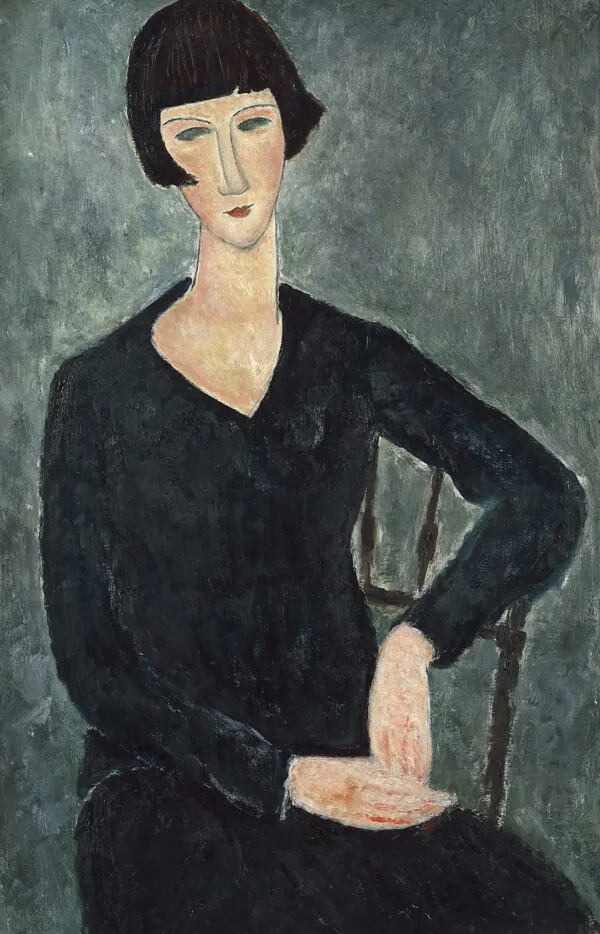
Because the pupils are painted at the outer edges of the eyes rather than in the middle, and the museum calls that placement singular in Modigliani’s work — a sideways glance that nevertheless still meets you. It is worth knowing that most of his sitters are given either no pupils at all or pupils set square, so this one deviates in a way you can see once it has been pointed out. The museum also calls the picture unique among his portraits for the combination of an exuberant decorative background with a patterned dress, and looking at it that reads true: nowhere else on this shelf does the wall behind compete so openly with the sitter. Compare the plain grey-green wall behind Café Singer, a canvas of almost exactly the same size, and the difference is the whole point.
The record of the original, and two numbers for one picture
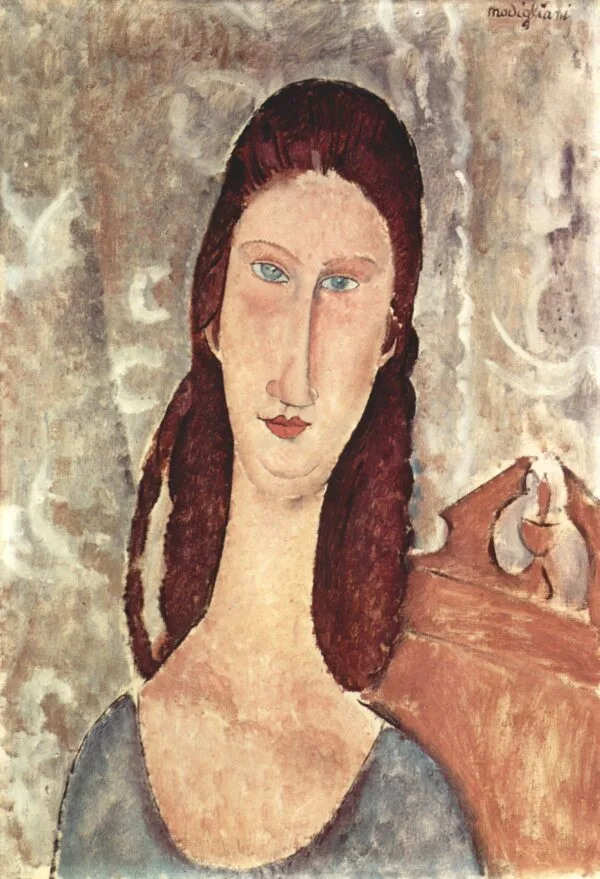
The original is oil on canvas, 92 cm high and 60 cm wide; we give width first, so on our page it reads 60 × 92 cm. The museum acquired it in 1987 and files it under two numbers at once — inventory 0149 and catalogue number A142 — which is why a longer identifier ending in A142 turns up in other databases. The museum places the work in Nice in 1918, probably in the summer, and explains why Modigliani was there: he had left Paris that April at his dealer’s urging, ill and short of money, with Jeanne Hébuterne pregnant and the city under bombardment. He painted children, local people and friends because there were no commissions to be had, and the Riviera months turned out to be among his most productive. Hébuterne is on this shelf in Jeanne Hébuterne in a White Chemise. The work also has its own Wikidata entry. The whole selection is in the Amedeo Modigliani gallery, and we have written a longer article about the painter.
Where has the picture been?
The museum publishes a chain of ten stations, with dates and even a gallery stock number, and it is the most detailed on this shelf. It opens where five other cells here open: Léopold Zborowski in Paris, who is himself painted in Portrait of Léopold Zborowski — the sixth time his name starts a chain on this shelf. Bernheim-Jeune bought it from him on 6 June 1922, under their number 23057; Madame Guérin bought it from Bernheim-Jeune on 9 April 1923; then the Jonas Netter collection from 1929, Madame Montreaux, the Galerie Bing collection from 1950, and the Robert von Hirsch collection. It was sold at Sotheby’s in London on 20 June 1978, as lot 743 of the von Hirsch sale, went to a private collection in Rome, and came up again at Sotheby’s in New York on 18 November 1986, lot 43, before the museum acquired it the year after. Every one of those stations is the museum’s own statement, not ours. Read as a list it is also a map of the trade that carried the École de Paris out of Paris and into private collections.
How is our hand-painted version made?
A painter paints it, with a brush, in oil on canvas, to your order. Every canvas painting takes some weeks, and each copy comes out slightly its own; that is the consequence of a person working rather than a machine. This motif is harder than most on this shelf because two patterns have to live together: the scrollwork behind and the flowers on the dress. Neither may be tidied. The scrolls are laid in with a loaded brush and left rough, and the flowers are small separate touches, not a repeat — painted evenly they turn into wallpaper and the dress stops being cloth. The face is smooth against all that movement, and the pupils go to the outer edges of the eyes and stay there. The yellow of the dress is the picture’s light source and must not be dulled towards brown. Before dispatch you receive a photograph of the finished canvas and approve it. It is never a print.
Which size for which wall?
For this motif we suggest 90 × 140 cm. On proportion the nearest of our sizes is 130 × 200 cm at 0.3 per cent from the original’s shape, then 90 × 140 cm at 1.4 and 71 × 107 cm at 1.7. This is a picture that gains from size more than most, because the two patterns need room to stay separate; small, the scrollwork and the flowers merge into a general busyness. The palette is yellow, ochre and black, warm throughout, so it lifts a grey or white room and fights a yellow wall. At 130 × 200 cm the sitter is larger than life and the background becomes a wall in its own right. A post-impressionist painting in a size that is not on the list is no trouble: we make it to order.
Frequently asked questions
Where is the original?
In the Cerruti Collection at the Castello di Rivoli near Turin, inventory 0149, catalogue number A142, acquired in 1987.
Who was the sitter?
Renée Modot, recently married to the actor Gaston Modot, whom Modigliani painted at the same time. The museum records that she posed in the afternoons in a makeshift studio in her own house.
Why are the pupils at the edges of the eyes?
Because Modigliani put them there. The museum calls the placement singular in his work — a sideways glance that still meets the viewer.
How closely does it follow the original’s proportions?
The original measures 60 × 92 cm. The closest of our sizes is 130 x 200 cm, which departs from the original’s proportions by 0.33%.
- Subject: a seated young woman in a flower-scattered yellow dress against a panel of ochre and black scrollwork, her pupils at the outer edges of her eyes
- Original: 60 × 92 cm, oil on canvas, 1918, Cerruti Collection, Castello di Rivoli, inv. 0149
- Ours: hand-painted oil on canvas, eight sizes or a custom size, with a photograph to approve before dispatch
- Worth knowing: the museum publishes ten owners with dates and a dealer’s stock number, and calls this the only Modigliani portrait to put a patterned dress against a patterned ground
The eyes on this canvas do have pupils. Of the 76 Modigliani works on this shelf 17 are like that, and 53 have no pupils – work by work.