
Description
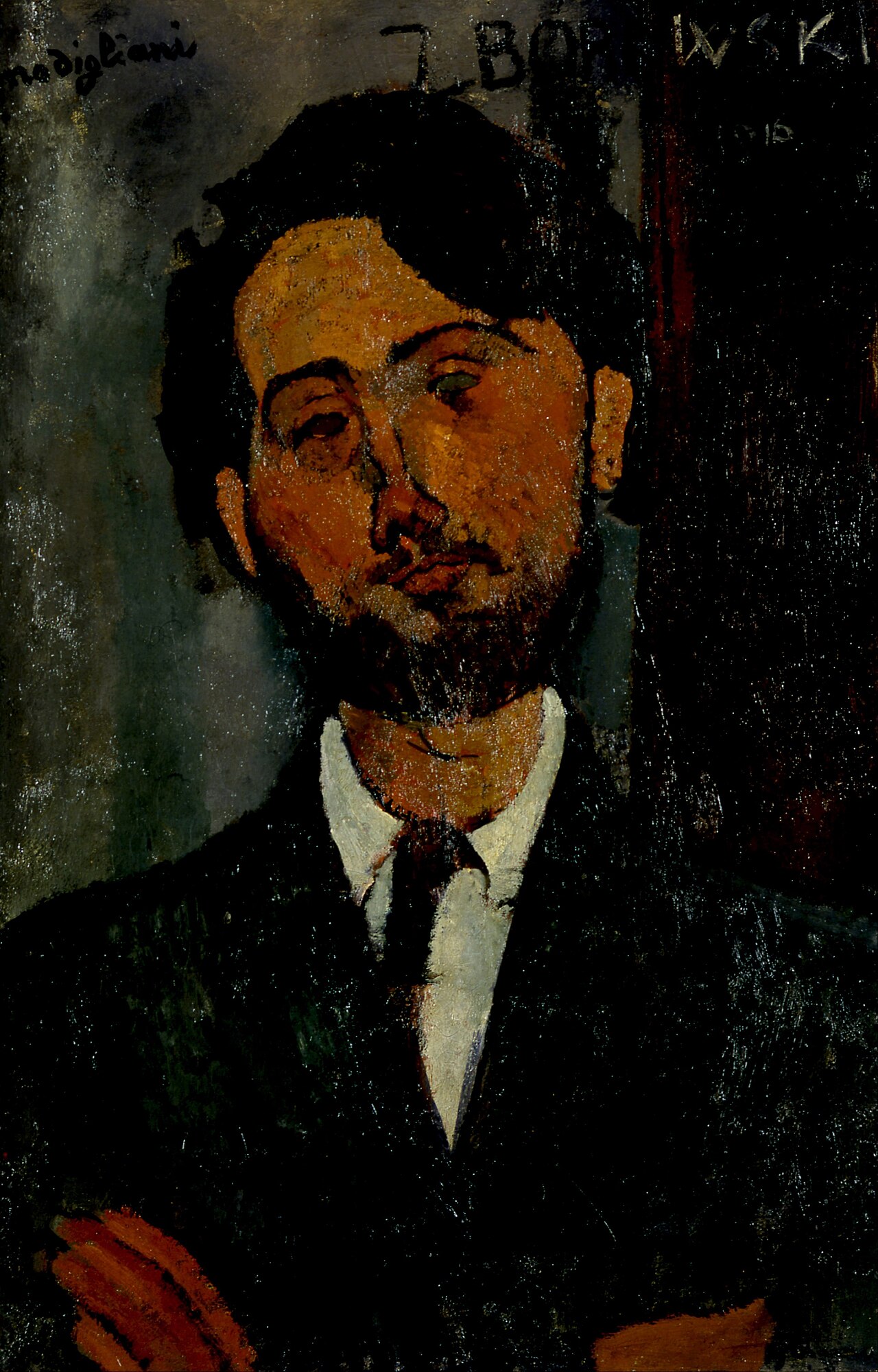
Portrait of Léopold Zborowski is a canvas of 1916, on permanent loan to the Israel Museum in Jerusalem. A bearded man in a dark jacket and a pale tie looks out of a dark ground, with the painter’s signature at the top left and the sitter’s name and the year scratched across the top right. With us it is made as a hand-painted copy, oil on canvas, to order, in eight sizes or in a size you give us; before dispatch we send you a photograph of the finished canvas.
| Title: | Portrait of Léopold Zborowski |
| Other titles: | the picture writes its own: ZBOROWSK, cut short by the sitter’s head |
| Painter: | Amedeo Modigliani (1884–1920) |
| Year of creation: | 1916 — and the painter wrote that year onto the canvas himself |
| Original size (width × height): | 43 × 65 cm — the museum’s figure; four other publications give four other sizes |
| Original technique: | oil on canvas |
| Painting style: | expressionism, École de Paris |
| Located: | Israel Museum, Jerusalem, on permanent loan — the museum’s own page cannot be read from our server, so we do not link it |
| Our reproduction: | hand-painted copy, oil on canvas, eight sizes or a custom size |
Portrait of Léopold Zborowski – Amedeo Modigliani
What is on the canvas?
A bearded man is shown to the shoulders, close to and almost frontal, filling most of the height. The face is a warm orange-ochre, modelled hard and bounded by dark contours; the brows are heavy and black. The two eyes are not painted alike: the one on our left is a dark hollow, almost shut, while the other carries a pale green-grey iris and looks straight out. The nose is long, and a full dark beard and moustache close the lower face so that the mouth barely shows. The hair is thick and black, pushed back from a high forehead. He wears a near-black jacket over a white collar, with a pale grey-white tie falling in a long wedge. The ground is divided: a mottled grey-green wall on the left, and on the right a dark red-brown vertical band against something almost black. Two orange-red passages sit in the bottom corners, cut off by the edge of the canvas. At the top left the signature is written thin and dark; across the top right, in large pale scratched capitals, stands the name, and the year beneath it.
Why does the picture carry the sitter’s name and the year?
Because Modigliani put them there, in paint, as part of the surface. The catalogue file records the inscription as ZBOROWSK and 1916, and that is what the photograph shows: the letters begin at the top right, the sitter’s dark hair runs into them, and the name comes out of the collision incomplete. He did the same thing more than once — Lola de Valence carries its title in the same way, with the head cutting the lettering — so this is a habit rather than an accident. Who the man is matters here more than usual: Léopold Zborowski was the Polish poet who became Modigliani’s dealer, found him rooms and models, and kept him working through the war years. He is the reason a good deal of the École de Paris survives at all, and he is on this shelf twice, since the other portrait of him is Portrait of Léopold Zborowski. He also owned Lolotte before it reached a museum.
The record of the original, and five published sizes
The original is oil on canvas, and the year is 1916 on every record we could read. The size is another matter, and it is worth setting out plainly, because it is the clearest case of scholarly disagreement on this shelf. A published Modigliani catalogue file lists the museum at 65 × 43 cm, Restellini at 65 × 41, Parisot at 63 × 41, Pfannstiel at 68 × 41, and the 1958 and 1963 exhibition catalogues at 65 × 42. Five figures for one canvas. We print the museum’s, 43 × 65 cm with width first, because the museum has the object in front of it, and we name the others rather than pretending the question is settled. Wikidata gives 65 × 43 as well, which agrees. On the number the picture is filed under there is a similar split: the Wikidata entry gives 401219, which is also the number in the museum’s web address, while the catalogue file records the loan number L-B04.008. They are different kinds of number and we do not merge them. We would rather link the museum itself, but its site answers every address we tried — the object page, an older path, an archived copy — with the same empty page, so there is nothing there to verify and we do not link it. The whole selection is in the Amedeo Modigliani gallery, and we have written a longer article about the painter.
Where has the picture been?
The first owner was the sitter. The catalogue file begins the chain with L. Zborowski in Paris, which is to say the dealer kept his own portrait, and marks what follows with a question mark of its own: the Georg Guggenheim-Strauss collection in Zurich. From there it came to the Israel Museum not as a gift or a purchase but as a permanent loan, made by the Georg and Josi Guggenheim Foundation through the Swiss friends of the museum. That is why the picture hangs in Jerusalem while the loan number still begins with an L. The file calls its own research unfinished, and we pass the chain on with that said.
How is our hand-painted version made?
A painter paints it, with a brush, in oil on canvas, to your order. Every canvas painting takes some weeks, and each copy comes out slightly its own; that is the consequence of a person working rather than a machine. This is a dark picture with one lit face, and the face is not smooth: it is built from orange, red and brown strokes that stay visible, so the copy must keep the brushwork rather than blend it away. The two eyes are different and must stay different. The lettering at the top is scratched into the paint rather than written on it, pale on dark, and it has to look that way — thin, uneven and interrupted where the hair crosses it. The tie is the only clean light shape in the picture and it holds the eye down; painted too bright it takes over. Before dispatch you receive a photograph of the finished canvas and approve it. It is never a print.
Which size for which wall?
For this motif we suggest 80 × 120 cm. There is no single closest size and we will not invent one: four of our eight share the same 2:3 shape and all four sit 0.8 per cent from the original’s proportions — 40 × 60, 80 × 120, 100 × 150 and 120 × 180 cm are equally close, so the choice is a matter of the wall. The picture is dark and reads from across a room, and the face is the only bright thing in it, which is an argument for size: at 80 × 120 cm the head comes up to life scale and a little beyond. On a small wall 40 × 60 cm keeps it as a study. It needs a light wall; against a dark one the jacket and the ground merge and the composition disappears. A post-impressionist painting in a size that is not on the list is no trouble: we make it to order.
Frequently asked questions
Where is the original?
At the Israel Museum in Jerusalem, held on permanent loan rather than owned by the museum.
How large is the original?
43 × 65 cm according to the museum. Four other publications give 65 × 41, 63 × 41, 68 × 41 and 65 × 42 cm; we follow the museum and name the rest.
Who was Zborowski?
A Polish poet who became Modigliani’s dealer and supported him through his last years. This is his portrait, and he owned it himself.
How closely does it follow the original’s proportions?
The original measures 43 × 65 cm. The closest of our sizes is 40 x 60 cm, which departs from the original’s proportions by 0.78%.
- Subject: a bearded man to the shoulders, dark jacket and pale tie, a signature at the upper left and his name scratched across the upper right
- Original: 43 × 65 cm, oil on canvas, 1916, Israel Museum, Jerusalem, on permanent loan
- Ours: hand-painted oil on canvas, eight sizes or a custom size, with a photograph to approve before dispatch
- Worth knowing: five publications give five different sizes for this canvas, and the museum’s own page cannot be read from our server, so we neither cite nor link it
The eyes on this canvas are painted without pupils. We counted all 76 Modigliani works on this shelf: 53 are like that, 17 are not – work by work.