






Description
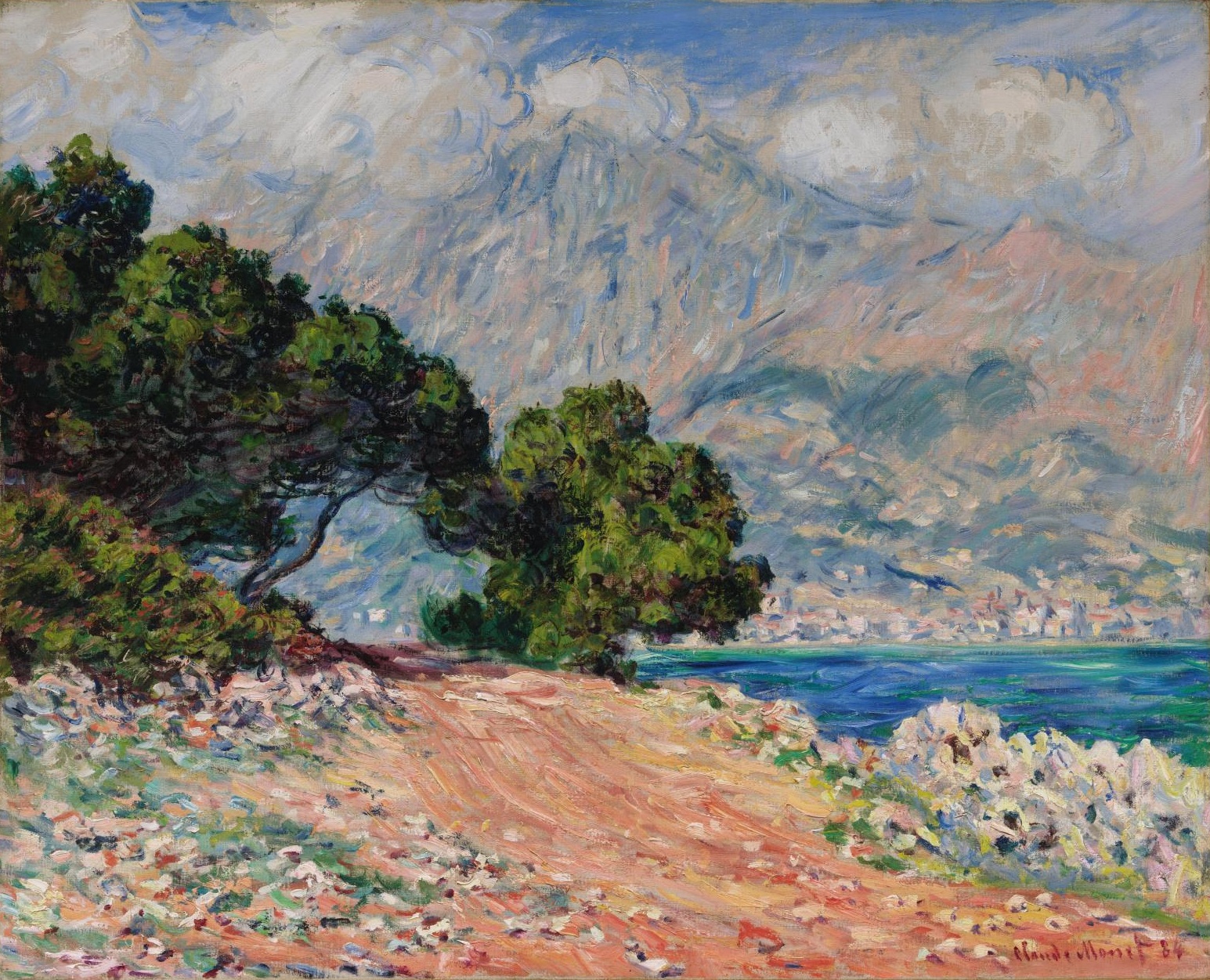
Cap Martin, near Menton is a hand-painted reproduction of Monet’s canvas in the Museum of Fine Arts, Boston: from a cape on the Mediterranean the view opens across the bay towards the Maritime Alps, dark pines lean in from the left, a pink-orange path winds through the foreground and a blue-green sea lies to the right. The original measures 81.6 x 67.2 cm, is oil on canvas, is signed “Claude Monet 84” at the lower right, dates from 1884 and carries accession number 25.128. We paint it in eight sizes or to your own, with a photograph of the finished work sent for approval before dispatch.
| Title: | Cap Martin, near Menton |
| Other titles: | Cap Martin, near Menton (the museum’s title); Cap Martin, bei Menton (the German title in Wikidata); in the Wildenstein catalogue the work is number 897 |
| Painter: | Claude Monet (1840–1926) |
| Year painted: | 1884 |
| Original size: | 81.6 cm x 67.2 cm |
| Original technique: | Oil on canvas |
| Painting style: | Impressionism |
| Located at: | Museum of Fine Arts, Boston (inv. 25.128) |
| Our reproduction: | Hand-painted oil on canvas, eight sizes or made to measure |
Cap Martin, near Menton – Claude Monet
What is on the canvas?
The upper half of the canvas belongs to sky and mountains. The clouds are painted in looping, broadly drawn strokes of white and light blue, the mountains below them in pink, lilac and pale blue.
On the left a group of dark green pines with thin, twisted trunks leans from the edge towards the centre, and a little right of centre stands a single, rounder tree. Behind it the bay opens: a band of deep blue and green sea runs to the right edge, and at the foot of the mountains a pale pink line of houses follows the shore. A broad pink-orange path takes up the lower third, winding from the lower left towards the centre, scattered with pebbles and touches of green, white and pink. At the lower right, by the water, lies a white and pale lilac mass that reads as either shrubs or rocks. The signature stands at the lower right in a reddish colour.
When and where was it painted?
The museum dates the canvas 1884, with no range, Wikidata gives the same year, and the inscription at the lower right reads Claude Monet 84. According to the museum’s record the canvas belongs to a group Monet painted on the French Riviera in April 1884. We stand on the eastern side of the cape, looking across the bay towards the Maritime Alps.
According to the museum he had visited this coast with Renoir the previous December.
What does the museum record say about the work?
The work is held by the Museum of Fine Arts, Boston, under accession number 25.128, with the credit line Juliana Cheney Edwards Collection. The museum gives the size height first, 67.2 x 81.6 cm, the technique as oil on canvas, and the inscription as “Lower right: Claude Monet 84”. The museum cites the Wildenstein catalogue of 1996, in which the work is number 897.
Where has the canvas been?
The museum publishes the chain of owners and, for the first stations, voices its own doubt. In May 1884 Monet possibly sold the canvas to Durand-Ruel in Paris, and in September 1886 Durand-Ruel possibly sent it to the American Art Association in New York; for both stations the museum relies on the Wildenstein catalogue.
By 1891 it had been acquired, probably from the American Art Association, by James F. Sutton (1849–1915) of New York, one of its founders, who certainly owned it when he lent it to an exhibition at the Union Club in New York, 12 to 14 February 1891. In 1915 it passed by inheritance to his widow, Florence Macy Sutton, and at the Sutton sale at the American Art Association on 17 January 1917 it went as lot 144 to Durand-Ruel in New York.
In the same year Durand-Ruel sold it to the siblings Robert J. Edwards, Hannah Marcy Edwards and Grace Edwards of Boston; Robert died in 1924, Hannah in 1929, Grace in 1938. A letter from Herbert Elfers of Durand-Ruel to the museum, dated 22 August 1939, records the sale as made to “the Misses Edwards”, that is, to the sisters. In 1925 the canvas came to the museum as a bequest and gift of the Edwards family, with an accession date of 2 April 1925.
Which Cap Martin is this?
Wikidata knows two works by Monet with the name of this cape in the title, both from 1884. The Musée des Beaux-Arts in Tournai, Belgium, holds La pointe du Cap Martin, oil on canvas, 65 x 81 cm, which Wikidata lists in the Wildenstein catalogue as number 893. The Tournai museum describes it as a seascape from the painter’s second journey to the South of France, with the foam of waves breaking on the rocks and trees shaken by the wind.
The Boston canvas has no waves breaking on rocks: the path in front, the pines in the middle, the calm bay and the mountains behind. Ours, then, is 25.128 in Boston, Wildenstein 897, signed at the lower right. From the same journey comes Bordighera, of 1884, held by the Art Institute of Chicago as 1922.426; by the museum’s record, Monet travelled there early that year.
Why does this work matter?
Because, as the museum’s record puts it, it shows what Monet went south for: the intensity of the light. To suggest the airy expanse of the sky he did not fill the whole canvas, but left much of the upper portion in reserve and only indicated mountain and cloud. An impressionist painting of this kind builds its scene not from exact contours but from the light it lets through.
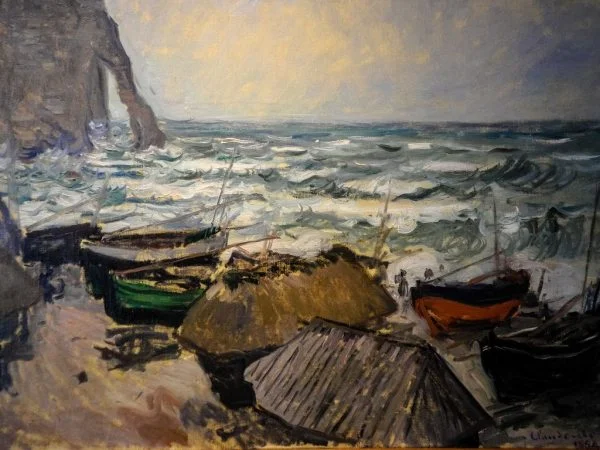
From 1884 our collection also includes Fishing Boats on the Beach at Étretat (Wallraf-Richartz-Museum, Cologne, WRM 3120) and Barque sur la Seine à Jeufosse (private collection, Wildenstein 915). From 1886 come the coastal canvases Storm on the Belle-Île Coast (Musée d’Orsay, RF 3163) and Rocks at Port-Goulphar (Art Institute of Chicago).
How is our hand-painted version made?
Each order is painted separately by an artist in oil on canvas, with no print and no machine step; that is how every canvas painting we send out is made. The hardest part here is the top: sky and mountains must stay sparse, light strokes over a pale ground, or the air Monet left there disappears.
The second test is the pines. They must be dark but not black, with trunks that twist and crowns through which the sea still glints. An oil painting reproduction of this canvas also depends on the path in the foreground, which has to stay warm, pink-orange and broken, never a flat field. A Monet reproduction with a sky this light will not take a thick glossy varnish, so ours stays matt. A hand-painted copy is not a facsimile: two canvases of the same size always differ in the brushwork.
Which size for which wall?
There are eight sizes, from 46 x 38 to 150 x 120 cm. By size the closest to the original is 80 x 65 cm, 1.6 cm narrower and 2.2 cm lower, but at 1.2308 a little longer in shape than the original at 1.2143. By proportion the closest is the smallest size, 46 x 38 cm at 1.2105, followed by 60 x 50, 90 x 75 and 120 x 100 cm at 1.2000.
For nearly the size of the original choose 80 x 65, for a larger wall 90 x 75 or 120 x 100, and for a narrow wall or above a shelf 46 x 38 or 60 x 50. The pale path and the blue bay bring southern light into a room, which makes this a good painting for the living room. All sizes are listed with the product in our Claude Monet gallery.
Custom size, stretcher bar and frame
If the size you want is not on the list, choose made to measure: send us the width and height and we keep the proportion of the original. The canvas is stretched on a wooden bar, and a frame is not included in the price.
Delivery and guarantee
Making it takes two to three weeks, a few days longer at the largest sizes. We send the canvas stretched on its bar in a sturdy box, or rolled in a tube, always with tracking. If it arrives damaged or differs noticeably from the photograph you approved, we replace it or refund you.
If the painting is a gift and you are unsure of the size, there is a voucher: the recipient chooses the size and the subject.
Frequently asked questions
Where is the original?
In Boston, at the Museum of Fine Arts, accession number 25.128.
What year is it from?
1884. The museum, Wikidata and the inscription at the lower right all give that year.
Where is the painter looking from this spot?
According to the museum, from the eastern side of the cape across the bay towards the Maritime Alps.
Why did Monet paint on the Riviera?
For the strong Mediterranean light. He visited the coast with Renoir in December 1883, then went back alone early in 1884 and painted for almost three months at Bordighera, Monte Carlo and Menton.
- Subject. Dark pines on the cape, a pink path, the blue bay and pastel mountains under a sky left half open.
- Original. Oil on canvas, 81.6 x 67.2 cm, 1884; inscribed at the lower right “Claude Monet 84”; Museum of Fine Arts, Boston, inv. 25.128.
- Ours. Eight sizes; 80 x 65 cm is closest by size, 46 x 38 cm by proportion.
- Worth knowing. According to the museum, Monet left much of the sky in reserve and only indicated it.