


Description
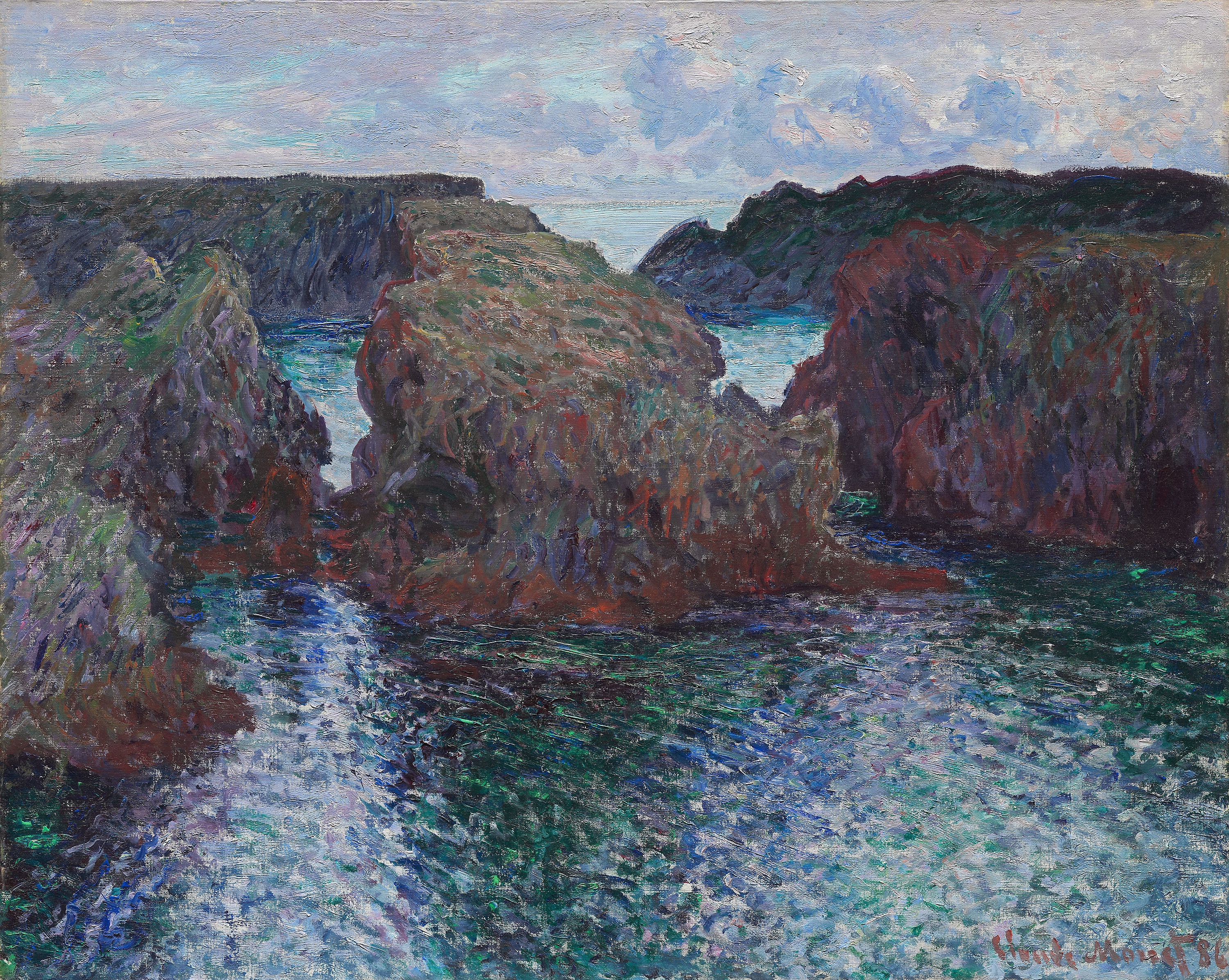
Rocks at Port-Goulphar is a hand-painted Monet reproduction of a seascape of 1886: a bright run of surf drives in from the lower left between reddish cliffs, and below it lies a dense, dark green sea. The original measures 81.8 x 66 cm, is oil on canvas, and belongs to the Art Institute of Chicago under accession number 1964.210, shown in Gallery 240. We paint it in eight sizes or to your own measurements, with a photograph of the finished work sent for approval before despatch.
| Title: | Rocks at Port-Goulphar |
| Other titles: | Belle-Isle · Belle Isle (an exhibition title and a stock-book name between 1895 and 1905) |
| Painter: | Claude Monet (1840–1926) |
| Year painted: | 1886, inscribed “Claude Monet 86” lower right |
| Original size: | 81.8 cm x 66 cm |
| Original technique: | Oil on canvas |
| Painting style: | Impressionism |
| Located at: | Art Institute of Chicago (acc. no. 1964.210) |
| Our reproduction: | Hand-painted oil on canvas, eight sizes or to your measure |
Rocks at Port-Goulphar – Claude Monet
What is on the canvas?
The lower half is sea, dense and dark, woven from short green, blue and violet strokes. Through it, from the lower left corner, drives a bright run of surf, the only truly white thing here, narrowing towards the middle where it disappears behind rock. The centre is held by a large tawny-red mass of stone seen slightly from above, its grassy back visible. Cliffs rise to left and right, and between them two narrow openings are left, through each of which pale open sea shows: those bright gaps give the scene its depth. Above it the sky is grey-blue and heavy, the horizon set high.
Where is Port-Goulphar?
Port-Goulphar is a narrow inlet on the south-western side of Belle-Île, the largest Breton island, in the Atlantic south of the Quiberon peninsula. That side is known as the wild coast: the land does not slope to the water but breaks off and falls straight into the sea, leaving tight inlets between the cliffs. Monet did not paint from a safe height. He placed himself so that we look into the throat of the inlet and down onto the water; the scene has no quiet front edge for the eye. It begins already in the surf.
Why did Monet go to Belle-Île?
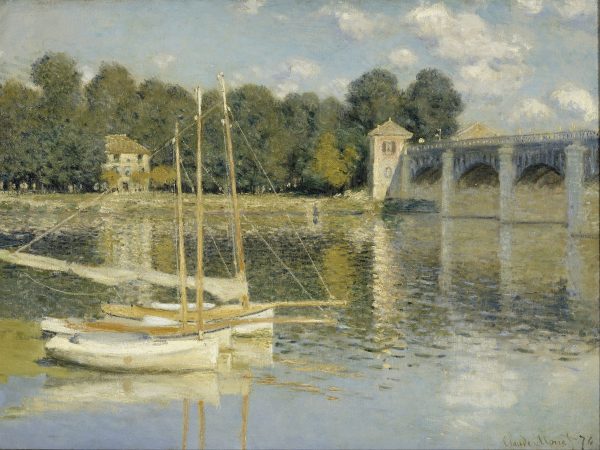
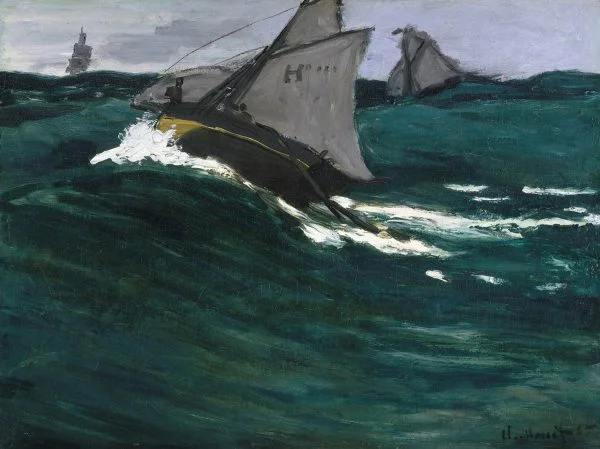
In the autumn of 1886 he left the river landscape he was known for and went to the island to paint the sea in bad weather. Where at Argenteuil he had laid colour in long, soft drags, here he puts it down shorter, denser and more crosswise, until the surface turns almost coarse. From the same journey came Storm on the Belle-Île Coast, which shows the same shore in worse weather still. For the same painter on smoother water, compare The Green Wave, where the sea is open and rolling rather than squeezed between rocks, or Fishing Boats on the Beach at Étretat, where the shore comes down to sand.
What does the signature say?
The museum’s record, under its heading for inscriptions, states: inscribed lower right, “Claude Monet 86”. It is indeed there, and can be read in the photograph the museum publishes: a red stroke in the lower right corner, laid over the already dried blue of the sea, two figures after the name. Monet dated it himself, and the museum gives the same year, with no “about” and no range.
What does the museum’s record say?
The work is held by the Art Institute of Chicago under accession number 1964.210, listed as Rocks at Port-Goulphar, Belle-Île, oil on canvas, 1886. The museum gives the measurements as height by width, 66 x 81.8 cm; our table puts width first, so we read 81.8 x 66 cm. The record also names the donors, Mr. and Mrs. Chauncey B. Borland, and Gallery 240. Its bibliography cites the Wildenstein catalogue at number 1095 and two of the painter’s own letters.
The painting’s path from Monet to Chicago
The museum publishes the full ownership history, unusually well documented here. The work stayed with the painter until 21 December 1892, when the Paris gallery Durand-Ruel bought it for 4,500 francs. From there it went to that firm’s New York branch, and here the record is honest: the Paris and New York stock books give different dates, 19 December 1895 and 4 January 1896, and the museum prints the discrepancy instead of choosing one. In the New York book it is entered as Belle Isle. On 6 March 1897 Mrs. Harriet Borland of Chicago bought it for $2,000; in 1933 it passed to her son Chauncey Blair Borland; and from 1964 the Borlands gave it in fractional interests, the last in 1973. Both prices are the museum’s own, confirmed by the Durand-Ruel archives; we quote no present value.
Two canvases with almost the same name
This motif is easy to confuse. Monet painted Port-Goulphar more than once, and the other well-known canvas of that name belongs to the Art Gallery of New South Wales in Sydney, number 8356. That work is upright, 81 x 65 cm, from 1887; the gallery also lists it as Seascape and bought it in 1949. The difference is visible at a glance: the Sydney canvas looks in from further off and higher, the water fills the lower two thirds with no white run of surf, and the rock stands mid-scene, detached from both shores. Ours is horizontal and seen from closer in. The most reliable distinction is the signature: both are signed lower right and both in red, but the Sydney one carries the year 87 and ours carries 86.
How is our hand-painted version made?
Every order is painted individually by an artist, in oils, on cotton or linen. A canvas painting is made here without printing, without transfer and without any machine step in between. The artist works from the museum photograph and our colour reference, beginning with the proportion between sky, rock and water, then the dark planes of the cliffs, and last the surf and the bright gaps, which must stay clean. The motif is demanding: almost no straight lines, and the stroke must stay short and dense or the water turns glassy. That is why every hand-painted oil painting leaving our workshop is a little its own.
Stretched on a wooden frame in a rigid box, or rolled in a tube, with tracking. Before that you receive a photograph of the finished work.
Which size for which wall?
Eight sizes are available, from 45 x 38 to 150 x 120 cm. The original is 81.8 cm wide and 66 cm high: nearest in size is 80 x 60 cm, nearest in proportion 50 x 40 and 150 x 120 cm. Above a sofa the larger sizes suit this motif: below 60 x 50 cm the fine stroke of the sea runs together into a single plane. As a painting for living room use above a longer piece of furniture, 120 x 100 cm reads calmly. For more from the same period see the Claude Monet gallery; close in subject is The Cliff Walk at Pourville, where the same painter shows a cliff from above.
How high to hang the painting: centre about 145 cm above the floor; above furniture leave the lower edge 20 to 30 cm clear. More on placing work is on our blog.
Custom sizes, stretcher and frame
None of the eight repeats the original’s proportion exactly. If it is the original’s ratio you want, a custom size is the only way: send us the width and height in centimetres. The canvas can arrive stretched and ready to hang, or rolled in a tube for framing yourself; a frame is not included in the price. A plain dark or natural wooden frame suits this scene, while a wide gilt frame closes it in.
Delivery and guarantee
Painting normally takes two to three weeks, longer at the largest sizes, since the oil has to dry between layers. Stretched canvases travel in a rigid box with protected corners, rolled ones in a tube. If the work arrives damaged, or differs noticeably from the photograph you approved, we replace it or refund the price. A hand-painted copy is not a factory product and small differences in the brushwork are expected; damage or a wrong subject are not, and those are ours to put right.
If the painting is a gift and you are unsure of the size, there is a gift voucher: the recipient chooses the size and the subject.
Frequently asked questions
Where is the original?
In Chicago, at the Art Institute of Chicago, accession number 1964.210, on view in Gallery 240.
Where exactly is Port-Goulphar?
On Belle-Île, in the Atlantic south of the Quiberon peninsula in Brittany, on the exposed south-western side.
What does the painting say in one sentence?
That at Port-Goulphar the sea is what moves and the rock is what does not give way, and Monet painted the difference with the brush, not with drawing.
Is the original for sale and what is it worth?
It is not; since 1973 it has belonged wholly to the Art Institute of Chicago. The museum’s record gives 4,500 francs in 1892 and $2,000 in 1897; we quote no present value.
- Subject. A white run of surf between reddish cliffs, dark green sea across the lower half, and two bright gaps of open sea behind, seen slightly from above.
- Original. Oil on canvas, 81.8 x 66 cm, 1886, signed and dated lower right; Art Institute of Chicago, acc. no. 1964.210, the gift of Mr. and Mrs. Chauncey B. Borland.
- Ours. Eight sizes from 45 x 38 to 150 x 120 cm, or made to your own measurements, the only way to keep the original’s proportion.
- Worth knowing. The Sydney gallery holds another Monet with this place in its title; the year in the signature tells them apart, 86 on ours and 87 on that one.