


Description
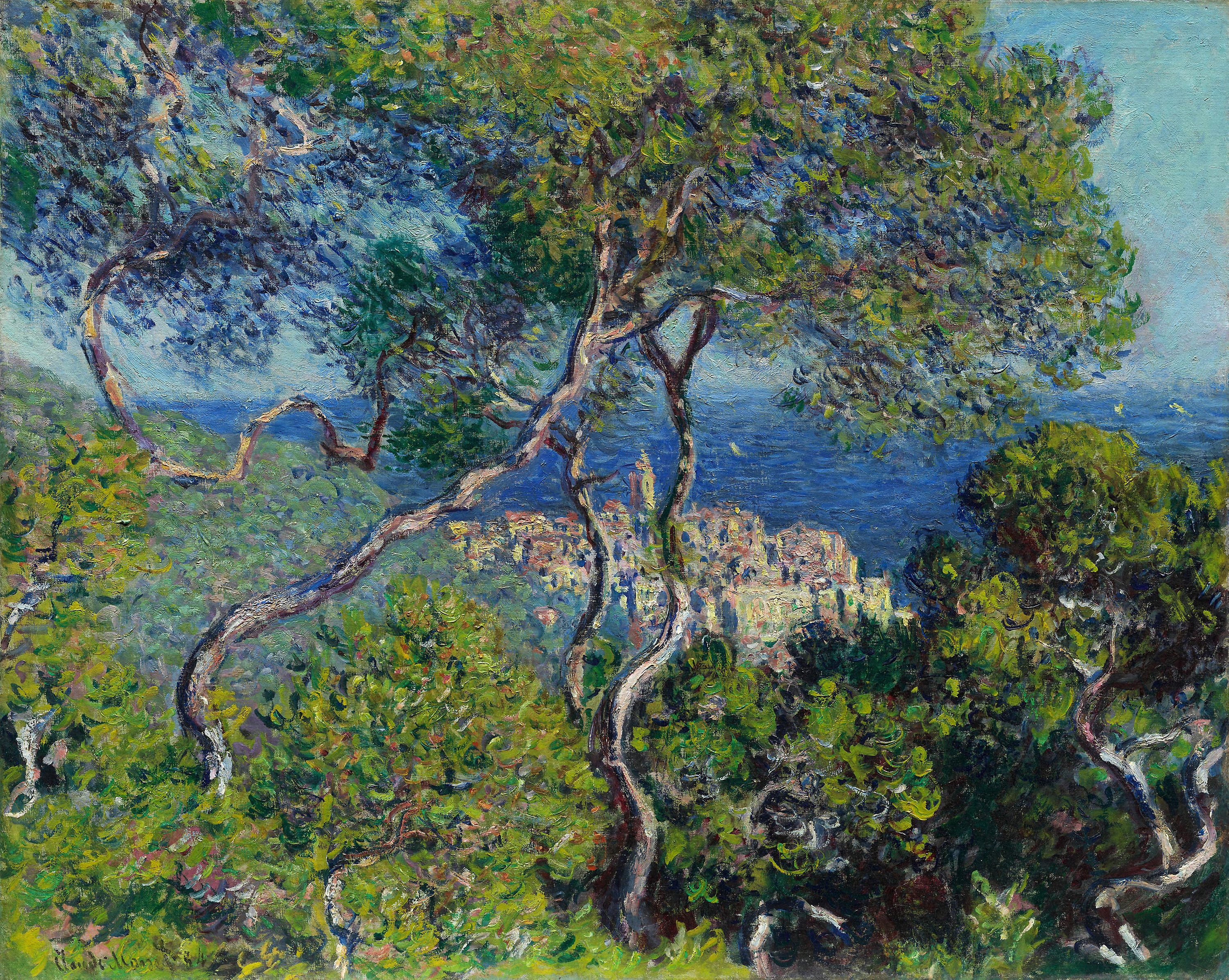
Bordighera is a hand-painted reproduction of Monet’s Italian Riviera scene: pale, twisting trunks climb across the canvas, a band of blue sea opens between them, and on the rise below it the town glimmers with a slender bell tower. The original measures 80.8 x 65 cm, is oil on canvas and belongs to the Art Institute of Chicago under accession number 1922.426. The museum dates it to 1884 and records the signature at lower left, “Claude Monet 84”. We paint it in eight sizes or to your own measurements, with a photograph of the finished work sent for approval before dispatch.
| Title: | Bordighera |
| Other titles: | Antibes (the name the museum showed it under in 1910) |
| Painter: | Claude Monet (1840–1926) |
| Year painted: | 1884; signed lower left “Claude Monet 84” |
| Original size: | 80.8 cm x 65 cm |
| Original technique: | Oil on canvas |
| Painting style: | Impressionism |
| Located at: | Art Institute of Chicago (acc. no. 1922.426) |
| Our reproduction: | Hand-painted oil on canvas, eight sizes or made to measure |
Bordighera – Claude Monet
What is on the canvas?
The scene is entirely overgrown. A dense canopy fills the upper two thirds: blue-green in shadow, yellow-green where the sun strikes it. Trunks twist through it, pale and almost white, thin and unnaturally bent, kinking twice before they vanish into the leaves: one up the middle, one curling in from the left edge, one dropping away at the right. Behind them lies a narrow band of sea, deep blue and smooth. Below that band, on a rise, stands the town: low pink and white roofs with a narrow, pointed bell tower among them. The bottom third is overgrown hillside, and the signature sits at lower left.
Why was Monet in Bordighera?
Early in 1884 he travelled to Bordighera, a town on the Italian Riviera near the French border. He meant to stay three weeks and stayed nearly three months. The museum quotes his letter to the sculptor Auguste Rodin: he was, he wrote, fencing and wrestling with the sun. In other letters he complained that the region’s abundant vegetation made a usable subject impossible to find. That difficulty is what ended up on the canvas: instead of a view he painted an obstruction, through which the view barely reaches us.
What does the museum itself say about the scene?
The Art Institute of Chicago records two things. First, that the work was painted from a hilltop vantage point, looking down towards the coast. Second, that the sea is “barely visible through the interlaced trunks of local pine trees”. The species is the museum’s identification, not our guess; from the canvas alone we can only read that the trunks are pale, thin and strongly twisted. The museum calls the composition sun-drenched, and that separates this canvas from Monet’s northern work, where the light is diffuse and grey.
How is the work dated?
To a single year, from two independent sources. The museum gives 1884 under its date field, with no range and no cautious “about”. The canvas carries an inscription the museum transcribes: lower left, “Claude Monet 84”. That is not automatic: some Monet works in our collection carry a span instead of a year, because the museum dates them that way, and there we state no year at all.
What does the museum record say about size?
The Art Institute of Chicago measures 65 x 80.8 cm, height by width; our table puts width first, so here you read 80.8 x 65 cm. Framed, the whole measures 96.6 x 80.4 x 8.3 cm, and the work hangs in Gallery 240. Those are in fact a database’s inch measurements, 25 1/2 and 32 inches, converted — while the museum measures its own canvas. Where museum and database disagree, the museum wins.
The road to Chicago: the Potter Palmer Collection
The museum publishes the full chain of owners, and every station is theirs, not ours. The work stayed with the painter until September 1891, when Isidore Montaignac of Paris bought it as agent for Knoedler and Company of New York. That same month Potter Palmer of Chicago acquired it, one of the first American collectors of the Impressionists. After his death in 1902 it remained in the family, and in 1922 the Palmers gave it to the museum — hence the name of the collection it is entered under. The museum notes that it reports this part after the Wildenstein catalogue of 1996. The same museum owns two more Monets from our collection: Apples and Grapes and Rocks at Port-Goulphar.
Fifteen Bordigheras — which is ours?
A whole run of canvases survives from those three months, and confusion is a real possibility: fifteen in public collections carry Bordighera in the title. Ours is the only one the museum gives the bare name Bordighera, under accession number 1922.426. The most misleading neighbour is View of Bordighera at the Hammer Museum in Los Angeles, at 81.8 x 66 cm — exactly one centimetre larger than ours in each dimension. Three hang at the Museum Barberini in Potsdam, among them Bordighera, Italy at 73 x 60 cm. The Musée d’Orsay holds Villas at Bordighera, the Metropolitan Palm Trees at Bordighera. And one confusion is the museum’s own: in 1910 it showed this very canvas as Antibes.
How is our hand-painted version made?
Every order is painted individually by an artist, in oils on cotton or linen. A canvas painting is made here without printing, without transfer and without any machine step in between; a Monet reproduction from our collection is a new object, not a copy of a photograph. This subject is demanding because of the foliage: the canopy is not a field of one colour but thousands of short strokes in a dozen tones of green, blue and yellow. If the painter mixes the green and lays it on evenly, the canopy stiffens and loses the flicker the original has. So it is built in layers, from a dark ground upward. Every hand-painted oil painting that leaves our workshop is a little its own. Before dispatch you receive a photograph of the finished work for approval.
Stretched on its frame in a rigid box, or rolled in a tube, with tracking. Before that you receive a photograph of the finished work.
Which size for which wall?
Eight sizes are available, from 45 x 38 to 150 x 120 cm. The original is 80.8 cm wide and 65 cm high, so the closest by size is 80 x 60 cm, and the closest in proportion are 50 x 40 and 150 x 120 cm, both at 1.25 against the original’s 1.24. The scene is dense and dark in its lower half, so it carries a larger size than you might expect: below 60 cm wide the town is lost. As a painting for living room walls, 90 x 70 cm is strong enough for the canopy to read. Related subjects are in the Claude Monet gallery; from the same journey comes Cap Martin, near Menton, and from Italy Venice, Palazzo Dario.
How high to hang the painting: centre it about 145 cm above the floor; above furniture, keep the lower edge 20 to 30 cm clear. We write more about hanging on our blog.
Made to measure, stretcher and frame
None of the eight sizes repeats the original’s proportion exactly. If that proportion is what you want, made to measure is the only route: send us the width and height in centimetres. The canvas can arrive stretched on a wooden frame and ready to hang, or rolled in a tube if you will have it framed yourself. A frame is not included in the price. This scene suits a warm wooden frame in walnut or olive, continuing the colour of the trunks; a cold silver frame argues with the canopy. The museum keeps its original framed, at 96.6 x 80.4 cm overall.
Delivery and guarantee
Painting usually takes two to three weeks, a few days longer at the largest sizes, because the oil has to dry between layers. Stretched canvases travel in a rigid box with protected corners, rolled ones in a tube. If the work arrives damaged, or differs noticeably from the photograph you approved, we replace it or refund you. A hand-painted copy is not a factory product and small differences in the brushwork are expected; damage or the wrong subject are not. We deliver within the European Union.
If the painting is a gift and you are unsure of the size, there is a gift voucher: the recipient chooses the size and the subject.
Frequently asked questions
Where is the original?
In Chicago, at the Art Institute of Chicago, under accession number 1922.426. The museum shows it in Gallery 240.
What does the work say in one sentence?
That the south had too much light and too much greenery, and that the painter put that difficulty on the canvas instead of hiding it.
What year is it from?
1884, when Monet painted on the Italian Riviera from January to April.
Where is Bordighera?
A seaside town on the Italian Riviera, close to the French border. Monet went there for a three-week working visit that turned into almost three months.
- Subject. Pale twisting trunks across the whole canvas, a narrow band of blue sea behind them, the town of Bordighera on its rise with a pointed bell tower, an overgrown slope below.
- Original. Oil on canvas, 80.8 x 65 cm, 1884, signed lower left “Claude Monet 84”; Art Institute of Chicago, acc. no. 1922.426, Potter Palmer Collection, Gallery 240.
- Ours. Eight sizes from 45 x 38 to 150 x 120 cm, or made to your own measurements, the only option that keeps the original’s proportion.
- Worth knowing. Fifteen Monet canvases carry Bordighera in the title; ours is the one the museum showed in 1910 as Antibes.