


Description
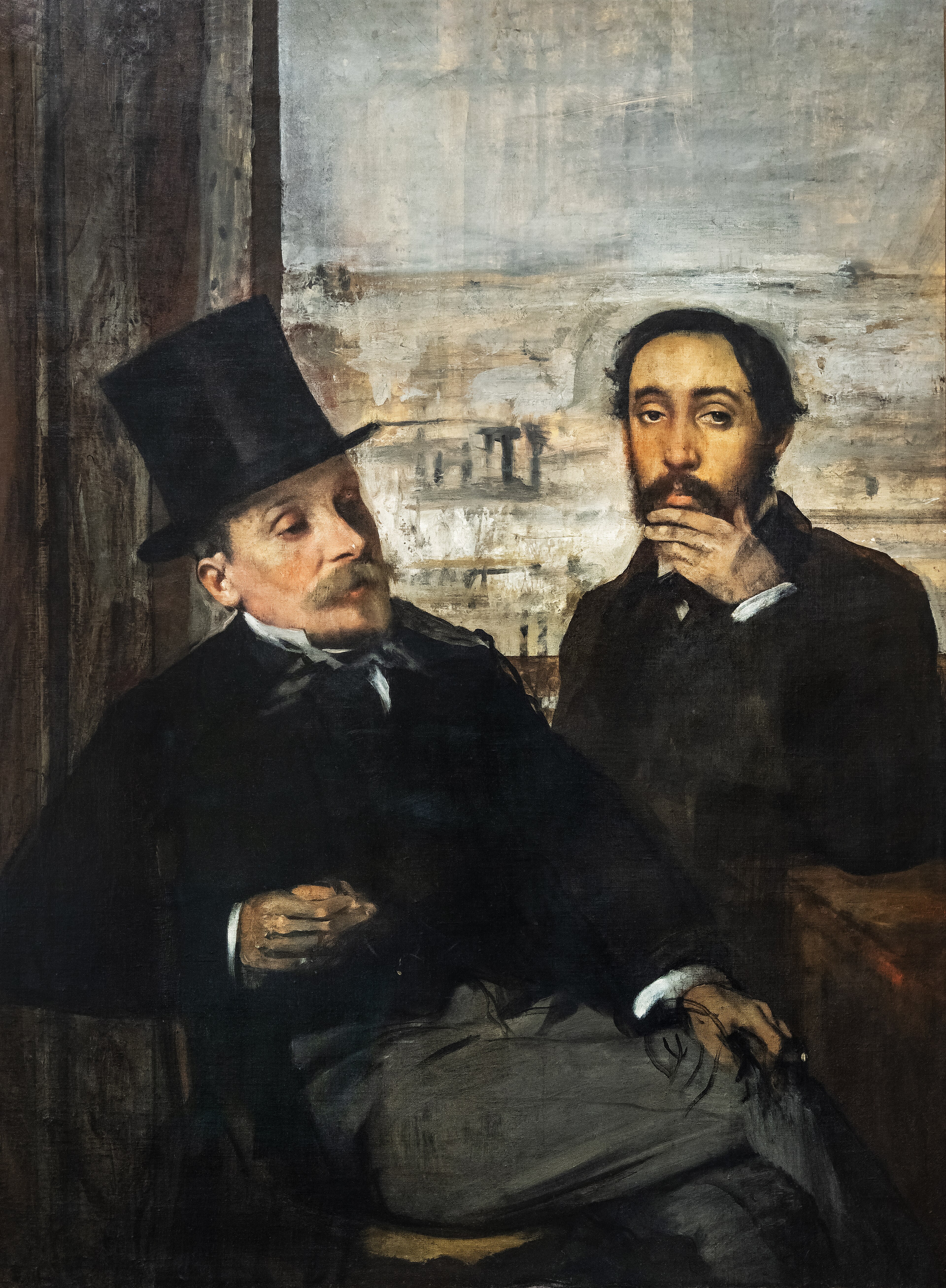
Degas and Évariste de Valernes is a double portrait in which one of the two men is the painter himself. They sit side by side in front of a window. The older man at the left wears a black top hat and a dark coat, has a grey moustache and holds a small object in his right hand; his gaze slips downwards and away. The younger man at the right is dark-haired and bearded, his hand resting against his chin and mouth; he is the only one of the two who looks straight out at us, and that look carries the whole canvas. Behind them Paris opens roof after roof in grey and white strokes, barely painted and almost washed out; at the left a dark vertical curtain closes the edge. The paint is thin throughout and the background was left unfinished. The original measures 89.5 x 116.5 cm, was made about 1865, and is held by the Musée d’Orsay in Paris under inventory number RF 3586. Ours is painted by hand in eight sizes from 30 x 35 to 100 x 110 cm or to your own measurement, and you receive a photograph of the finished work for approval before it ships.
| Title: | Degas and Évariste de Valernes |
| Other titles: | Degas et Évariste de Valernes |
| Painter: | Edgar Degas (1834–1917) |
| Year: | about 1865 |
| Size of the original: | 89.5 cm x 116.5 cm |
| Technique of the original: | oil on canvas |
| Style: | Impressionism |
| Where it hangs: | Musée d’Orsay, Paris (inv. RF 3586; Schulman catalogue MS 1193, Lemoisne I-116) |
| Our version: | hand-painted oil on linen canvas, 8 sizes from 30 x 35 cm to 100 x 110 cm, custom size on request |
Degas and Évariste de Valernes – Edgar Degas
Who is in the picture?
Both men are named, and one of them was painted by himself. The title under which the museum enters the work is Degas and Évariste de Valernes: the younger, bearded man at the right is the painter, and the older man in the top hat at the left is the painter Évariste de Valernes. The one at the left sits turned slightly aside, in a dark coat and black top hat, with a grey moustache; he holds a small object and his gaze slips downwards and past us. The one at the right is younger, dark-haired and full-bearded; his hand rests against chin and mouth, the elbow propped so the body leans a little forward. He is the only one of the two who looks straight out at us. That look carries the whole canvas: a double portrait in which one of the two knows he is being watched.
What is on the canvas?
Two men, a window, and very little else. Behind them Paris opens up, roof after roof in grey and white strokes, barely painted and almost drained of colour; the sky is a pale band without cloud. At the left a dark vertical curtain closes the edge and gives both figures a firm boundary. The coats are dark and broadly laid in; faces and hands are the only parts the painter stayed with. The paint is thin everywhere, in places thin enough that the priming shows through. The background was left unfinished, and we do not hide it: that unfinishedness is what makes the two faces so strong, because nothing else competes with them.
Why does this portrait matter?
Because here the painter is both author and sitter. Degas painted himself in the company of an older colleague, and not in a studio but seated, in a coat, as though the two were paying a visit. The second reason is the division of attention: one looks aside and is preoccupied, the other looks directly at us. The picture therefore does not present two equal sitters but one who is observed and one who returns the observation. The third reason is the unfinishedness. Degas often left a background in its first layer, but here it is almost a programme: the city beyond the window is only indicated, and the whole meaning sits in two heads and one hand against a chin.
What does the portrait mean?
That friendship between painters is also a contest of looking. Impressionism in the early Degas is not yet loosened colour but exact drawing and a restrained tone; this canvas stands closer to the old masters than to the late Degas. As a canvas painting it is serious and quiet, without ornament, and it holds up well in a room where people sit for a long time. The colours are dark and grey against a pale window, which makes it considered wall art for a living room, a study or a library. Anyone wanting a large painting with a painter’s portrait in it gets the painter’s own gaze here. Our reproduction is made to keep that gaze doing the work.
How did the canvas reach the Orsay?
By a family route, and it is on record. The work stayed in Degas’s studio, and then, by the Schulman catalogue, was with Gabriel Fèvre in Nice between 1918 and 1931 — Gabriel Fèvre being the son of Marguerite, the painter’s sister, and so the painter’s nephew. The museum records the acquisition simply as a gift of Gabriel Fèvre, with no year, and we do not supply one. From 1931 to 1947 it was in the Musée du Louvre, from 1947 to 1986 in the Musée du Jeu de Paume, and since 1986 in the Musée d’Orsay. The canvas reached the national collection from the painter’s own family.
The motif among the painter’s works
Degas never painted portraits to commission; he took his sitters from his own circle, and the double portrait suited him. Among the works by Degas we offer, the closest to this canvas are Lorenzo Pagans and Auguste De Gas, again two men side by side with one of them looking away, Edmondo and Thérèse Morbilli, a double portrait from the painter’s own family, and Portrait of Léon Bonnat, the portrait of another painter from the same circle. This canvas is entered in the Schulman catalogue as MS 1193, dated circa 1865, and it is held by the Musée d’Orsay under inventory number RF 3586.
How is our hand-painted version made?
With a brush and oil paint, in the same technique as the original, so ours is oil on canvas too. The hardest thing is the balance between the two faces. The one at the right has to look straight out and stay alive; the one at the left has to be absent without being empty. Paint the second face too strongly and the scene splits into two equal portraits and loses its tension. So we build the right-hand face with sharper transitions around the eyes and the left-hand one more softly. The second hard part is the background. Because it is unfinished in the original we leave it thin too and do not complete the city beyond the window; anyone who draws houses there destroys the whole relationship. The third is the dark coats, built from brown, blue and green, never from black alone. Every copy is made afresh and no two are quite alike; every hand-painted copy is its own. We have no photographs of our own finished canvases for this subject yet, because we have not painted it before, so none is shown here and none is described. You receive a photograph of your own canvas before it ships.
Which size for which wall?
If you are unsure: 70 x 80 cm. Here we have to say something that has not come up on the other works: none of our eight sizes matches the proportion of the original. The original is 89.5 x 116.5 cm, a ratio of 1.30, while our sizes run between 1.09 and 1.17 and are all noticeably squarer. The nearest are 30 x 35 and 60 x 70 cm at 1.17, still about a tenth away from the original. In scale the nearest is 90 x 100 cm: it matches the original’s width to within half a centimetre but is 16.5 cm shorter. In practice that means the scene is a little compressed in height at every one of our sizes, with less sky above the two heads. If you want exactly the proportion of the original, order a custom size; we do that routinely and for this subject it is the better choice. 30 x 35 and 43 x 47 cm suit a shelf; 50 x 55, 60 x 70 and 70 x 80 cm sit well above a desk. At 80 x 90, 90 x 100 and 100 x 110 cm the right-hand man’s gaze meets the viewer’s across a whole room. Measure your chosen size on the wall first with a paper cut-out. None is held in stock: each piece is painted to order.
Custom size, stretcher bar and frame
On this subject a custom size is more than an option: it is how you get the proportion of the original, which none of our rungs offers. We paint to your measurement and keep the height, so that a band of window stays above the two heads and the curtain at the left is not cropped away; that is our work made to order. Every piece is sent stretched on a wooden stretcher bar, ready to hang. For the frame use our 3D application: on this subject it shows every moulding we carry — gold, silver, black, white and natural wood — and it is for choosing a frame and nothing else. How the work sits on your own wall is shown by our separate service, placement in the room.
Delivery and guarantee
Each piece is painted to order in our workshop in Slovenia; allow 15-45 days depending on the size, at the largest sizes usually at the upper end. It travels stretched and protected for transport, framed if you chose a frame, to sixteen countries in the European Union, without customs. Before dispatch you receive a photograph of the finished work for approval, and our returns arrangement applies to every order. The full range is in the Edgar Degas gallery, and his life is described in our article about Edgar Degas.
Frequently asked questions
Which painting is this?
Degas’s oil Degas and Évariste de Valernes, 89.5 x 116.5 cm. It is held by the Musée d’Orsay in Paris under inventory number RF 3586.
Which of the two is Degas?
The younger, bearded man at the right, who looks straight out at us with his hand against his chin. The older man in the top hat at the left is the painter Évariste de Valernes. Both are named in the title under which the museum enters the work.
When was it painted?
The museum states: about 1865. The Schulman catalogue gives the same year. We keep the approximation.
How big is the original?
89.5 cm wide and 116.5 cm high, by the museum’s measurement. With its frame the museum gives 111.5 x 140.5 cm. The catalogue gives a rounded 89 x 116 cm; we follow the museum’s figure.
Why does the background look unfinished?
Because it is. The Paris roofs beyond the window are painted in one thin layer, and in places the paint is sparse enough that the priming shows through. That is an observation from the picture; the museum record says nothing about it.
How did the work reach the national collection?
Through the painter’s family. The catalogue records it as being with Gabriel Fèvre in Nice between 1918 and 1931 — the son of Degas’s sister Marguerite. The museum enters the acquisition as a gift of Gabriel Fèvre, without a year.
Where can it be seen?
At the Musée d’Orsay in Paris. Whether it is on display at any given moment or in storage, the record does not say.
Which of your sizes is closest to the original?
In scale, 90 x 100 cm. In proportion, none: the original’s ratio is 1.30 and ours run between 1.09 and 1.17. If you want the original’s proportion exactly, order a custom size.
Can I have a size that is not listed?
Yes, and on this subject we particularly recommend it. We paint to your measurement, including exactly the proportion of the original. Tell us where the work will hang so we can fit the framing to it.
Is this a print?
No. The work is made by hand in oil; the brush strokes are visible and can be felt, particularly in the coats and in the thin background.
Is it suitable as a gift?
Yes, particularly for someone who likes portraits or painting itself — two painters, one of whom painted them both. Because each piece is painted to order, allow for the making time; if you would rather leave the choice to them, there is our gift voucher.
- Subject: a double portrait of two painters before a window; the man at the right is Degas himself and the only one looking at us
- Original: Edgar Degas, oil painting on canvas, 89.5 x 116.5 cm, Musée d’Orsay, Paris (RF 3586)
- Ours: painted by hand in oil, eight sizes from 30 x 35 to 100 x 110 cm, custom size recommended
- Worth knowing: the canvas reached the national collection from the painter’s nephew, the son of his sister Marguerite