







































Description
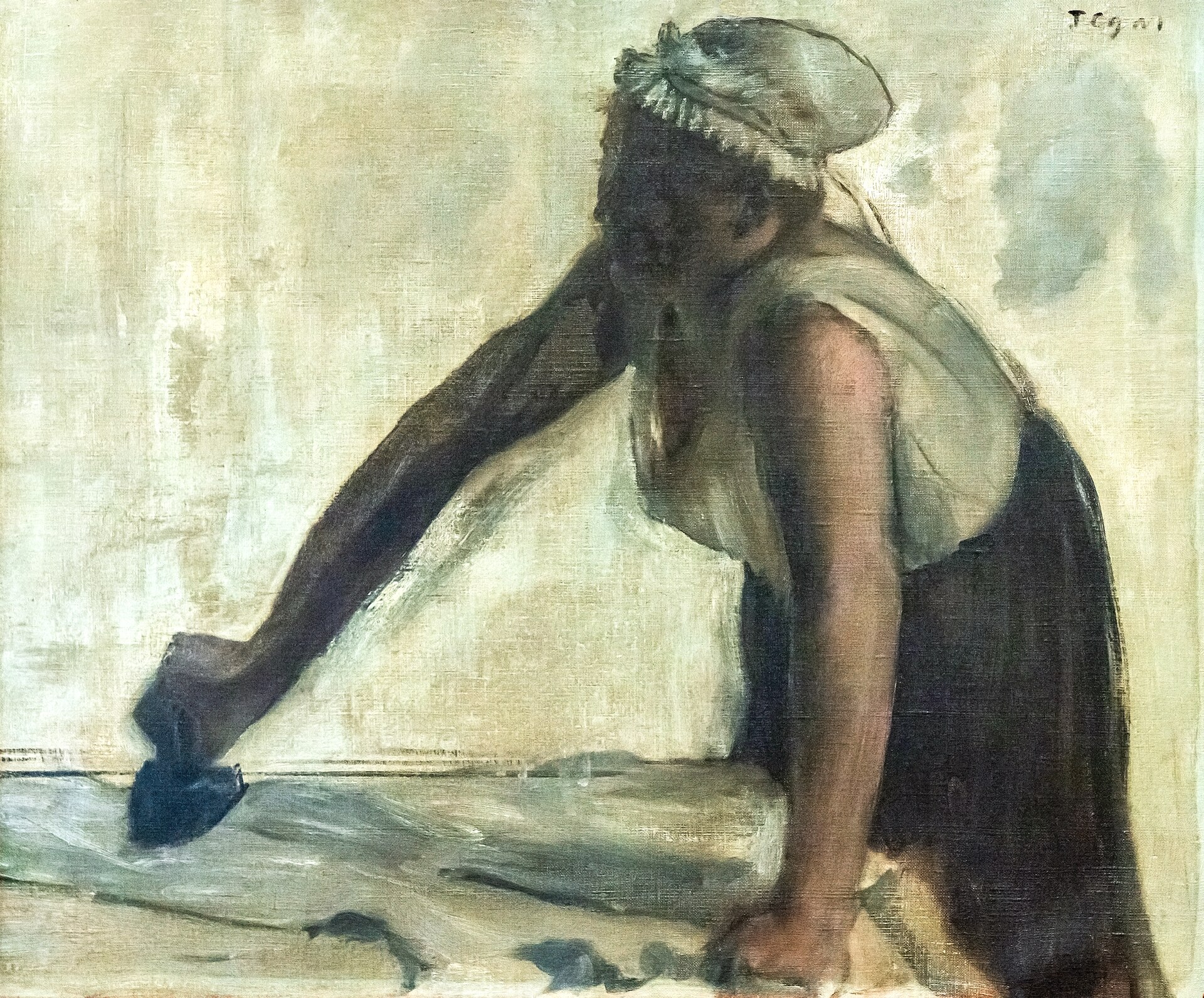
The Ironer against the Light shows a woman standing in profile at the ironing table, leaning forward into light that comes from behind her. Her head is lowered and her face turned down to the work; the dark hair is covered by a pale cloth knotted at the top. Her outstretched arm runs as a long dark diagonal from the right down towards the left and ends at the dark iron, while the other hand rests on the table at the lower right and carries the weight of the body. She wears a pale sleeveless bodice with a cloth over the shoulder and a dark, almost black skirt. Behind her is a wide, thinly painted wall in cream and ochre through which the weave of the canvas shows, and below, the table spreads with its grey-white linen. Because the light is behind her, the front of the figure stays in shadow and the body reads above all as a silhouette. The original is 56 x 46 cm, dated 1874-1878, and it is in the Musée Angladon in Avignon under inventory number K 108. We make it by hand, in eight sizes from 50 x 40 to 150 x 120 cm or to your own measurement, and before dispatch you receive a photograph of the finished work for approval.
| Title: | The Ironer against the Light |
| Other titles: | La repasseuse à contre-jour (the catalogue’s title) |
| Painter: | Edgar Degas (1834–1917) |
| Year: | 1874–1878 (signed at the upper right: Degas) |
| Size of the original: | 56 cm x 46 cm |
| Technique of the original: | peinture à l’essence on canvas — oil paint thinned with turpentine, not ordinary oil |
| Painting style: | impressionism |
| Where the original hangs: | Musée Angladon, Avignon (inv. K 108), Jacques Doucet collection; catalogue Schulman MS 584, Lemoisne I-361 |
| Our version: | hand-painted oil on linen, 8 sizes from 50 x 40 cm to 150 x 120 cm, custom size on request |
The Ironer against the Light – Edgar Degas
What is in the scene?
One woman, one table, one window you cannot see. She stands in profile, leaning forward over the ironing table, her head lowered and her face turned down to the work; the dark hair is covered by a pale cloth knotted at the top. The outstretched arm is the drawing of the picture: a long dark diagonal from the upper right down to the left, ending at the iron. The other hand presses on the table at the lower right and takes the weight of the leaning body — anyone who has ironed will recognise the posture before they recognise the painting. Behind her a wide wall of cream and ochre, below her the grey-white linen. There is nothing else at all: no room, no window frame, no second figure.
Why is she dark against a pale wall?
Because the light is behind her, which is what the title says. À contre-jour means against the daylight, and it is a decision with consequences: the whole front of the figure falls into shadow, the face is unreadable, and the body becomes a silhouette. Degas has thrown away the two things a portrait normally sells — the face and the detail — and kept only the shape of the effort. What you are asked to look at is a posture, not a person, and the picture is unusually severe about it. That severity is why the work reads as modern more than a century and a half later: it is composed the way a photograph taken into the light is composed, and Degas was among the first painters to take that seriously.
Why is it not an oil painting in the usual sense?
Because the catalogue gives the technique as peinture à l’essence, and that is not the same as oil. The paint is oil colour whose oil has been drawn off and which is then thinned with turpentine; it dries fast, it dries matt, and it goes on so thinly that the support shows through. That single fact explains the look of this picture: the wall behind the figure is thin enough for the weave of the canvas to read through it, which in an ordinary oil would be an unfinished passage and here is the method. Our version is painted in oil on linen, because oil on linen is what stretches, hangs and lasts; the thinness is reproduced by keeping the layers thin, not by changing the material, and we would rather say that plainly than let you discover it.
What does the scene mean?
That work has a shape, and the shape is enough. As a canvas painting it is the quietest kind of subject given the most severe treatment, which is a combination that stays interesting for years rather than months. Because the palette is cream, ochre, grey-white and near-black, it makes restrained wall art for a kitchen, a hallway or a study, and it sits with almost any wall colour. Among Degas’s works it belongs to the laundry pictures, the group he returned to for two decades, and it is the most reduced of them: one figure, no anecdote. Our reproduction is built around the diagonal of the arm and the exact darkness of the silhouette, because if either is wrong the picture is not this picture.
From Jacques Doucet to a museum in Avignon
This canvas came out of Degas’s studio and into the hands of Jacques Doucet, the couturier and collector, at Neuilly-sur-Seine. It stayed in that family: Madame Jacques Doucet from 1929, then Jean Dubrujeaud from 1958, then Jean and Paulette Angladon-Dubrujeaud — and in 1993 the collection became a museum, the Musée Angladon in Avignon, where the picture is still catalogued as part of the Jacques Doucet collection. Two exhibition dates are worth noting because they are early: it was shown in Saint Petersburg at the Institut français in 1912, while Degas was alive, and at the galerie Georges Petit in Paris in 1924. Unlike most works in this shelf’s Degas group, it is signed, at the upper right — not stamped after his death.
The motif among Degas’s works
The laundry pictures are a family of their own and we sell three others. Woman Ironing is the same subject from the front, with the face visible, and reading the two together is the fastest way to see what the backlighting costs and buys. The Laundress and Washerwomen are the same working world seen at other moments. The catalogue entry is the Schulman MS 584, Lemoisne I-361, peinture à l’essence on canvas, 46 x 56 cm, signed upper right, and the work belongs to the Musée Angladon in Avignon, the museum built on the Jacques Doucet collection, which does not publish an online record for this particular picture.
How is our hand-painted version made?
With a brush and oil paint, as an oil on canvas. The hardest part is the silhouette. A shape that dark has to keep its edges soft where the light wraps round the shoulder and hard along the arm, and a copyist who makes it uniformly dark loses the light altogether. The second hard part is the wall: broad, thin, barely modulated cream and ochre, which must stay alive without becoming a texture — the original achieves that with a technique we do not use, so we build it in thin oil layers and stop early rather than late. The third is the iron itself, a small dark accent at the end of the arm; it is the full stop of the composition, and if it is painted too large the diagonal stops working. No two versions are quite alike; each hand-painted copy is its own. For this motif we have no photographs of our finished canvases yet, because we have not painted it before, so none are shown here and none are described. A photograph of your own canvas comes to you before dispatch.
Which size for which wall?
Two answers, depending on what you want. For the original scale: 61 x 51 cm, which is 5 cm wider and 5 cm taller than the canvas Degas painted — as close to seeing the real thing as our ladder gets, and its ratio of 1.20 is within 2% of the original’s 1.22. For a wall-sized version: 90 x 75 cm, whose ratio is also 1.20 and which is the size most people mean when they picture this on a wall. 50 x 40 cm suits a shelf or a narrow space. 70 x 60 and 80 x 70 cm are usable but drift squarer; 80 x 70 cm at 1.14 is the furthest of the eight from the original and crops closest above the head, so avoid it if the proportion matters. At 120 x 100 and 150 x 120 cm a large painting of this kind turns a single figure into a wall-filling silhouette, which is striking but no longer intimate. Measure your chosen size on the wall first with a paper cut-out. None is held in stock: every piece is made to order.
Custom size, frame and stretcher
If none of the eight fits, we paint to your measurement, keeping the ratio of 1.22 and the height of the wall above her head, since the empty space above the figure is what makes the silhouette read; that is our work made to order. Every piece ships stretched on a wooden stretcher, ready to hang. For the frame use our 3D application: it shows every moulding we carry — gold, silver, black, white and natural wood — and serves the choice of frame and nothing else. How it behaves on your own wall is shown by our separate service, placement in the room.
Delivery and guarantee
Every piece is made to order in our workshop in Slovenia; allow 15-45 days depending on the size, at the largest sizes usually at the upper end. It travels stretched and protected for transport, framed if you chose a frame, to sixteen countries in the European Union, without customs. Before dispatch you receive a photograph of the finished work for approval, and our returns arrangement applies to every order. The whole range is in the Edgar Degas gallery, and his life is described in our article on Edgar Degas.
Frequently asked questions
What work is this?
A laundry picture by Degas, catalogued as La repasseuse à contre-jour. It measures 56 x 46 cm and is in the Musée Angladon in Avignon under inventory number K 108.
Is the painting signed?
Yes, at the upper right, and that is worth saying because most Degas works of this period carry only the studio-sale stamp applied after his death. This one he signed himself.
When was it painted?
Between 1874 and 1878. The catalogue gives that span; you will often meet the looser “the 1870s”, and we print the range rather than the decade.
What is peinture à l’essence?
Oil paint with the oil drawn off and the pigment thinned with turpentine. It dries quickly and matt, and it goes on thinly enough for the canvas weave to show through — which is exactly what you see in the wall behind the figure.
Why can I not see her face?
Because the light is behind her. That is what à contre-jour means, and the shadow on the front of the figure is the point of the picture rather than a shortcoming of it.
How big is the original?
56 cm wide and 46 cm high — small, about the size of a sheet of A2 turned sideways. Our 61 x 51 cm is the closest we make to it.
Who was Jacques Doucet?
A Paris couturier and collector who owned this canvas at Neuilly-sur-Seine. It passed down through his family to Jean and Paulette Angladon-Dubrujeaud, and their collection became the Musée Angladon in 1993.
Which of your sizes matches the original?
61 x 51 cm in scale — 5 cm larger on each side. In proportion, 61 x 51, 90 x 75 and 120 x 100 cm all give 1.20 against the original’s 1.22.
Which size should I avoid if I want the original proportion?
80 x 70 cm. At 1.14 it is the furthest of the eight from 1.22, and it crops tightest above the head.
Is this a print?
No. The work is made by hand in oil on linen; the brushstrokes are visible and can be felt, though on this motif they are deliberately thin and restrained.
Is it suitable as a gift?
Yes, particularly for someone who likes a picture that is severe rather than pretty, and for a kitchen it is a rare thing: a serious painting about the work that happens there. Since every piece is made to order, allow for the making time; if you would rather leave the choice to the recipient, there is our gift voucher.
- Motif: a woman ironing, lit from behind, her body reduced to a dark silhouette against a pale wall
- Original: Edgar Degas, 1874–1878, peinture à l’essence on canvas, 56 x 46 cm, Musée Angladon, Avignon (K 108)
- Our version: hand-painted in oil, eight sizes from 50 x 40 to 150 x 120 cm; 61 x 51 cm is closest to the original’s scale
- Worth knowing: unlike most Degas works of these years it is signed, not stamped, and it was exhibited in Saint Petersburg in 1912