



Description
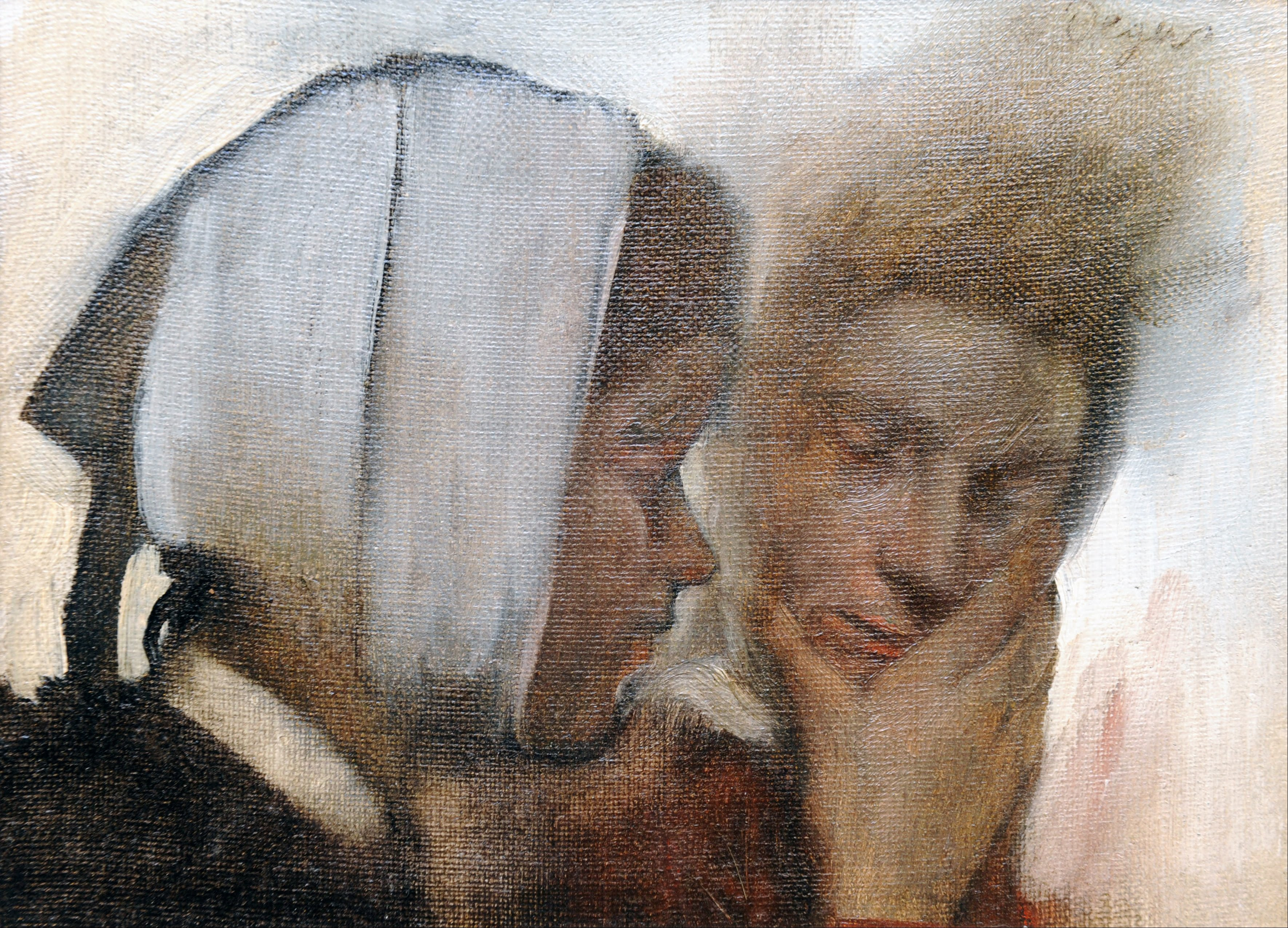
Washerwomen is a small canvas with two women’s heads and a single gesture that the museum’s own title explains. The woman at the left is seen in profile, turned to the right; a pale headscarf is pulled over her dark hair and she is dressed in dark clothes. The woman at the right has lighter, loose hair and a tilted head, her cheek resting on a raised hand, her eyes half closed. The museum enters the work as Study of two women’s heads; laundress suffering from toothache — so the gesture is not tiredness but toothache. The background is only a pale grey-white, smeared on quickly, without a room and without objects; the paint is thin and the ground shows through in places. The original is tiny, 21 x 15 cm, made between 1870 and 1872. It belongs to the Musée d’Orsay under number RF 1953 8 and is on view in Le Havre. Ours is painted by hand in eight sizes from 50 x 40 to 150 x 110 cm or to your own measurement, and you receive a photograph of the finished work for approval before it ships.
| Title: | Washerwomen |
| Other titles: | Étude de deux têtes de femmes ; Blanchisseuse souffrant des dents (the museum’s title), Les blanchisseuses |
| Painter: | Edgar Degas (1834–1917) |
| Year: | between 1870 and 1872 (signed upper right: Degas) |
| Size of the original: | 21 cm x 15 cm |
| Technique of the original: | oil on canvas |
| Style: | Impressionism |
| Where it hangs: | owned by the Musée d’Orsay, Paris (inv. RF 1953 8), on deposit at the Musée André Malraux, Le Havre (inv. DA 61.98); Schulman catalogue MS 1198 |
| Our version: | hand-painted oil on linen canvas, 8 sizes from 50 x 40 cm to 150 x 110 cm, custom size on request |
Washerwomen – Edgar Degas
Who is in the picture?
Two women, neither of them named. The museum record does not name them, but it says something else that decides how the picture is read. The one at the left is seen in profile, turned to the right; a pale scarf is pulled over her dark hair, she is dressed in dark clothes and she looks calmly ahead. The one at the right is turned more towards us, with lighter, loose hair, her head tilted aside and her cheek resting on a raised hand; her eyes are half closed and her mouth slightly tense. That second gesture is the core of the picture, and the museum names it outright: the work is entered as Study of two women’s heads; laundress suffering from toothache. It is therefore not weariness at the end of a long working day but toothache, and we do not read it any other way than the record does.
What is on the canvas?
Two heads and nothing else. The background is a pale grey-white, laid on quickly and smeared with a broad stroke; there is no room, no furniture, no basket of linen and no object at all to say where the two women are. The paint is very thin and the ground shows through in places, which is to be expected at this size: the canvas measures 21 x 15 cm, smaller than a sheet of A5. It is precisely that smallness that makes the strokes short and decisive; the two faces are built from a handful of them and the right-hand woman’s hand from fewer still. The range of colour is narrow — white scarf, dark dress, flesh tones and the grey behind them — so the whole weight falls on the tilt of a head and a pair of half-closed eyes. The signature is at the upper right.
Why does this picture matter?
Because it is a working sheet, not a scene. Degas did not paint a laundry; he painted two heads as he saw them and left them without surroundings — a study that stayed a picture in its own right. The second reason is the choice of moment. The painting of that period liked to show working women either industrious or picturesquely wretched; here there is neither, but a specific bodily complaint with nothing to do with the morality of labour. The third reason is scale. On twenty-one centimetres of width Degas made a scene that survives enlargement to a metre, and that is rare: most small studies fall apart when they are blown up.
What does the picture mean?
That work has a body. Impressionism in Degas means watching people at work, and here the watching is close enough to catch a pain that has nothing to do with the work at all. As a canvas painting it behaves unlike a large scene: small in origin, quiet, and it asks you to come nearer. Because the colours are restrained — white, grey, a dark dress and flesh tones — it makes unobtrusive wall art for a living room, a kitchen or a hallway. Anyone looking for a large painting with a real expression in it gets two heads and one very human gesture. Our reproduction is built around keeping that gesture legible.
Stolen in 1974, found in 2010
The history of this canvas is the strangest on this shelf, and the catalogue gives it in full. After Degas’s studio the work was with Mme Jeantaud in Paris, then with Carle Dreyfus, also in Paris, until 1953. In that year it went to the Musée du Louvre; the museum records the acquisition as the bequest of Carle Dreyfus, 1953. In 1961 it was placed on deposit with the museum in Le Havre. In 1974 it was stolen from that museum. It was not found again until 2010, when it was assigned to the Musée d’Orsay; the catalogue adds that it appeared in the sale of 3 November 2010 as lot 142 and was withdrawn from that sale. In 2011 it returned to Le Havre, to the Musée André Malraux, again on deposit. Thirty-six years passed between the theft and the return.
The motif among the painter’s works
Laundresses and women ironing occupied Degas for years and we offer several. Closest to this canvas are The Laundress and Woman Ironing, both scenes from the same working world. Worth singling out, though, is Mrs Jeantaud in the Mirror: by the catalogue it was Mme Jeantaud herself, the sitter of that picture, who once owned this canvas. This work is entered in the Schulman catalogue as MS 1198, dated 1870–1872 and signed upper right, and its owner is the Musée d’Orsay, which enters it under RF 1953 8.
How is our hand-painted version made?
With a brush and oil paint, in the same technique as the original, so ours is oil on canvas too. The hardest thing is scale. The original measures 21 x 15 cm and our smallest size is 50 x 40 cm, so every version we paint is at least two and a half times wider than the original. Strokes that are a few millimetres long on the original must not become broad bands of paint when enlarged; so we break them into several shorter strokes and keep the same direction rather than the same thickness. The second hard part is the half-closed eye and tense mouth of the woman at the right: painted too softly, the expression goes and only a leaning head is left. The third is the background, which has to stay smeared and empty; anyone who paints a room there turns a study into a scene. Every copy is made afresh and no two are quite alike; every hand-painted copy is its own. We have no photographs of our own finished canvases for this subject yet, because we have not painted it before, so none is shown here and none is described. You receive a photograph of your own canvas before it ships.
Which size for which wall?
If you are unsure: 70 x 50 cm — and that is not an arbitrary choice. The original’s ratio is 1.40, and 70 x 50 cm gives exactly 1.40; the match is perfect and the scene is squeezed neither in height nor in width. The other thing to say is this: the original is smaller than every one of our sizes, at barely 21 x 15 cm, so each version we paint is considerably larger than the work it copies. 50 x 40 and 60 x 40 cm suit a narrow wall, a shelf or a kitchen and stay close to the intimacy of the original. 70 x 50 and 80 x 60 cm are the right choice above a chest of drawers or a desk, the first for its proportion. 90 x 60 and 100 x 80 cm want some distance; at those sizes the two faces are close to life size. At 120 x 90 and 150 x 110 cm the enlargement is considerable and the brushwork is visibly spread out — an effect some people want and others do not, and it is fair to say so in advance. Measure your chosen size on the wall first with a paper cut-out. None is held in stock: each piece is painted to order.
Custom size, stretcher bar and frame
If none of the eight sizes suits, we paint to your measurement, keeping the 1.40 ratio and the gap between the two heads so that the woman at the right does not come too close to the edge; that is our work made to order. Every piece is sent stretched on a wooden stretcher bar, ready to hang. For the frame use our 3D application: on this subject it shows every moulding we carry — gold, silver, black, white and natural wood — and it is for choosing a frame and nothing else. How the work sits on your own wall is shown by our separate service, placement in the room.
Delivery and guarantee
Each piece is painted to order in our workshop in Slovenia; allow 15-45 days depending on the size, at the largest sizes usually at the upper end. It travels stretched and protected for transport, framed if you chose a frame, to sixteen countries in the European Union, without customs. Before dispatch you receive a photograph of the finished work for approval, and our returns arrangement applies to every order. The full range is in the Edgar Degas gallery, and his life is described in our article about Edgar Degas.
Frequently asked questions
Which painting is this?
Degas’s oil, which we list as Washerwomen. The museum’s title is longer: Study of two women’s heads; laundress suffering from toothache. It measures 21 x 15 cm and belongs to the Musée d’Orsay under RF 1953 8.
Why is the woman at the right holding her cheek?
Because she has toothache. That is not our guess: the museum enters the work under a title that says so directly. It is exactly that detail which separates the scene from the usual depictions of tired working women.
When was it painted?
Between 1870 and 1872. The museum and the Schulman catalogue give the same span, and we do not shorten it to a single year.
How big is the original?
Very small: 21 cm wide and 15 cm high, smaller than a sheet of A5. With its frame the museum gives 38 x 32.5 cm. Every one of our sizes is larger than the original.
Is the original on canvas or on card?
The sources differ. The Musée d’Orsay, which owns it, gives oil painted on canvas; the Schulman catalogue gives card as the support. We follow the museum that owns the work, and state the difference here rather than passing over it.
Where can it be seen?
In Le Havre, at the Musée André Malraux, where it is on deposit under number DA 61.98. The owner remains the Musée d’Orsay in Paris.
Is it true that the painting was stolen?
Yes. By the catalogue it was stolen from the Le Havre museum in 1974, found in 2010 and then assigned to the Musée d’Orsay; in 2011 it returned to Le Havre. The catalogue also records that in 2010 it appeared in a sale and was withdrawn from it.
Is the canvas signed?
Yes. The Schulman catalogue records the signature at the upper right: Degas.
Which of your sizes matches the original?
In proportion, 70 x 50 cm, which gives exactly the original’s 1.40. In scale, none, because the original is smaller than all of our sizes.
Is this a print?
No. The work is made by hand in oil; the brush strokes are visible and can be felt, and on this subject they show more than on larger originals because of the enlargement.
Is it suitable as a gift?
Yes, for someone who likes portraits and the stories behind them; this one has an unusual story. Because each piece is painted to order, allow for the making time; if you would rather leave the choice to them, there is our gift voucher.
- Subject: two women’s heads; the one at the right rests her cheek on her hand because, by the museum’s title, she has toothache
- Original: Edgar Degas, oil, 21 x 15 cm, owned by the Musée d’Orsay (RF 1953 8), on deposit in Le Havre
- Ours: painted by hand in oil, eight sizes from 50 x 40 to 150 x 110 cm; 70 x 50 cm matches the original’s proportion
- Worth knowing: the canvas was stolen from the Le Havre museum in 1974 and not found until 2010