


Description
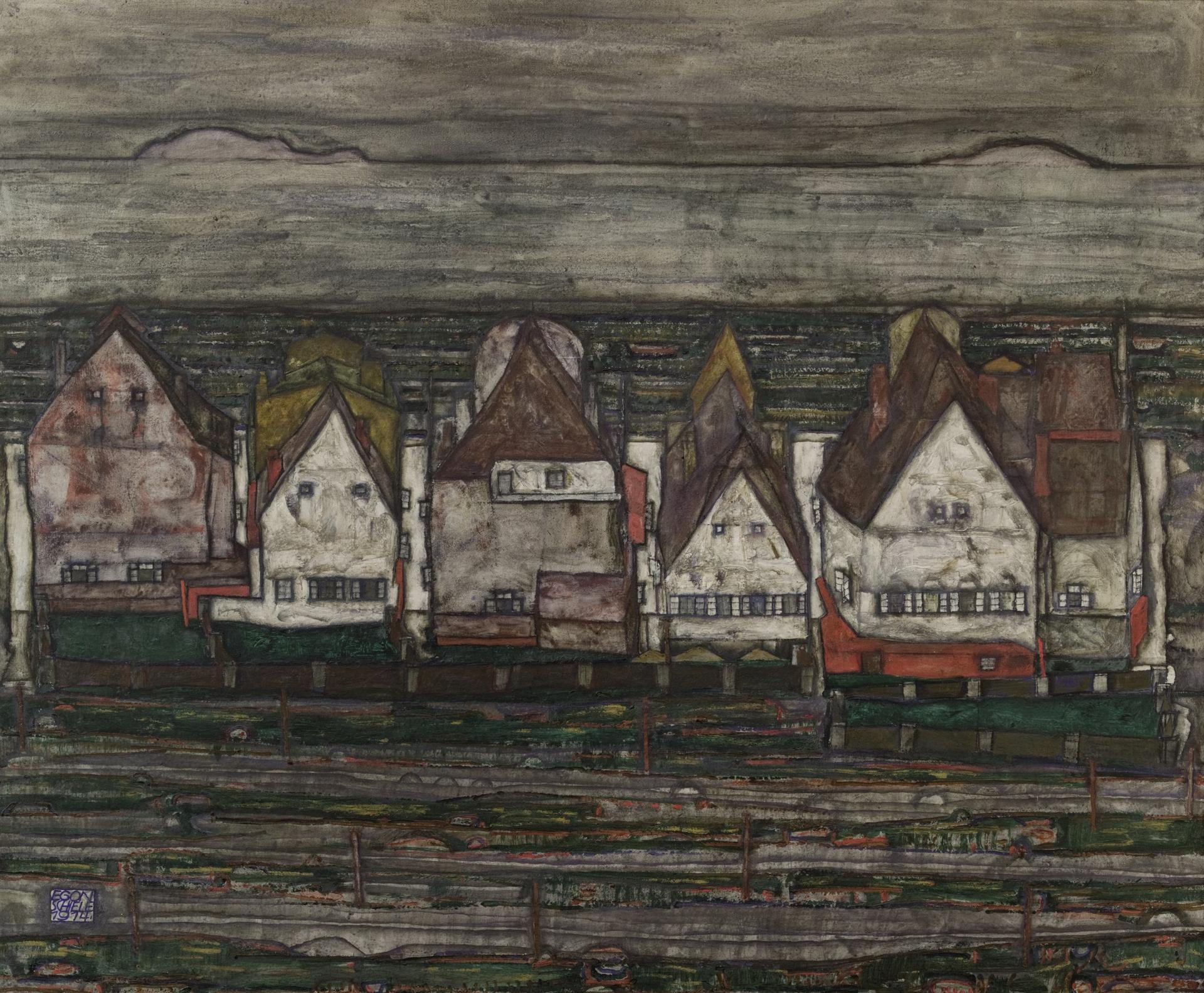
Houses by the Sea is a work of 1914 by Egon Schiele: five houses in a row across the middle of the canvas, with small dark windows in pale façades, between a grey sky and bands of fields below. The original is in the Leopold Museum in Vienna under inventory number 452; it measures 119.7 x 99.5 cm — 119.7 cm wide and 99.5 cm tall. We make it as a hand-painted oil painting on canvas, in ten sizes or to your own measurement, and we send you a photograph of the finished work for approval before it ships.
| Title: | Houses by the Sea |
| Other titles: | Houses by the Sea (Row of Houses) · Die Häuser am Meer (Häuserreihe) |
| Painter: | Egon Schiele (1890–1918) |
| Year: | 1914; signed and dated lower left “Egon Schiele 1914” |
| Original size (width × height): | 119.7 cm x 99.5 cm |
| Original technique: | Oil on canvas |
| Style: | Expressionism |
| Location: | Leopold Museum, Vienna (inv. 452) |
| Our reproduction: | hand-painted oil on canvas, 10 sizes from 43 x 35 cm to 130 x 105 cm, or a made-to-measure size |
Houses by the Sea – Egon Schiele
What does the work show?
A row of houses seen straight on. Across the middle stand five buildings side by side, with pale whitish and pink façades, roofs in brown, ochre and dull red, and small dark windows in short rows; red touches mark doors and plinths. Behind them lies a broad dark-green band of fine horizontal strokes, and above it a streaked grey sky crossed by a thin line with two pale, low humps. Below the houses a low wall, and under it long strips of green, grey and red with thin red posts. Lower left, in a small box, is the signature.
Is there a sea in the painting?
Yes, according to the museum. Its description places the houses in an indefinable landscape between sky, sea and fields, and speaks of the areas of water and sky in the background — which makes the dark-green band behind the roofs the sea. It is no sea with waves: like everything else here, it is laid flat as one more horizontal layer.
How does Schiele show near and far without perspective?
By the width of the bands. Per the museum record, the whole work follows the principle of horizontal layering, typical of the flat spaces in Schiele’s compositions of this period, and suggests near and far without perspective: the strips of terrain in the lower half are narrower than the areas of water and sky behind, which therefore appear farther away. The houses cross the canvas like a horizontal belt, lined up, in the museum’s words, like pearls.
Why do the houses look like faces?
Because Schiele painted them that way, and the museum says so directly: the houses are rendered anthropomorphically, the façades turned into pale faces and the windows into eyes and mouths. The record reads the five houses as standing in distinctive isolation, and contrasts them with the close, cell-like connection between buildings in works such as The Small Town III. That is the reading of the museum that holds the work, and we give it as theirs.
What is the original painted with?
Per the record, in oils on canvas, signed and dated lower left. Ours is painted in oils on canvas as well: the medium and the support are the same as the original.
Is the format upright or horizontal?
Horizontal. Our steps follow it in a landscape format, from 43 x 35 cm to 130 x 105 cm. The width carries the row of houses almost from edge to edge.
Can I have it at the size of the original?
Nearly, but not exactly, and the nearest size is not the nearest shape. The original is 119.7 cm wide and 99.5 cm tall. Our 120 x 95 cm step matches its width within three millimetres but is 4.5 cm lower; our largest, 130 x 105 cm, is bigger on both sides. The original’s ratio of sides is 1 : 1.203, and only 60 x 50 cm shares it, about a millimetre off; the other steps differ in height by seven millimetres to almost five centimetres, 120 x 95 cm among the most. For size and proportion together, only a made-to-measure size will do.
Where does the work come from and where is it now?
The provenance note this page already carried follows directly below, kept word for word and unaltered. The museum’s record confirms every date in it and names what it leaves out, and the reading of that is ours. Before Jenny Steiner it lists Josef Hoffmann (1914) — sourced to a letter from Schiele to Hoffmann of 16 April 1914 — then Gustav Nebehay, Karl Grünwald and Wilhelm Steiner. The seizure of 3 October 1938 is documented in the Austrian State Archives. Between the 1941 auction and Rudolf Leopold, where the note below moves straight on, the record names two owners: Josefine Ernst, who bought the work there, and her son Johann Ernst, who sold it to Leopold under a contract of 1 August 1955. In its settlement text of June 2012 the museum adds that Jenny Steiner, née Pulitzer (1863–1958), owned a silk manufactory, fled to Paris immediately after the Anschluss and later emigrated to the USA; that the painting was offered at the Dorotheum in 1940 without finding a buyer; and that it was clearly seized from her in 1938. A solution was reached with her only granddaughter in 2011 and with the other heirs in 2012. The work is today in the Leopold Museum under inventory number 452; the museum’s whole Schiele holding is on the Leopold Museum’s Egon Schiele page.
⭐ The painting’s history: seized in 1938, later settled
In 1922 the work came into the ownership of the Viennese collector Jenny (Eugenie) Steiner. On 3 October 1938 it was seized and distrained by the Nazi authorities, and on 4 February 1941 it was sold at the 463rd auction of the Dorotheum in Vienna as lot 68. After the war it entered Rudolf Leopold’s collection and in 1994 the Leopold Museum Private Foundation. A claim by Jenny Steiner’s heirs was later resolved by settlement. We write this history down because it is part of the work.
Where does this work sit among Schiele’s works?
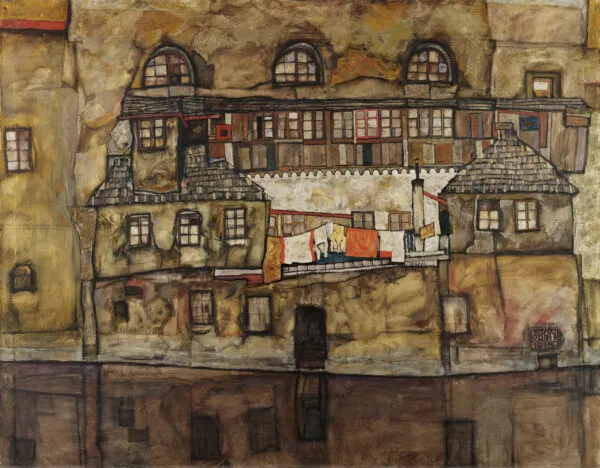
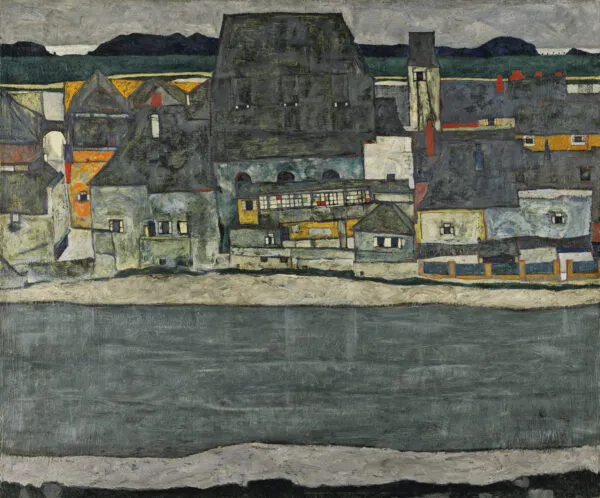
Among his paintings of towns and houses. From the year after is House Wall on the River, from two years before the landscape Calvary, and the shop also has Krumau on the Vltava (The Small Town IV). The full selection is in the Egon Schiele gallery, with more on his life in our article about Egon Schiele. Schiele was a younger contemporary of Gustav Klimt and the Vienna Secession was the milieu he came out of; Viennese Expressionism is the movement he helped define, and Austrian art of the period is still read through those two names. As an expressionist painting it turns a row of houses into a row of faces. Like House Wall on the River, it is oil on canvas.
How is our hand-painted version made?
Every canvas is painted by an artist in oils, stroke by stroke — not a machine impression but a hand-painted copy made for your order. Two places are the hardest here. The first is the windows: they are small, dark and slightly irregular, and they are what turns each façade into a face; square them off into neat rows and the houses stop looking back. The second is the width of the bands: the strips in the lower half must stay narrower than the water and sky above, because that difference is the only depth in the work — even them out and the houses lose their place between near and far. When the work is finished we photograph it and send you the photograph for approval, and only then does it ship. For this family we hold no studio photographs — it has not been photographed in our workshop yet, and nothing has been removed; when it is next painted it will be photographed and the images added here. As a canvas reproduction it arrives stretched on a wooden bar, ready to hang.
Which size suits which wall?
Short answer: a row of houses wants a long wall. Above a sofa or a sideboard 100 x 80 cm and 110 x 90 cm work; for a smaller wall 60 x 50 cm or 70 x 55 cm; for a large room 120 x 95 cm and 130 x 105 cm, our largest step. Our smallest size is 43 x 35 cm. A canvas painting of five houses needs width for the windows to read: below 60 x 50 cm they become dots.
How do I order a made-to-measure size, stretcher bar and frame?
If none of the ten sizes suits your wall, we paint the work to your own measurement. The canvas comes stretched on a wooden bar; our 3D application is for choosing a frame only, not for showing the work on your wall. The frame is chosen separately and need not be part of the order.
How is it delivered and what do we guarantee?
We paint to order and deliver to sixteen countries in the European Union, among them Germany, France, Italy, the Netherlands and Poland; the United Kingdom and Ireland are not currently among them. Before dispatch we send you a photograph of the finished work for approval, and if you are not satisfied we correct the work or paint it again. Production time varies with the size and the studio’s workload.
Frequently asked questions
Where is the sea in Houses by the Sea?
According to the Leopold Museum, in the background: the dark-green band of fine horizontal strokes behind the roofs is the water. The museum places the five houses in an indefinable landscape between sky, sea and fields. There are no waves; like everything else in the work, the sea is laid flat as one more horizontal layer.
Why do the houses in Houses by the Sea look like faces?
Because Schiele rendered them anthropomorphically: in the museum’s words, the façades become pale faces and the windows eyes and mouths. The five houses stand in distinctive isolation, lined up across the canvas like pearls on a string.
Where is Houses by the Sea today?
In the Leopold Museum in Vienna, under inventory number 452. Rudolf Leopold bought it in 1955, and in 1994 it passed with his collection to the Leopold Museum Private Foundation. The museum also lists it as Row of Houses.
Who owned Houses by the Sea first?
The architect Josef Hoffmann, from 1914, the year it was painted; the museum sources this to a letter from Schiele to Hoffmann of 16 April 1914. After him the record lists Gustav Nebehay, Karl Grünwald and Wilhelm Steiner, and from 1922 the Viennese collector Jenny Steiner.
Was Houses by the Sea looted by the Nazis?
Yes. It was seized from Jenny Steiner on 3 October 1938, after she had fled to Paris, and sold at the Dorotheum in Vienna on 4 February 1941 as lot 68. After the war it reached Rudolf Leopold, and the Leopold Museum settled with her heirs: with her only granddaughter in 2011 and with the other heirs in 2012.
Is there a photograph of Schiele with Houses by the Sea?
Yes: in 1914 Anton Josef Trčka photographed Schiele in his studio, posing with his typical expressive gestures and holding a carved toy horse, with Houses by the Sea in the background. The Leopold Museum acquired the photograph in 2023.
Does it work as a gift?
It does; if you are unsure which size to choose there is a gift voucher.
- Subject: five houses in a row, their façades like faces, between the sea and sky behind and bands of fields in front.
- Original: 1914, oil paint on canvas, 119.7 x 99.5 cm, signed lower left, Leopold Museum, Vienna, inv. 452.
- Ours: hand-painted in oils on canvas, 10 sizes or a made-to-measure size.
- Worth knowing: the painting was seized from Jenny Steiner in 1938; the museum reached a settlement with her heirs.